At noon Thursday in the first of their three property tax increase hearings, Bulloch County Board of Education members heard from two people very much opposed to the board’s proposed 3-mill rate hike; two or three others who want better controls on spending, an exemption for senior citizens or both; and one not opposed to the increase who noted that surrounding counties all have higher millages for school funding.
That’s a rough approximation of the views among the six citizens who signed up and spoke.
School system Chief Financial Officer Alison Boatright had first presented the rationale behind the tax proposed tax increase from last year’s 7.932 mills to 10.4 mills for school maintenance and operations. (That’s a 2.468-mill direct rate increase, but under the Georgia law known as the Taxpayer’s Bill of Rights, it has to advertised as an increase from the “rollback rate” of 7.446 mills that would have been needed to offset average inflation in property values, so in that sense it’s an increase of 2.954 mills, or 39.67%.
Boatright also gave examples of the tax hike’s cost to owners of supposedly average Bulloch County properties. Much of this had been stated here in previous stories.
A mill is 1/1000th the assessed value of property, with most in Georgia assessed at 40% of market value. So, a 3-mill hike would mean $300 added tax on $250,000 worth of non-exempt property.
Complying with requirements in the tax law, Boatright cited slightly different example values to state that the increase in tax will be approximately $349 on an “average homestead property” (market value $300,000) and $325 added tax on an “average non-homestead property” (market value $275,000).
The slideshow also included the total school tax – the portion of a total Bulloch County property tax bill that goes for school operations – that would result from the proposed increase. That “school M&O” tax would be $1,227 on a $300,000 homestead property, or owner-occupied home – and $1,144 on a $275,000 non-homestead parcel, a category that includes rental housing and second or vacation homes, as well as businesses.
The first two speakers, very much opposed to the millage hike, were Bulloch Action Coalition co-founders Lawton Sack and Cassandra Mikell. The BAC, a 501c4 nonprofit corporation identified as a civic and social organization, has been campaigning against local tax increases consistently for more than two years.
Sack began with criticism of the timing of the noon Thursday, Aug. 14 tax increase hearing and also of the specially called meeting at 4 p.m. July 30 where the board reversed course and by a 5-3 vote formally proposed the tax increase.
“First, this is a horrible time to hold a meeting, second to the one that was held a couple of weeks ago at 4 p.m. that allowed pro-tax-increase BOE employees to attend but not the average, working taxpayer, all the while touting that you heard from the community, despite that horrible time and the fact that at least 60 percent of the communications received were against the tax increase,” he said.
Board members at the July 30 meeting had acknowledged receiving many texts, emails, calls and face-to-face comments, including a variety of views.
At the close of Thursday’s hearing, District 4 member Donna Clifton commented that she believed the times of the hearings – noon this Thursday and then 9 a.m. and 6 p.m. next Thursday, Aug. 21, would give people who work various shifts time to attend hearings. Three hearings, on at least two different days, are required under the Taxpayer’s Bill of Rights, and this is typical of the way Bulloch County and Statesboro officials have scheduled them in previous years.
Coalition opposition
Sack also took issue with the way the Board of Education, Superintendent Charles Wilson and staff developed a budget that originally called for a millage rollback, only to change course with the most recent meetings. In mid-July, Wilson had announced that continuing the tax rollback plan while maintaining a healthy fund balance could require the elimination of about 125 teaching positions, the Transitions Learning Center alternative-school program and some other programs for the 2026-2027 school year.
“For years the superintendent has led the board to prepare to spend down the over $40 million in reserves that were made from (pandemic-era federal funding), a plan that he created and he now finds to be untenable,” Sack said.
He asserted that the school system’s budgeting, under Wilson’s leadership, “has failed and continues to fail all the stakeholders in this county, from the children to the teachers to the taxpayers,” and noted “reading readiness” scores that were significantly higher for Bryan and Effingham counties than for Bulloch.
Mikell had sheets of paper with what she said were “dozens of comments from taxpayers who feel differently” than those who had spoken on July 30 for the millage increase. She had her young daughter, who Mikell noted is home schooled, hand copies of these to the board members.
These taxpayers, “say that they are stretched to the breaking point on … mortgages, groceries, fuel, medical bills, on fixed incomes,” she said. “Seniors who’ve paid into the system for decades are asking when do they get a break. … Some feel they’re being taxed out of their homes.”
Concerned seniors
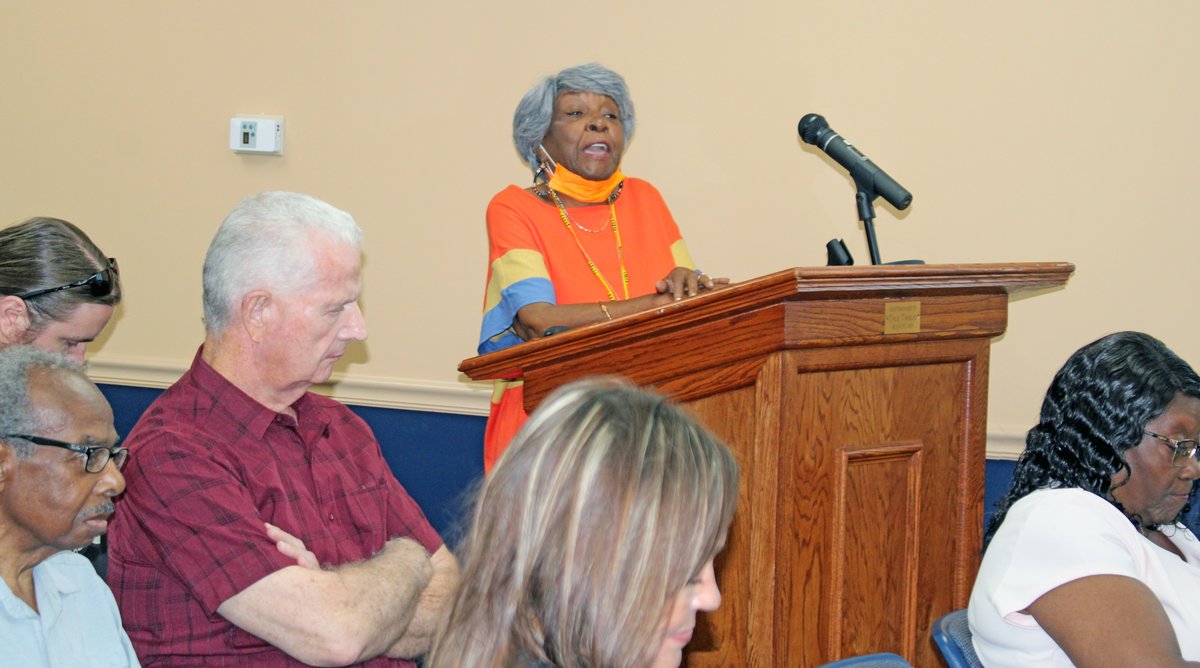
Two seniors who signed up together to speak for themselves were married couple Lawrence and Mary Lee, who are in their 80s. It was Mrs. Lee who did the talking in the three minutes allotted at the microphone, the limit for each citizen who spoke Thursday, with a timer running.
“My husband and I are here because we are senior citizens and within the last three years we have seen a rapid increase in our taxes – in our county taxes, in our city taxes. We have seen an increase in our taxes but yet we have not seen an increase in our retirement. …,” she said. “I think it’s unfair to people who have … paid into society, that we have reached a place where we should be comfortable in our lives. …, I think it’s just totally unfair. … I think that the board might want to consider some other means.”
Approached after the hearing, the Lees, who moved to Bulloch County in retirement about 20 years ago and have no children or grandchildren in the schools here, said they do not oppose adequate funding for the schools but believe there needs to be a school tax exemption for senior citizens.
Comparing counties
“I guess I’m the only one here so far, I’m not opposed to the increase,” Jon Martin told the board. “I’m looking at the surrounding counties in a publication here that’s outside in the lobby (at the Bulloch County Schools central offices). “Our last year’s 7.932 (mills school tax), the surrounding seven counties, we pay half. They’re paying twice as much as we are, and I’m wondering why? Are they being scammed? I don’t think so.
“I think they have the same thing we have,” he said. “I think the rollback several years ago … if it had not been rolled back, maybe we would not be raising it by so much this time.”
The Statesboro Herald will look at such a comparison of counties in further reporting on this topic. One factor in the variation is that Bulloch is one of just eight Georgia counties where the original, permanent Local Option Sales Tax, or LOST, is dedicated to the maintenance and operation of the schools, which creates a continued, offsetting rollback of several mills of school property tax. (Most Georgia counties levy an original LOST but divide it among their city and county governments on the basis of population). This is a different tax from the renewable E-SPLOST, or Education Special Purpose LOST, which is used for school construction and bus, software and equipment purchases.
Obviously, another big factor in varied millage rates among counties is the assessed value of homes and other real estate. Real estate prices are significantly lower in most of the neighboring counties than in Bulloch, but they tend to be higher in Bryan and Effingham. In the National Association of Realtors’ fourth-quarter 2024 price report, the median prices for homes were $254,960 in Bulloch County, $288,969 in Effingham County, and $324,017 in Bryan County but just $143,932 in Candler County and $148,284 in Evans County.
Before suggesting spending cuts or a tax increase, Boatright and Wilson had noted last spring that Bulloch County’s state equalization grant was decreasing by $5.9 million because of the county’s increased wealth as gauged by rising property values, which also led to a $2 million increase in the district’s required 5-mill “fair share” – a part of Georgia’s school funding formula – as the value of a mill rose. Meanwhile, the school district staff projected a $1 million loss to the House Bill 581 tax relief legislation.
So, this produced an expected decline in state funding in the $7.9 million to $8.9 million range this fiscal year. Meanwhile, on the expense side the staff expects a roughly $500,000 increase this year for adding school resource officers to cover all of the schools. An increase in athletic coaching supplements was projected to cost $500,000, and health insurance and Teacher Retirement System costs continue to increase.