Georgia Southern University on Thursday formally opened its new $9.5 million Military Science Building, headquarters to the Eagle Battalion ROTC program, which has won awards as the top Army ROTC program in a more than five-state region three of the last eight years.
“Having received multiple MacArthur Awards, our program is recognized as one of the finest and largest ROTC programs in the country, producing military leaders who are ready, Day 1, to serve our nation,” said GSU President Jaimie Hebert, PhD. “This facility will allow our staff and our cadets to push those standards even higher.”
For about a decade, the Reserve Officer Training Corps’ home on the Georgia Southern campus was a portable building, described by officials as a crowded, leaking “double-wide.” Now being taken down, it provided less than one-third the interior space of the new two-story, 32,000-square-foot brick and steel structure.
Money for its construction was included in the fiscal 2015 state budget, signed by Gov. Nathan Deal in a ceremony on the Georgia Southern campus in April 2014.
Regent Laura Marsh, who represents the area on the Board of Regents of the University System of Georgia, took part in Thursday’s ceremony, as did state Sen. Jack Hill and Col. Nelson Kraft, the university system’s military affairs director. They joined university and ROTC officials to cut a ribbon onstage inside the building, which is on Old Register Road and visible from U.S. Highway 301.
Other officials represented Bulloch County, the city of Statesboro, U.S. Rep. Rick Allen’s office and the National Security Agency’s Georgia office.
What it replaces
GSU Provost and Vice President for Academic Affairs Jean Bartels, PhD, RN, thanked state leaders for seeing the need.
“It probably didn’t hurt, however, that when we had many of you here to tour our old facilities, we tried to do it on full field days when the rucksacks were filling every inch and corner …, cadets were tracing maps on the walls because they didn’t have desks to spread out on, and there actually were buckets capturing the dripping rain from the ceiling,” she said.
Bartels, who started her Georgia Southern tenure as chair of the School of Nursing, said the Military Science Department adds to academic opportunities on campus. Besides students who choose military science as their major study area, others take it as a minor while majoring in other subjects. Those who do major in military science also have another major, such as nursing or engineering, among the regular disciplines.
“Our ROTC program has been recognized by the U.S. Army Cadet Command for having the highest grade point averages of late, the last I saw 3.38,” Bartels said.
That GPA is on a scale where 4.0 is a straight-A average.
“In addition, and this is where I’m particularly proud, the program is recognized as the top nursing program in the country, and produces the largest number of Army ROTC nurses into the cadet corps of anyone,” Bartels said.
MacArthur Awards
The U.S. Army Cadet Command at Fort Knox, Kentucky, announced last year that Georgia Southern’s ROTC program was one of the eight winners of the MacArthur Award for 2015. As such, the Eagle Battalion was selected as the top program from 6th Brigade Army ROTC, which includes 39 programs in five states, Puerto Rico and the Virgin Islands. Georgia Southern’s program also won the MacArthur Award in 2009 and 2010.
Currently, the Eagle Battalion musters 181 cadets on the Georgia Southern campus plus about 40 at Armstrong State University and Savannah State University, said Lt. Col. Erik Kjonnnerod, professor of military science and director of the GSU military science department. It serves as the ROTC headquarters for all three schools.
Kjonnnerod has been in charge of the program for 18 months now and is scheduled to leave at the end of the academic year for a command in Hawaii. The faculty includes six other Army officers who serve as assistant professors and four noncommissioned officers as military science instructors on the Statesboro campus plus four more in Savannah.
What’s in it
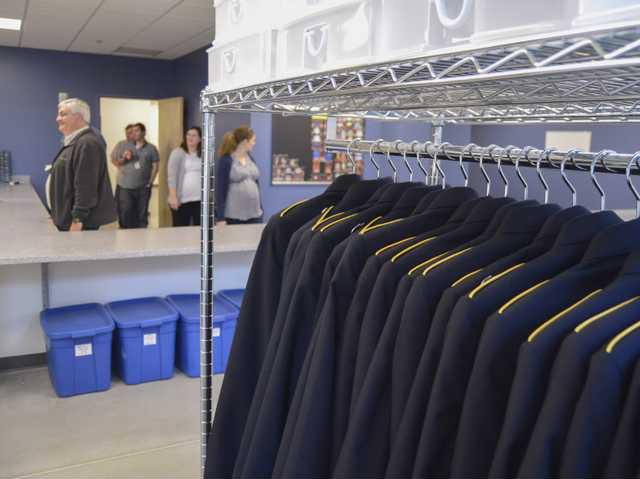
The multi-purpose room, at 5,000 square feet the size of a school gym minus bleachers, will host formations, commissioning ceremonies and formal dining events. The building also includes 25 offices, four 32-seat classrooms, a computer lab with 28 work stations, a cadet lounge and an upstairs conference room with a large, horseshoe-shaped table.
Brasfield & Gory General Contractors completed the building, designed by the Savannah architectural firm Cogdell Mendrala, in a little over a year after breaking ground in November 2015. In his public remarks, Kjonnnerod thanked the builders and the university administration.
“Anything we needed, they did,” he said. “They built us an arms room. Not many programs have an arms room … The university listened to us and they wanted to support us because they want to provide us the best because they recognize how awesome our program is and what we do not only for the cadets but also for the Army.”
Slated for construction next on campus, a multidisciplinary classroom building will replace other long-term “temporary” buildings. The chainlike fence is up and officials should be breaking ground in a month or so, Hebert said.
Herald reporter Al Hackle may be reached at (912) 489-9458.