

When the smoke cleared in fields and swampy areas near the confluence of Brier Creek and the Savannah River in what is now Screven County, Georgia, on March 3, 1779, as many as 150 fighters for the cause of American independence lay dead and a reported 277 had been wounded or captured. On the “British,” or Loyalist side, five were dead and 11 wounded.
The Battle of Brier Creek is a little-known moment in Georgia’s little-known part in the Revolutionary War, but the tragically one-sided fight that afternoon played a consequential role in the American Revolutionary War and may have prolonged it, reports John Derden, Ph.D.
Derden, professor emeritus of history at East Georgia State College, was the Bulloch County Historical Society’s guest speaker during its monthly lunchtime meeting July 24 in Statesboro. In addition to summarizing the battle and its place in history, he spoke as an active member of the Brier Creek Revolutionary War Battlefield Association Inc. in support of its plans to preserve the battlefield – now part of the Tuckahoe Wildlife Management Area near Sylvania – and enhance its educational and memorial functions.
“The American Revolution in Georgia is little known. It’s not talked about a lot,” Derden said. “Even people in Georgia don’t know a whole lot about it. … The Revolution itself is not well known in Georgia, but you know, the Battle of Brier Creek was a very consequential battle in the American Revolution, not just in Georgia, and yet it’s also very little known.”
Southern strategy
At a point when the war had reached a stalemate in New England and the Mid-Atlantic colonies, the British generals turned to a Southern strategy. Hoping to rally support from Loyalists in the Southern colonies, they sent an amphibious force by sea to capture Savannah and marched other British forces north from Florida, which remained a loyal British colony, Derden explained.
Savannah was captured on Dec. 29, 1778, after which the British advanced toward Augusta, capturing it on Feb. 1, 1779. But the British commanding general did not stay there long, beginning a march back south toward Savannah on Feb. 14. That same day, a separate Loyalist militia force was defeated by a Patriot militia in the smaller Battle of Kettle Creek, northwest of Augusta. That victory boosted Patriot morale and raised hopes for the recapture of Savannah.
“The American attitude is that we’ve got the (British) on the run, we’re going to follow them, as we go down the river we’re going to consolidate our forces and we’ve got a chance of taking Savannah back,” Derden said.
So, while Patriot militia units amassed on the South Carolina side of the Savannah River, others began to slowly pursue the British back toward Savannah. Gen. John Ashe led a large group of Patriot militia from North Carolina who would become the bulk of the Patriot, or “American” forces at Brier Creek.
A large number of forces on the “British” side in the battle were actually Loyalists from the colonies, Durden explained.
“There were Americans in every category,” he said. “Most of the soldiers that fought at Brier Creek were Americans – on both sides. A lot of people don’t understand that, but the American Revolution was very much a civil war. Americans were divided over whether they wanted independence or wanted to fight England or not.”
The British forces crossed Brier Creek and destroyed the bridge. Pursuing with perhaps 1,200 or 1,400 Patriots – estimates vary – Ashe had them pass back into the area where the creek and the Savannah River form a peninsula and encamp there to rebuild the bridge. Confident that the British were on the run, Ashe himself crossed the Savannah, either by fording or ferry, since there were no bridges across the river yet, and met other Patriot generals in South Carolina before returning to camp on March 1, Derden said.

A strategic trap
Unfortunately for the American Patriots, a British general had noticed something different about the Brier Creek peninsula.
“Now, when the British had moved up toward Augusta, the commander had noted the Brier Creek-Savannah confluence, and I think he thought to himself, and he says as much, you know, this would be a good place to trap somebody,” Derden said.
This idea was passed to the British field commander, Lt. Col. Jacques-Marc Prevost, who is believed to have had about the same number of men as the Patriots but divided his forces to take advantage of the situation.
Prevost sent the smaller portion of his troops toward the creek bridge area, to make noise and let the Patriot soldiers know they were there. Then on March 1, he sent a 900-man assault force on a two-day march with full gear farther upstream to a place called Paris Mills, to destroy the bridge there and turn back toward the Patriot force.
On the afternoon of March 3, many of the Patriot soldiers were carrying out camping chores such as foraging for food and firewood when their advance pickets started exchanging shots with the British decoy force.
“And then within just a few minutes the British columns appear, marching six abreast, they get within sight of the Americans, they wheel into line, they form a line and then a reserve line about 400 yards behind them, they have five pieces of artillery, and the American camp is like an anthill that has been disturbed,” Durden said.
Ammunition boxes had not been issued to the Patriot troops. The militiamen had different calibers of guns, and some didn’t have weapons in hand at all, he said.
“One of the things they don’t have is bayonets,” Derden said. “The British have bayonets, and when you’re in conflict and you have a flintlock and you fire it one time and you don’t have a bayonet and the other guy firing at you has a bayonet, it’s almost like you’re disarmed. What do you do? Well, you run away.”
The actual battle probably lasted about 15 minutes, he said, after which the British began to hunt down the scattered Patriots, who were hemmed in by the river and the swamp. Some managed to cross the river on boats or logs. Some threw down their guns and swam, and some drowned, he said.
Ashe escaped across the river. “A well-known patriotic figure prior to the Battle of Brier Creek,” he was court-martialed, Derden noted. A military court in South Carolina found Ashe guilty of not properly attending to the security of his camp but acquitted him of the more odious charge of “want of personal courage.”
Serious consequences
The loss at Brier Creek halted the Patriot momentum after the victory at Kettle Creek, and Georgia was the only rebellious colony returned to British rule during the Revolution, he said. Further losses, including the British capture of Charleston, with the largest single surrender of American troops during the Revolution, followed before the tide turned in favor of independence again.
Gen. William Moultrie, a South Carolina hero of the Revolution, stated in his memoir that he thought the war lasted a year longer because of the disaster at Brier Creek. Yet Brier Creek has been “a battle which very few people have ever heard of, and even fewer know where it was,” Durden said.
But he added that he thinks that tide has started to turn.
Battlefield memorial
A metal detection survey at the battlefield has helped researchers identify where things occurred, and the Brier Creek Revolutionary War Battlefield Association is working with students in designing walking trails with markers through the site, Derden noted.
The Georgia Department of Transportation has put up highway signs to the battlefield, and the association is also working with the Department of Natural Resources to place a lighted flagpole at the memorial and engraved pavers around it.
Possibly 150 soldiers are buried there, in unknown gravesites, so “it is hallowed ground in a sense,” he said.
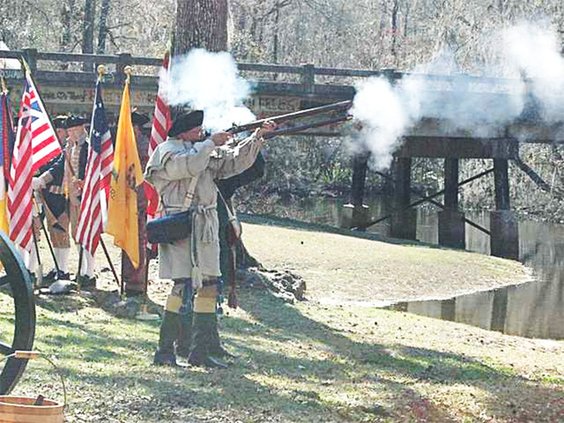
On the weekend closest to each March 3 the association and battlefield site welcome school children and other visitors to an event with re-enactors. A memorial service is held there that Sunday.