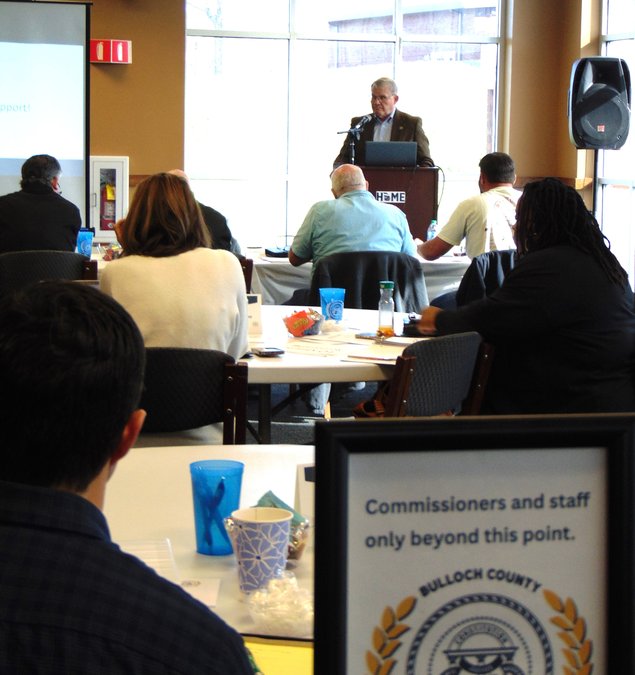

Monday, during the first day of the Bulloch County government’s two-day goal-setting retreat toward the fiscal year 2025 budget, County Manager Tom Couch spoke on planning toward a six-year extension of the Special Purpose Local Option Sales Tax and observed that it can’t pay for everything everybody has suggested, even with a “robust economy.”
“I think it’s going to be very tough funding everything that everybody’s going to want with 100 to 110 million dollars over six years,” he said. “In fact, it’s probably impossible.”
He called four projects – a jail expansion, a new judicial complex, an indoor recreation center and a stand-alone elections building – “inevitable.” But the speculative, ballpark cost estimates he gave for just the first two projects suggest that those alone – the jail pod and judicial center – could use up all of the SPLOST revenue.
The county commissioners, Couch and staff members met throughout the business day Monday and were to meet again 8:30 a.m.-4:30 p.m. Tuesday in the Gene Bishop Field House at Paulson Stadium, 2100 Malecki Drive. County constitutional officers and department heads were making presentations at various times about their agencies’ goals and needs.
The main sales tax Couch talked about is the original, multipurpose 1% SPLOST shared by the county government and the four cities or towns for building projects and equipment purchases of various kinds. He also briefly mentioned the transportation purposes sales tax, or T-SPLOST, but noted that the current T-SPLOST won’t expire until 2027 or 2028.
However, the current SPLOST, which Couch called “SPLOST ’19” because it was authorized by a majority of Bulloch County voters in a 2019 referendum, will expire at the end of October 2025.
He noted that elections in November 2024 and March 2025 will be the opportunities to put the SPLOST extension proposal on the ballot before the tax lapses. Without completely ruling out this November’s election, he tentatively recommended a March 2025 SPLOST referendum, after first talking about the condition of the local economy.
Couch and the county staff last year created a “local economic index,” he noted, and reported that as of December 2023, three of the four factors measured – consumer sentiment, new housing starts, consumer spending and local employment – were all up quarter-over-quarter compared to 10 years earlier. The one that was down was consumer sentiment, and that reportedly surged in December.
“We have good confidence this is a good measure of the local economy. …,” Couch said. “We think it’s robust, and right now our local economy is very robust.”
Sales tax revenues, which are used as the measure of consumer spending, were growing before the COVID-19 pandemic and actually accelerated during the pandemic years, he said. A change in Georgia law a few years ago, Couch noted, allowed the state to begin collecting sales tax from online retailers that are based in other states but do significant business in Georgia, and counties receive shares.
He had originally been slated to give the SPLOST briefing Monday afternoon, but it was moved up to 10 a.m. after Election Supervisor Shontay Jones informed other officials Monday she would be unable to attend. Candidate qualifying for the May 21 state and county primaries concluded at noon Friday, and by Monday the elections office staff was preparing for the 7 a.m.-7 p.m. Tuesday, March 12, final election-day opening of Bulloch’s 16 voting precincts for Georgia’s presidential preference primary.
Meanwhile, Couch was talking about two only slightly later elections in regard to a SPLOST referendum. A new SPLOST proposal would have to be completed in time to place it on a ballot about 90 days before the election, “and in that same time period, we have to negotiate intergovernmental agreements with the cities as well,” he noted.
“I believe with all of the different kinds of planning that we’re doing and what we’ve heard about, we may need to wait until March of ’25,” he said. “I think that November of 2024 will be really ambitious; I’m not going to tell you it’s impossible.”
Revenue growth
SPLOST ’19, Couch recalled, was originally projected to collect about $65 million as the baseline amount, but it is now “on track” to net $80 million to $85 million before it expires, he confirmed with county Chief Financial Officer Kristie King.
“And then with SPLOST ’25, just based on today’s collections, we could go between a hundred and a hundred and ten ($100 million and $110 million), but we haven’t tested it statistically,” he said, and added that the actual amount could be more or less.
The county is also faced with the fact that “everything is more expensive now,” since the cost of projects has increased along with the revenue, he noted.
Couch said the county’s SPLOST planning faces two major issues, one internal and one external, with the external one being negotiations with the cities. The internal issue comprises competing wants and needs of the county’s own agencies.
“I think in both cases it’s going to be very, very competitive,” Couch said. Then he went on to make the comment about it being “very tough to fund everything everybody wants” for $110 million.
4 ‘inevitable’ projects
As previously reported, the commissioners have contracted consultants to draft a “master facilities plan” for county buildings and grounds and also do a “workforce study” to predict the county government’s own workforce needs. Both are scheduled to be completed later this year and will be used in the SPLOST planning.
“I can give you four examples of what’s really going to be a legitimate need,” Couch said. “Another jail pod is going to be inevitable. A judicial complex is going to be inevitable. Some type of indoor recreation center, although there may be some disagreement as to what the scale should be, is going to inevitable, and I think it’s also going to be inevitable that we’re going to need a stand-alone elections building.”
While noting that the county has no real cost projections yet, he said he could say “with reasonable confidence” that a jail pod, especially if connected with an update of Bulloch County Correctional Institution, could cost $50 million.
“A judicial complex, if you do it all-in-one, which is probably going to be recommended, that could be anywhere from 50 to 80 million dollars,” Couch said.
He did not offer any guess about what an indoor recreation center would cost. But Couch said he agrees with the Recreation and Parks Department leadership that it should be a “community-based” facility for local needs.
“I know some folks, some city officials, think that ought to be tourism-based. Either way, it’s going to be an expense, but I think there’s greater risk if it’s going to be tourism-based,” he said. “Even though it’s more expenses toward, probably, the general fund, I think community-based is what we need. We need something that’s going to serve our kids, our adults.”
Calling the Bulloch County Agricultural Complex, with its arenas, and Splash in the Boro waterpark “two retail facilities,” Couch said he thinks the county, population-wise, is about 30,000 to 40,000 more people away from supporting another “tourist-type recreational facility.”
To fund all four projects and also work that will be needed on existing buildings, the county will need to be “more creative” and probably less “debt averse,” Couch said. So the staff will be working with the county’s financial advisors at Davenport & Company, retained under contract, for guidance on “retooling” its “financial model” for capital projects.