(Note: In a previous version of the story, the cost of the message board was incorrect. The $118,767 cost figure now listed is correct. The Herald apologizes for the error.)
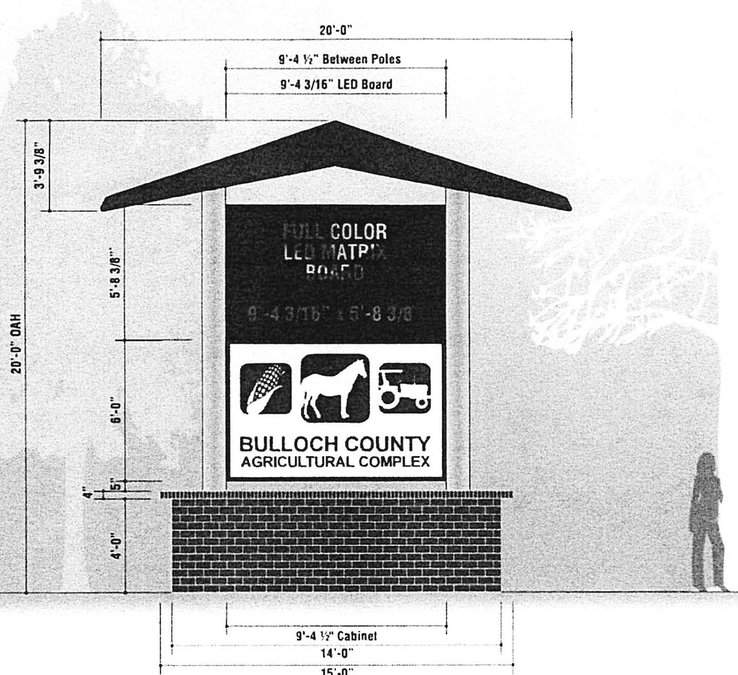
For $118,767, the Bulloch County government is buying an almost 6-by-10-foot double-sided digital message board for the Recreation and Parks Department to position at the Ag Arena entrance in a place visible to drivers on U.S. Highway 301.
This SPLOST-funded expense was one of two items pulled from the “consent agenda” portion of the Dec. 2 county Board of Commissioners meeting for separate votes. Otherwise, the consent agenda would have contained nine items for the board to approve on a single motion and vote. But commissioners may, before approving the consent agenda, remove individual items from it for separate discussion — or information — and votes under “new business.”
The other item removed from “consent” to “new business” was the approval of two grants, totaling $100,000, from the county’s opioid settlement funds to two local nonprofit organizations.
Commissioner Nick Newkirk, who frequently asks for items to be separated out — sometimes to oppose them but more often because he says the commissioners or public need to hear and understand more — asked that those two items be handled separately. Chairman David Bennett noted this, and other commissioners made and seconded a motion to approve the other seven consent agenda items, which passed 5-0, with Commissioner Timmy Rushing absent.
The light-emitting diode, or LED, message board for highway-frontage placement at the Bulloch County Agricultural Complex was actually the second of the two reassigned “new business” items then briefly discussed.
Commissioners had received a memo addressed from Recreation and Parks Assistant Director Tony Morgan to County Manager Chris Eldridge about the Galaxy Outdoor Electronic Message Center. It was priced through Sourcewell, a cooperative purchasing organization for local governments and government agencies, for purchase from Daktronics Inc.
“Daktronics has brought a display sign for us to look at for quality and clarity,” Morgan had written. “We are impressed with the sign and the ability to work on it.”
He stated that Daktronics provides a five-year warranty, guarantees parts for 10 years after production life, and does not anticipate discontinuing this model “any time soon.”
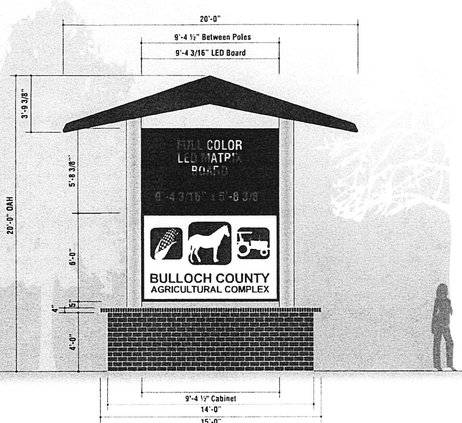
The sign will be remotely controlled and programmed using a Verizon 4G modem and cellular data plan. Although he described it as a 6-by-10 sign, a sketch and specifications sheet shows the “cabinet” with the screen as 9 feet, 4½ inches wide between support poles and the programmable part of the sign as a little over 5 feet, 8 inches tall.
Larger structure
The screen portion would be atop the fixed Agricultural Complex sign with its corn, horse and tractor icons, and the whole structure would have a brick base 14 feet wide and a roof-like aluminum top 20 feet wide.
Eldridge noted that the project was approved for SPLOST, or Special Purpose Local Option Sales Tax, funding through this year’s budget. Referendums approved by a majority of county voters for the overall SPLOST authorize funding for Recreation Department projects, and the commissioners vote on an updated capital improvements program budget, listing specific projects, annually.
County employees will be doing some of the structural work, according to Eldridge, who arrived in Bulloch County as county manager in early October.
“We’re self-performing the base, the brick base that you see there,” Eldridge said. “It will match the dark gray in the arena. So I believe it matches the quality of the facility there, and we didn’t have any kind of presence out there on 301 is one of the things I noticed first, coming in.”
He added that “as far as visitation,” the Ag Complex is “one of our bigger draws, compared to tournaments and other things, too,” and confirmed with a Rec Department staff member present that the Ag Complex facilities are already booked for 40 weekends in 2026.
“So it will be nice to have something out there that matches what we have at the Ag Complex, and there’s other things I think we should do down the road to improve that complex as well, to better accommodate events,” said Eldridge.
Newkirk indicated he was opposed to the cost of the particular purchase.
“I know we need the sign out there, and I go along with the Rec Department a lot of the times, and they’re doing a lot of good stuff out there, but me personally, I think spending $120,000 on a sign is a little bit too much,” he said.
Noting that the project is SPLOST-funded, Commissioner Toby Conner said this “means that that money is dedicated, allocated, for only certain projects, correct?” Eldridge and Kristie King, the county chief financial officer, replied that this was so.
“It’s not like we’re taking $120,000 out of the general fund,” Conner continued. “That money has to be spent or we don’t get it back.”
No ‘Lite-Brite’ here
Eldridge agreed that it was part of the capital improvement plan previously approved by the commissioners.
“It is a balance, and I understand the cost, but you also want something that looks good, too,” Eldridge commented. “I’ve made the mistake in a prior job that I think we went cheap, and it looked like a Lite-Brite out there. So you know, that’s the balancing act as far getting something quality that people can read as they’re driving by.”
For those who might miss the reference, a Lite-Brite is a trademarked children’s toy, perhaps more popular in past decades. The original version used colored plastic pegs to form messages or pictures on a back-lighted board.
But the Galaxy GT6x LED matrix board has more in common with a flat-screen TV. By being remotely changeable, it could be used by the county, although “it wouldn’t be often,” for public service or public safety messages, he said.
Commissioner Ray Mosley made the motion to approve the purchase. Commissioner Anthony Simmons seconded the motion, and it passed 4-1, with Newkirk opposed.
Opioid grants
The other item moved from consent agenda to new business was the approval, on a single motion, of two Opioid Settlement Fund grants, $50,000 each, to Freedom Through Recovery and the Bulloch County Alcohol and Drug Abuse Council.
This was actually the first of the two items, and Newkirk spoke as Peyton Fuller, senior accountant in the county Finance Department, came forward to explain.
“I know it’s not taxpayer money, but I just want to make sure the public knows that this is not taxpayer money, that this is grant money that we got from a lawsuit, that this has nothing to do with taxpayer monies going to these private companies,” Newkirk said.
“Sure, 100 percent,” Fuller responded. “When we put out the grant application (request), we made that clear in the description, in the Facebook posts and everything. All the information that has gone out about this grant has been about it coming from the lawsuits.”
As Fuller, County Attorney Jeff Akins and King outlined in further comments, the money is from state-led legal settlements with companies that made, sold or promoted opioid painkilling drugs, allegedly contributing to the epidemic of addiction and overdoses. Bulloch County, through past votes of the commissioners, signed onto several of the lawsuits or settlements.
“It has trickled down to the counties that participated in the lawsuits. This goes back a while,” Fuller said. “And so we looked at the amount of money we got and decided to put out a grant application.”
The application was published in September and remained available for about a month and a half.
“We received three applications. We received the applications and decided that two of them were eligible and one of them was not,” said Fuller. “The guidelines for giving out the money are very restrictive in how they’re used, and one of the applicants just did not meet those guidelines, and the other two did.”
He didn’t name the declined applicant, but documents in the commissioners’ packets showed that Food Bank Inc., also known as Statesboro Food Bank, also applied.
“And we do plan to make this an annual solicitation, so people will be able to apply again next year,” Fuller added.
More grants ahead
When Bennett asked if it’s true that the money “comes in sporadically through the year,” King replied that she has a schedule, “but there’s multiple different lawsuits” against pharmaceutical manufacturers, pharmacy companies “and anyone who could have contributed to pushing opioid substances and contributed to addiction issues.”
The funds are supposed to continue coming in over something like 18 years, King said. Because of the multiple settlements, “there may still be some more coming down the pike,” Akins added.
Simmons made the motion to approve the grants of $50,000 to the Bulloch County Alcohol and Drug Abuse Council and $50,000 to Freedom Through Recovery, both nonprofit corporations. Mosley seconded, and the grants were approved 5-0.