Question: I saw a man selling something called “Texas holey rock” at the fish and aquarium auction at the Atlanta Farmers Market. What is it and what is it used for?
Answer: Honeycomb limestone, or “Texas holey rock,” is a type of limestone that comes from Texas and is riddled with holes and chambers. It is used to harden water and balance pH in some aquariums. The holes provide places for fish to take refuge or sleep. It is popular in aquariums with cichlids. It is usually sold by the pound. As you saw at the auction, there are dealers who sell the rock to the public. Pet dealers and tropical fish stores may offer it as well.
Another possible use for honeycomb limestone is in rock gardens. The rocks are interesting in their own right, and some of the holes could be filled with soil and planted with plants like hen-and-dibbies (sempervivums) or small sedums. Large specimens could be used as ornaments or curiosities the way unusual eroded rocks are sometimes used in traditional Chinese gardens.
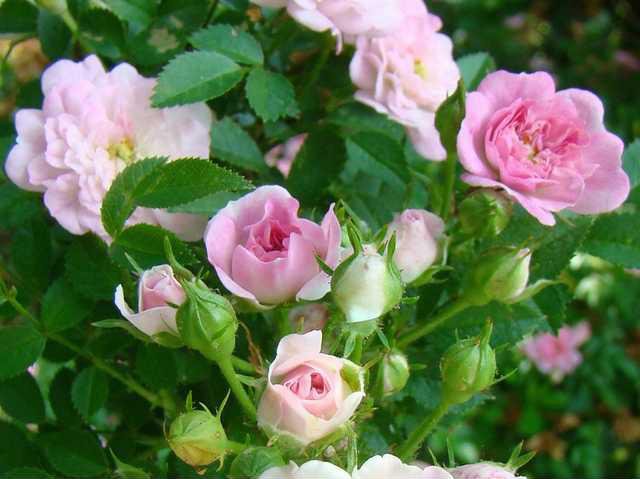
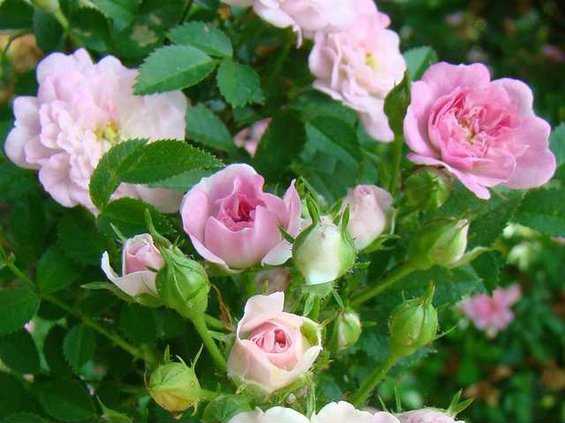
Q: I saw a rose with tiny leaves and tiny pink buds and flowers that was labeled ‘Petite Pink’ blooming in a garden on Mother’s Day. I was told it was a groundcover rose. It was charming. It was sort of like ‘Dorothy Perkins,’ but much smaller. Is it easy to grow? Is it for sale?
A: ‘Petite Pink’ (sometimes listed as ‘Petite Pink Scotch,’ although it is not related to the true Scotch rose, Rosa spinosissima) is a charming and easy-to-grow rose.
This rose was found in 1949 by Jackson M. Batchelor of Willard, North Carolina, growing in the garden of a 1750s plantation home on the Cape Fear River, near Wilmington, North Carolina. No one seems sure of its origins or history. Batchelor sent plants to the National Arboretum in 1956 where it was rated as an outstanding groundcover shrub for slopes.
The flowers are a medium to light pink and are produced in mid- to late spring. They are beautiful in small bouquets or corsages. When you look at the fine foliage and dainty buds and flowers (the open flowers are only the size of a quarter), it seems dismissive to think of ‘Petite Pink’ only as a utilitarian groundcover.
The reasons it is sometimes recommended as a groundcover are because of its low growth habit and its durability and lack of problems. ‘Petite Pink’ reaches two to three feet tall (four if allowed to grow on a chain-link fence or trellis) and spreads three to four feet if grown on open ground. In the 30 years we have grown the rose, we have never fertilized it or had to spray it for any disease or insect problems. We have also found it to be more shade tolerant than the average rose.
You can find ‘Petite Pink’ at specialty nurseries and rose suppliers. It is not commonly available but is worth seeking.
If you have questions about services or products regulated by the Georgia Department of Agriculture, write Arty Schronce (arty.schronce@agr.georgia.gov) or visit the department’s website at www.agr.georgia.gov.
Consumer Q's: 'Petite Pink' roses are cute, easy to grow