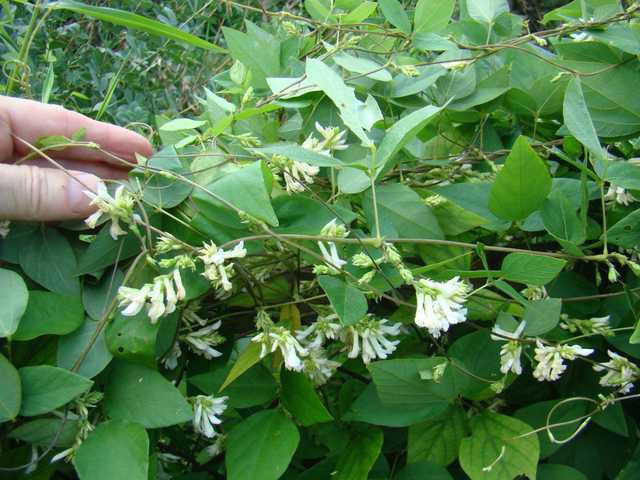
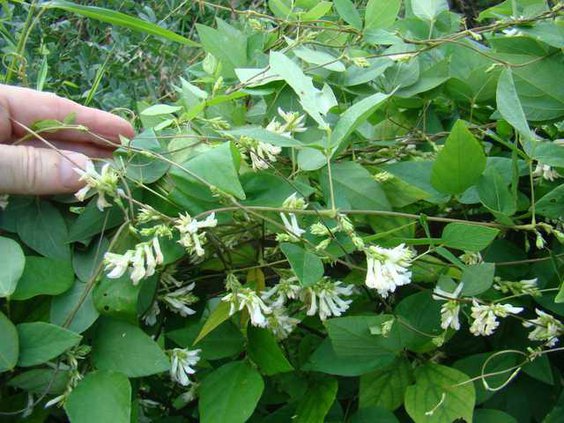
Question: What is a hog peanut?
Answer: Hog peanut (Amphicarpaea bracteata) is a native vine noted for producing edible peanut-like seeds underground. It is also known as American hog peanut, hogpeanut, hog-peanut, talet, ground bean and wild peanut. It is indigenous to eastern and central North America, including Georgia.
Hog peanut is a member of the pea family and looks like a thin, vining garden bean. It has two types of flowers. One type is borne high on the plant and produces seeds in small, flat, bean-like pods. These flowers are white, lavender or purple. The other type grows low on the plant, is inconspicuous, buries itself underground and produces, usually, a single large seed per flower.
Eaten raw, the underground seeds are similar in taste and texture to a green peanut. They can also be cooked, but we have not tried this. It would take considerable effort to gather enough to warrant cooking.
Various birds, including ruffed grouse, bobwhite quail and wild turkey, eat both the aboveground or underground seeds. Wild hogs will eat the underground seeds, hence the common name. Hog peanut is a larval host plant for several species of butterflies including the silver-spotted skipper, little yellow golden-banded skipper, long-tailed skipper and gray hairstreak.
Hog peanut is not commonly offered for sale. Being a legume, it may have some value as a nitrogen fixer, particularly since it is shade tolerant. It could be used improve land for wildlife. It could also be of interest to experimenters or visionaries who want to work with it to increase the number and size of the underground seeds and create a new agricultural crop.
Q: I remember my grandmother telling me about picking cotton when she was young. I tried to pass along some of her stories to my own grandchildren. She was told not to leave "shirt-tails" in the field. I cannot remember what she meant by that. Can you help me?
A: "Shirt-tails" are the strands of cotton fibers that cling to the bolls after picking. Skillful and conscientious cotton pickers would not leave shirt-tails or would keep them to a minimum. To the growers and to pickers who were being paid, leaving cotton fibers in the field was like leaving money there.
If anyone knows other terms for this or has other old-time agricultural terms to share, please pass them along to Arty Schronce, 19 Martin Luther King, Jr. Dr., Agriculture Building, Room 128, Atlanta, GA 30334 or to arty.schronce@agr.georgia.gov.
Q: I am concerned about credit card security at gasoline pumps. Is there anything being done and is there anything as a consumer I can do to help protect myself?
A: The Georgia Department of Agriculture (GDA) is conducting a campaign to check Georgia gas pumps for "skimmers," illegal devices that capture credit and debit card information. The campaign is in conjunction with the Georgia Association of Convenience Stores as part of the department's routine fuel dispenser inspections.
"It is an issue that the industry is aware of, and many companies are taking steps on to implement further security efforts," according to Rich Lewis, Director of the Fuel and Measures Division of GDA. "We hope those efforts combined with our surveillance will keep these thieves from preying on our traveling public."
Here are a few steps you can take to mitigate the risk of identity theft while pumping gas:
Pay in cash inside the store.
Check to make sure the gas pump dispenser cabinet is closed and has not been tampered with.
Use a gas pump close to the front of the store. Thieves often place skimmers at the gas pumps farther away from the store so they are not noticed as quickly.
Use a credit card instead of a debit card. Credit cards have better fraud protection, and the money is not deducted immediately from an account.
If using a debit card at the pump, choose to run it as a credit card instead of a debit card. That way, the PIN number is safe.
Monitor bank accounts regularly to spot any unauthorized charges.
Consumers who suspect their credit/bank card number has been compromised should report it immediately to authorities and their credit card company or banking institution. Complaints can also be reported to the Georgia Department of Agriculture's Fuel and Measures Division at (404) 656-3605.
If you have questions about services or products regulated by the Georgia Department of Agriculture, write Arty Schronce (arty.schronce@agr.georgia.gov) or visit the department's website at www.agr.georgia.gov.
Consumer Q's: Credit card security at the gas pump
Also included: What 'hog peanuts' are