Two years after launching a $5 million program to rehabilitate substandard housing in cooperation with homeowners, Statesboro’s city government has started completely replacing some too-far-gone houses by having new ones built on the same spot.
Next, the city is applying for a further $1.5 million grant, and officials hope to work with Habitat for Humanity to build affordable homes on some vacant lots.
So far the city has spent or committed to spend $3.7 million of the $5 million City Council allocated to the housing rehab program from pandemic-era federal ARPA funds, city Planning and Housing Administrator Justin Williams reported during the council’s Nov. 19 work session.
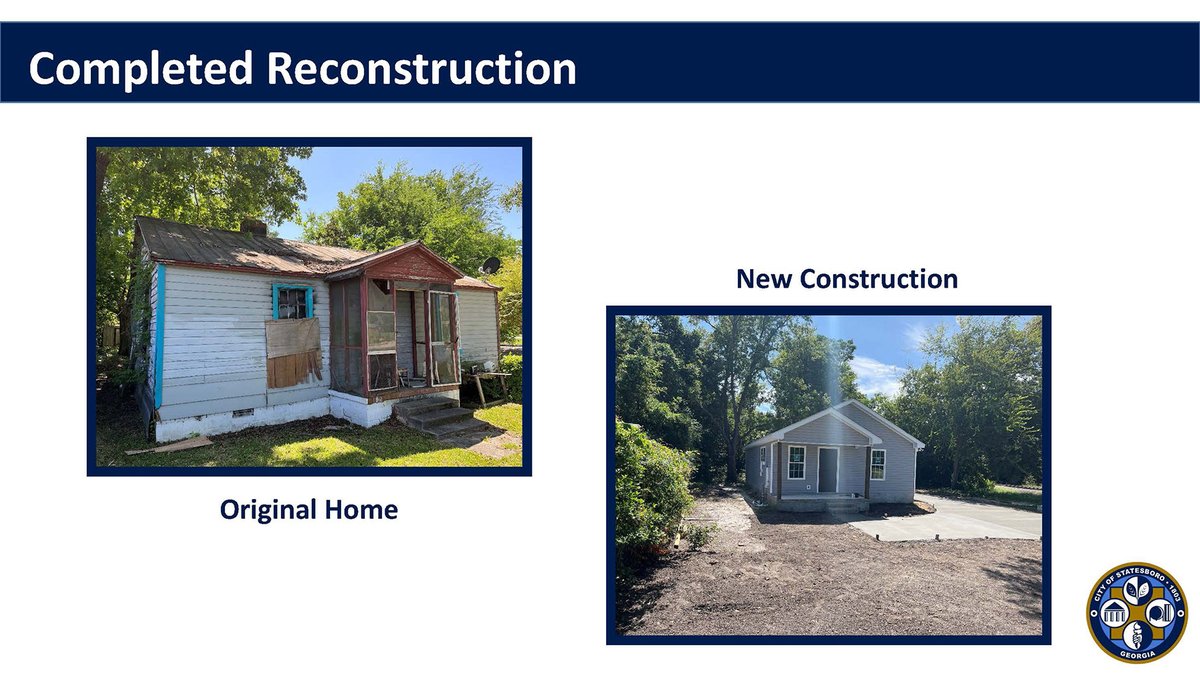
Projects completed thus far include major “systems” renovations, such as new roofs, heating and air-conditioning systems or foundation repairs to at least 10 homes, plus the total replacement of one house with a new one built on the same site. That first “reconstruction” home is now occupied, Williams said.
Another 17 or 18 houses are now in the process for contractors to undertake major renovations, he said in an interview Monday.
“There are still more that have been awarded (to homeowners) that we just haven’t been able to get to in terms of construction,” Williams said. “But we’ve got contractors all over the city right now working.”
A city permit for a second replacement home has been issued, and the dilapidated house was demolished last weekend, for construction yet to begin.
Originally, a few more than 80 applications were received for home rehabilitation. A second round later yielded more than 30 additional applications. But not all homes or applicants qualify. About 45 houses were identified for minor to major repairs, Williams said during the work session, but he noted that some had problems so severe that repairs could not be cost-effective.
“As we were coming to the end of the houses that we were able to rehab, we realized that we were in a situation where we could only do reconstruction. …,” he told the mayor and council. “We went through a second process of accepting new applications … and unfortunately, going through those individually we really discovered that we just have a lot of houses that are too far gone.”
On Sept. 11, bids were opened to award contracts on an additional four reconstruction homes, Williams reported. So that will bring the total number of homes being replaced to six, and Williams said the city’s plan is to do at least six more, for a dozen total reconstructions.
‘Before’ and ‘after’
The slide show he presented included “before” and “after” photos of rehabilitated homes with relatively standard upgrades, such as new roofs and windows, visible from the outside.
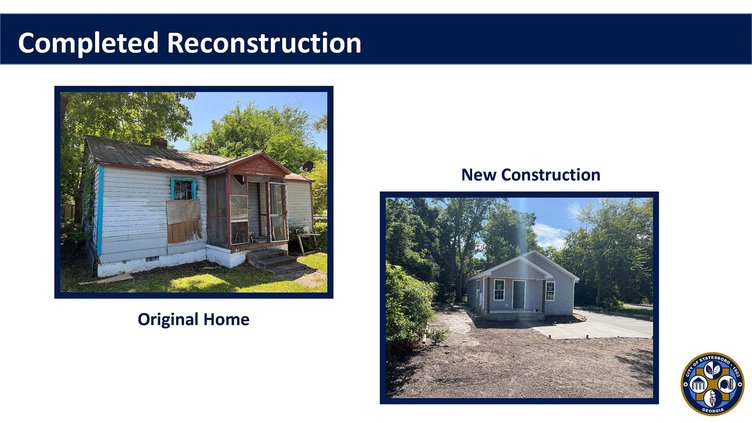
Photos of the one “reconstruction” or replacement home completed so far, on West Grady Street, showed a far more dramatic contrast. The original ramshackle house had some partially boarded-up windows, a rusty metal roof and a tiny screened porch. The new home on the same site, while not large or fancy, resembles some of those Habitat for Humanity has built locally.
Other photos included some of “ongoing” or “potential” project houses, one or two of which appeared uninhabitable.
One picture showed a house that had been identified for rehab work but has now been damaged further by hurricane-shattered trees. It was one of several homes in the program that received storm damage, Williams said.
The rating system used by the city and the consulting firm Insight Planning & Development to qualify and prioritize homes for rehab or replacement takes several factors into account. These include owner income, “special population” scores for senior citizens and people with disabilities, a rating for the severity of “system” problems with the home, and the cost and effectiveness of rehabilitation.
To be eligible, the owner-occupants must have annual household incomes less than 80% of Bulloch County’s median household income for each family size.
The city initially targeted an area around Johnson Street in western Statesboro for the first phase of rehab funding. But Statesboro’s 2021 Urban Redevelopment Plan established a map with other eligible areas and also allowed funding for “scattered sites” across town.
Whether for rehab or reconstruction, the funding takes the form of forgivable loans to homeowners who apply and qualify. For rehabilitation projects, the loans are forgiven at a rate of 20% per year, and can be totally eliminated if the qualifying owner remains in the home for five years. But if owners or heirs sells the home after one year, they owe the city 80% of the cost of the renovation. If the home is sold after two years, the owner would have to repay 60%, and so on.
But for complete reconstructions, the “affordability period,” or time the applicant must remain in the home to have the loan completely forgiven is extended to 10 years, said City Manager Charles Penny. In other words, the debt is forgiven at a rate of 10% each year.
Replacing a 1,000-square-foot home – the modest size of many of those in the program – with an all-new one now costs about $150,000, Penny said. So building 11 more will cost about $1.7 million, Mayor Jonathan McCollar noted in the discussion.
This is out of 22 homes that Williams said could qualify for reconstruction, including the one already done.
“There’s only so many, so much funds that we have,” he told the mayor.
ARPA deadline
Reconstruction contracts will help the city meet a requirement to commit its available ARPA funds to specific projects by the end of this year.
In 2021, Statesboro received approval for $12.3 million in American Rescue Plan Act funds from the U.S. Treasury Department. City Council set aside $5 million for the housing rehabilitation program and, in December 2021, hired Insight Planning & Development, based in Wilmington, North Carolina, to administer it, at fees of up to $550,000, or 11% of the grant total.
So, administrative costs reduced the amount of direct ARPA grant money available for repairs or reconstruction to around $4.5 million. But the council in June 2023 agreed to assign interest earned on the city’s ARPA deposits to the program, beginning with $300,000 for the first two replacement homes.
“We have more flexibility with the interest than we do with the ARPA funds,” Penny told the council last week. “The ARPA funds we have to have committed by the end of December, otherwise we’ll lose those funds, and I don’t think any of y’all want to let those funds go back.”
CHIP grant sought
During the regular meeting that followed, the council unanimously approved a resolution for the city to apply for a grant from the Community Home Investment Program, or CHIP. This is ultimately federal taxpayer money through the U.S. Department of Housing and Urban Development, administered at the state level by the Georgia Department of Community Affairs.
Statesboro’s city government is aiming for a $1.5 million CHIP grant, some of which could go toward the housing rehabilitation program. But the majority of the funding would go into a new project, involving a church and another local nonprofit, to build all-new housing on now vacant lots.
“The intent is to construct new, affordable housing on empty lots for eligible home buyers,” Williams said.
Agape Worship Center took part in the effort by purchasing four lots on Pine Street where old duplexes were then removed by voluntary demolition.
Now Habitat for Humanity of Bulloch County intends to work with the city to build new houses there.
“We know we’re looking at building at least six, directly on Pine Street, but we’re still figuring out a total number for new construction,” Williams said.
Getting the CHIP grant is not a certainty, but Williams and Penny expressed confidence that Statesboro should qualify based on its ongoing housing rehabilitation program and its participation, since qualifying in 2019, in the Georgia Initiative for Community Housing.