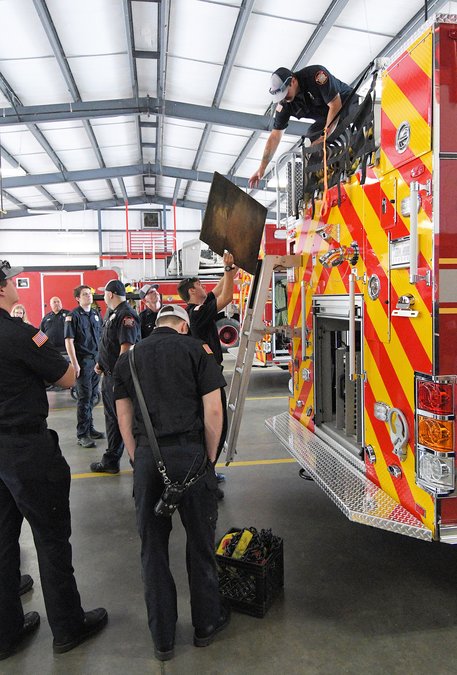
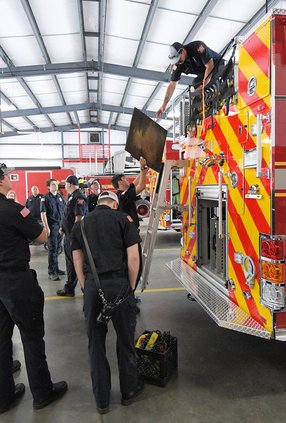
Two new 2023 Pierce Enforcer fire engines ceremonially pushed into Station 1 by firefighters and civilians Tuesday morning represent a $1.3 million city expenditure of local sales tax funds to keep the Statesboro Fire Department’s front-line apparatus up-to-date.
Push-in ceremonies date from the era when fire engines were pumps mounted on wagons designed to be pulled by teams of people or horses and so had to be pushed backwards into a firehouse. No such ceremony had been conducted here in living memory, but Statesboro Fire Chief Tim Grams said he thought it would be a way to show appreciation, share some pride and let the community touch its Special Purpose Local Option Sales Tax dollars at work.
“These two were purchased with SPLOST money, and I think it’s important to recognize and give the opportunity to the public to actually be able to see and even put their hands on that tax money that funds equipment for all of these different services, including the Fire Department,” Grams said before the ceremony.
Backed by firefighters, Grams gave a brief statement to a small gathering inside the station's bay before they assembled again outside for pictures and the push-in ceremony. Firefighters and members of the public joined in to symbolically push the engines into the bay with some help from engineers driving gently in reverse.
With dark gray cabs over traditional red bodies, the two Pierce Enforcers introduce a new color scheme to the SFD fleet, previously liveried white over red. Of course, they also have bright yellow stripes and markings for high visibility. These aren’t grand tower trucks or anything like that. But carrying hoses and portable ground ladders, these are what people think of when they hear “fire engine,” Grams observed.
Each carries a 1,000-gallon tank but a pump that theoretically can drain that in under a minute, pushing more than 1,500 gallons per minute from hydrants or other sources. These 2023 engines are equipped with technology not seen on the older engines, including lighting equipment and multiple cameras for watching the scene and maneuvering the trucks, displays and alerts that monitor the performance of the engine and pump and hearing protection for firefighters.
Engines’ life cycle
They replace, in front-line status for everyday fire response, two older fire engines, one a 2010 model, the other a 2011. But those engines will remain in service with the department as reserve apparatus, responding to calls when one of the front-line engines needs repair or scheduled maintenance.
Grams had explained, in an interview Monday, that the department’s replacement strategy for fire engines – as distinguished from tower or ladder trucks – is a 20-year cycle. The goal is to keep them in front-line service 10 years and then as reserve apparatus for 10 more years.
“It’s a way for us to save on the wear and tear and maximize their useful lifespan in the fleet, and that’s a common practice within the fire profession, to rotate your apparatus into primary and reserve roles,” Grams said.
From its two stations, the Statesboro Fire Department operates four companies of firefighters, each assigned to one of four front-line apparatus, which include three fire engines and one “aerial,” or tower, truck.
As of now, those front-line machines are the two new 2023 engines, a 2013 engine that will remain in front-line service a little longer and a 2013 tower truck. All were built by Pierce Manufacturing.
The 10-year step in the cycle remains a goal in regard to fire engines, and for aerial trucks, which answer fewer calls here, the expected life extends out to 30 years, Grams said.
In March, the Statesboro Fire Department, with City Council’s approval, sold three machines that were more than 20 years old to the Emanuel County Fire Department for a total of $90,000. These were a 2001 International fire engine, a 1991 GMC fire engine and a 1981 Ford ladder truck that had been Statesboro’s first “aerial apparatus.”
Ordered in 2021
Funded from the city’s share in the SPLOST approved by Bulloch County voters in 2019, Statesboro’s newly arrived 2023 fire engines were ordered from Ten-8 Fire and Equipment with council approval back in August 2021. The exact price for the two together was $1,342,410.
Twenty months passed before the trucks arrived. But fire engines, manufactured on order, require time for delivery, and these were ordered during the slowdown in manufacturing and supply that began with the COVID-19 pandemic.
“They told us up-front that it was going to take a while, which is why we went ahead and ordered when we did,” Grams said. “But it has certainly taken a while, and they kind of let us know that that’s going to be the new norm.”
The Statesboro Fire Department serves, in addition to Statesboro, unincorporated areas of Bulloch County within five miles of the SFD’s station. The county collects a special property tax millage in this fire-service zone and passes it on to the city. The SFD generally provides an Insurance Services Office fire safety rating of “2,” on the ISO scale where “10” is the least protection and “1” the best available.
Ready to roll
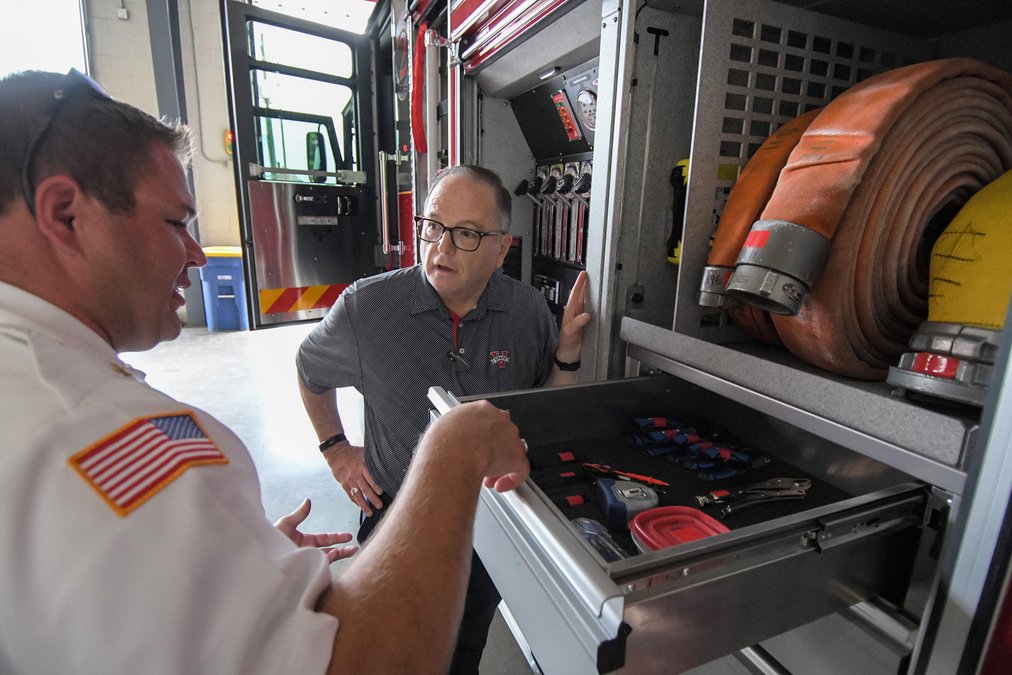
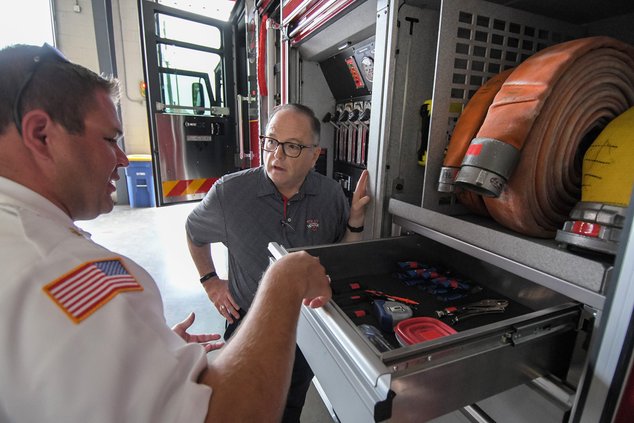
While guests enjoyed refreshments after Tuesday’s ceremony, Statesboro Fire Department Prevention Chief Stephan Hutchins gave his father-in-law Rick Mitchell, pastor at Life Spring United Methodist Church, a detailed tour of one of the new engines, including looks at nearly every system on the vehicle.
Mitchell visited Hutchins at work before, but had never received a tour and explanation about how the engines work and how they are used to fight fires.
"I don't think the average person realizes what all is involved, and what all they have for every contingency. But it was quite impressive," commented Mitchell. "I am really grateful for the hard work they do."
As Hutchins and Mitchell finished their tour and guests began filtering out, firefighters and trainees began loading equipment onto the vehicles to get them ready for service. Hutchins said they would be ready to go in less than one and a half hours, and firefighters were eager for the first call so they could put the new state-of-the-art apparatus to use.
"It really does make a huge impact on the morale of the firemen, you know," he said.