The Bulloch County Board of Education and staff plan to develop a College and Career Academy Program as the school system builds one new high school and potentially expands other facilities. But a centralized career academy campus is not in the cards here, key speakers emphasized during the recent Bulloch Career Workforce Summit.
The 2024 summit, third in a series of such meetings begun in 2021, was held Jan. 31 in the Oak Room of the Jack Hill Building at Ogeechee Technical College, at 8 a.m. over breakfast prepared by Statesboro High School culinary arts students. Leaders in the Bulloch County Schools career, technical and agricultural education, or CTAE, efforts updated an audience that included representatives of some industries as well as the college and Georgia Southern University.
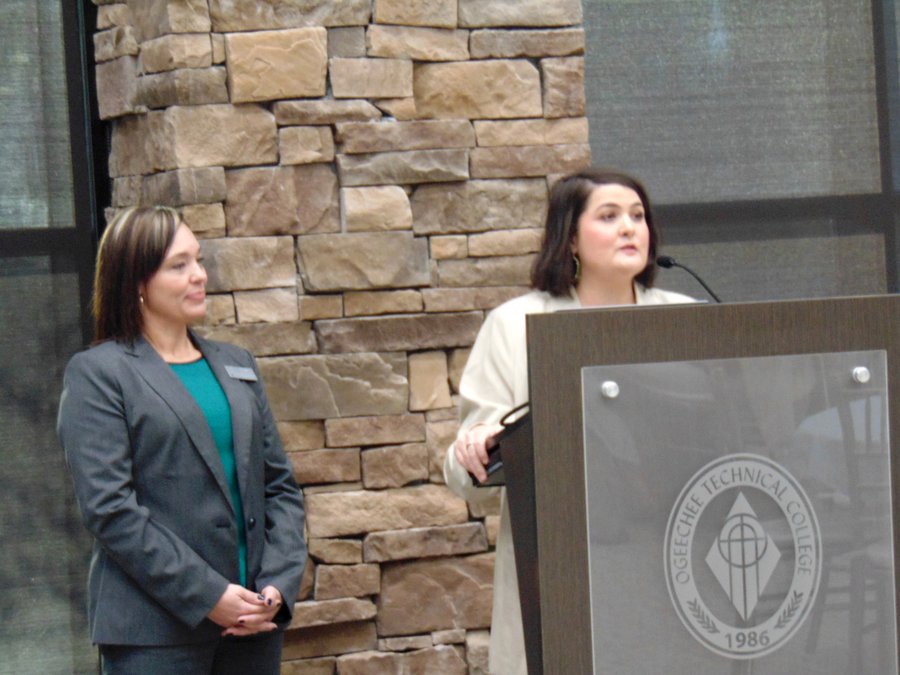
After other speakers reported on recent successes and recognized CTAE student and faculty award winners, the county school district’s Assistant Superintendent for School Improvement Teresa Phillips and CTAE Director Bethany Gilliam addressed the future in terms of the College and Career Academy Program.
“We plan to leverage all three of our high schools in order to maximize our CTAE pathway offerings for students, and this will allow us to maximize our community resources and give more opportunities for students to complete multiple pathways in a certain area that they’re interested in,” Phillips said.
This approach, she said, also allows for more flexibility and “adjustments for the future” while the schools work with their “postsecondary and industry partners.”
More pathways
As of 2023, the three high schools – Portal Middle High, Southeast Bulloch High and Statesboro High – together offered courses in 30 career pathways in 13 “career clusters.” But the plan is to expand to 35 pathways, Phillips noted. Pathways are sequences of courses that prepare students for careers or further education toward those careers, and clusters are groupings of related pathways.
Current and planned career clusters offered by Bulloch County Schools include Agricultural Education; Architecture & Construction; Arts, Audiovisual Technology & Communications; Business, Management & Administration; Finance; Education & Training; Government & Public Administration; Health Science; Hospitality & Tourism; Human Services; Information Technology; Law, Public Safety, Corrections & Security; Science, Technology, Engineering & Mathematics; and Transportation, Distribution & Logistics. The schools also offer Workforce Ready and, in cooperation with employers, Work-Based Learning courses.
“And we get to offer some really unique pathways to better prepare our students,” Phillips said.
A Heavy Equipment Operations pathway is scheduled to be introduced next year at Southeast Bulloch High. Other new or unique pathways she mentioned include those in Logistics, Non-Invasive Healthcare Technology, Sports Medicine, Electric Vehicles, Public Administration, Cosmetology and Networking.
“Some programs are only going to be offered at one high school,” Phillips said.
But a variety of offerings and opportunities, aligned with local and regional workforce development needs, she said, are offered at each school.
“We do plan to offer transportation to students if they want to take a pathway that’s not offered at their high school,” Phillips said. “The plan is to be able to transport them to the other high schools to take those courses.”
No ‘stand-alone’ academy
Gilliam also spoke of the College and Career Academy Program as something other than a building.
“One thing about this is, it’s not a stand-alone career academy, it’s a career academy program, which means that it’s imbedded in each of our three high schools, which does allow for maximizing of our community resources so we’re not pooling all to one location, we’re spreading that out,” she said.
Some pathways, such as the new Industrial Maintenance pathway, “will eventually be offered at all three high schools, because that is such a huge need,” Gilliam said.
Meanwhile, some other pathways, such as the Carpentry program, the Plumbing, Maintenance & Electrical and the HVAC (heating, ventilation and air-conditioning) pathways, all of which are based at Statesboro High, will continue to be provided on just one campus.
“However, students will be able to access those programs from the other two schools,” Gilliam said.
Additional space needs
On a chart of all the pathways, the Industrial Maintenance program is designated as needing additional space at both Statesboro High and Portal Middle High. Other pathways listed as needing additional space at Statesboro High are HVAC, Health Science Clinical Lab, Culinary Arts, Networking and Firefighting (the only “Law, Public Safety, Corrections and Security” pathway currently listed for any of the schools).
A new Public Health program is listed as being based only at Portal Middle High, but not as requiring any additional space.
The planned Heavy Equipment Operations pathway, new Non-Invasive Technology in Health and new Electric Vehicle pathways are listed as based only at Southeast Bulloch High School. But none of the new pathways at Southeast Bulloch are designated as requiring additional space.
One reason is that the Board of Education and staff have plans to build a new Southeast Bulloch High School replacement as a larger and additional school. The five-year facilities strategy also calls for converting the existing SEB High to be Southeast Bulloch Middle and repurposing the current middle school facility as a new entity, Southeast Bulloch Upper Elementary.
Proposed for 2,500 students expandable to 3,000, and with currently anticipated construction funding of $95 million, the new SEB High will be the county’s largest school yet. It may take until 2027 to build, according to a timeline Superintendent of Schools Charles Wilson suggested last year. With Bulloch County Schools leaders focused on building the new school and eventually some additions to current schools, a centralized career academy like those in some neighboring counties is not part of their vision.
So in closing remarks for the workforce summit, Wilson also stressed that the College and Career Academy program “is a program.”
“We didn’t just run out and, you know, spend another $100 million and put another brick-and-mortar in the ground,” he said. “We can do this through our existing facilities.”
Current stats
As of 2023, the three high schools together had 1,510 students taking at least one CTAE course, down slightly from the previous year. But many of those students took courses in more than one pathway, Gilliam said, and 416 students completed a pathway.
The numbers of students involved in work-based learning, now 283 working at jobs while earning both wages and school credits, increased, as did the number of high school students dual-enrolled at colleges and universities, to 467 students last year, Gilliam reported.
Student earnings from the work-based learning jobs at 234 employer sites totaled a reported $1,364,178 for 138,341 hours worked.