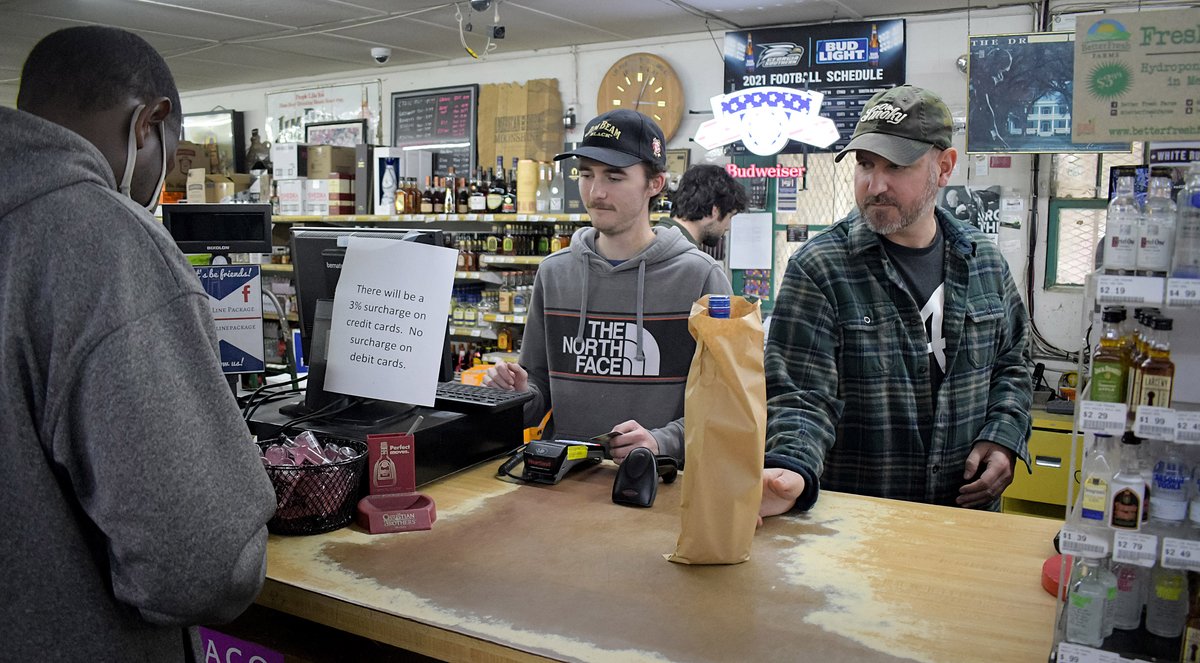

Statesboro City Council, by a 4-0 vote Tuesday morning, finally approved the Package Stores Ordinance, setting rules for the licensing of liquor stores to begin April 1, after a 74% majority of voters last November authorized liquor stores in Statesboro for the first time in memory.
The city is requiring a minimum 1,000 yards distance between any new liquor store and any existing liquor store, double the 500-yard minimum in Georgia law. But Statesboro will require only a 100-yard minimum between a liquor store and any existing college or university building, an allowed local reduction from the default distance in state law, which is 200 yards from any part of a college campus.
City Hall staff members can begin receiving applications April 1 for package shop licenses, said City Attorney Cain Smith. Those applications will also serve to hold locations, once approved by council, in the city’s special “location reservation,” process. But during Tuesday’s 9 a.m. council meeting, he said there would be no reason for applicants to line up outside the doors of City Hall before it opens at 8:30 a.m. that Friday.
“We do want to make it clear. …Don’t camp out on East Main Street the night before,” Smith said.
“It’s not a Star Wars premier?” quipped Councilman Phil Boyum.
“No, it certainly is not, because no sort of right vests upon receipt of application,” Smith replied. “The location reservation only becomes a right, only vests, after approval by council. So I just want to put that out there, to make it very clear that it’s not first in time, first in line when it comes to getting these applications.”
Unique to Statesboro, the location reservation process is designed to address the fact that the 1,000-yard minimum would block a second store from locating within that radius of the first store approved.
Smith acknowledged that this could create competition to be first to apply. The city staff “will note for council the order in which applications are received,” but this will not be the determining factor, he said. Instead, the council will be expected to decide what applications are approved based on existing section 6.13 within the overall Alcoholic Beverages Ordinance, which fills Chapter 6 of the Statesboro Code of Ordinances. The newly added city law for licensing liquor stores will be Section 6.23.
Deciding factors
As was already the case for stores that sell beer and wine and for places such as bars, pubs and restaurants, the council will need to consider things such as the reputation of an applicant and the suitability of the location, Smith explained after the meeting. Section 6.13 also requires the council to consider previous violations of alcoholic beverage laws, manner of conducting business, prior incidents, number of licenses in the trading area and any previous denials or revocations.
In current practice, the mayor and council often hear a series of “no objections” answers from key city staff members who have reviewed a license application. But if applications are received for more than one liquor store license in a 1,000-yard radius, the council would need to decide which location and applicant are better qualified, Smith acknowledged.
Final compromise
The only change the council made to the ordinance Tuesday before final approval was adding “public safety,” at the request of Councilman John Riggs, to the passage that sets a “stated policy goal” for the use of excise tax revenues from package stores. The goal now will be to allocate a minimum of 50% of the new revenue to public safety spending and contracts with qualified 501c3 nonprofit organizations to provide youth services and other social services in Statesboro.
Riggs, who participated by teleconferencing, said he wanted the half to go for youth and social services, as Mayor Jonathan McCollar had proposed, and the other half to go for public safety, mental health and addiction issues. McCollar said mental health and addiction programs were already covered under social services. After Boyum agreed to add public safety in his motion for approval of the ordinance and noted that 50% was stated as a minimum, Riggs seconded the motion.
Councilwoman Venus Mack was away, and all four council members present voted yes.
Other provisions
The ordinance limits liquor stores to commercial retail and highway-oriented commercial zones and the central business district and imposes substantial liability insurance requirements on store owners. It adheres to state law on minimum distances from non-college school campuses and educational buildings, churches and government-owned alcoholism treatment centers.
But it imposes no minimum square footage or minimum inventory value on stores, after council previously discussed but abandoned these ideas.
Prospective Statesboro liquor store owners and managers may not have been planning to camp out at City Hall, but some are ready to apply as soon as possible.
Ready to apply
Pam Hodges, whose family has operated the County Line Package Shop, across the Candler County line near Pulaski, for almost 40 years, has been following the council’s discussion for months.
“We’re ready to go, ready to put in our application and hope for the best. …,” she said. “We’re very excited and hope that our customers will follow us to Statesboro.”
Hodges still wasn’t revealing the prospective Statesboro store location and said the County Line owners will be taking “one step at the time,” as to whether the original store will continue to operate if they open one here.
Two Guys Beer, Wine & Tobacco, in College Plaza on Fair Road, is already long-established in Statesboro. But selling distilled liquors will still require a new license, and the owners are planning to expand into a neighboring part of the shopping center.
Two Guys business manager Chay Duffin attended Tuesday’s meeting and texted the store’s owners as soon as the motion passed.
“They were pleased with how everything is going,” she said. “We’re excited. They told me last month that they were going to ready to turn it in the moment we could.”
She is working on setting up TIPS training for all of the store’s employees as soon as possible, she said. An older section of the Alcoholic Beverages Ordinance required Training for Intervention Procedures certification or equivalent city-approved training only for employees of places that serve alcohol for on-premises consumption, but the new section makes that requirement also apply to liquor stores.
TIPS courses, meant to prevent serving underage customers and people who are already drunk, are provided locally by the Bulloch County Alcohol and Drug Council.
Location reservations
Under the provision for location reservations, would-be package store operators can submit their application to have the location reviewed and approved before submitting proof of insurance or completion of a fire and safety inspection, if they pay the city’s standard application fee and submit all other required information
If approved by the mayor and council after a public hearing, a the location reservation will block any other liquor store applicants within 1,000 yards of the site from being considered.
“We understand that there’s a lot of capital investment involved in these liquor stores – or package stores – so the idea is that that way they can go ahead and reserve that location and the 1,000 feet around it, if council approves it,” Smith said after the meeting.
But the reservation will be revoked if the applicant has not completed all required city building permits and substantially started construction or renovation within 180 days. After beginning construction, the applicant would have another 180 days to complete it, or could apply for one 180-day extension for extenuating circumstances.
The application form does not exist yet but should be ready for release Monday, March 28, said City Clerk Leah Harden. The form will be placed on the City of Statesboro website under the tax and license office page and will also be available for pick up in City Hall at the tax and licensing desk. That’s where completed applications will be accepted beginning April 1.