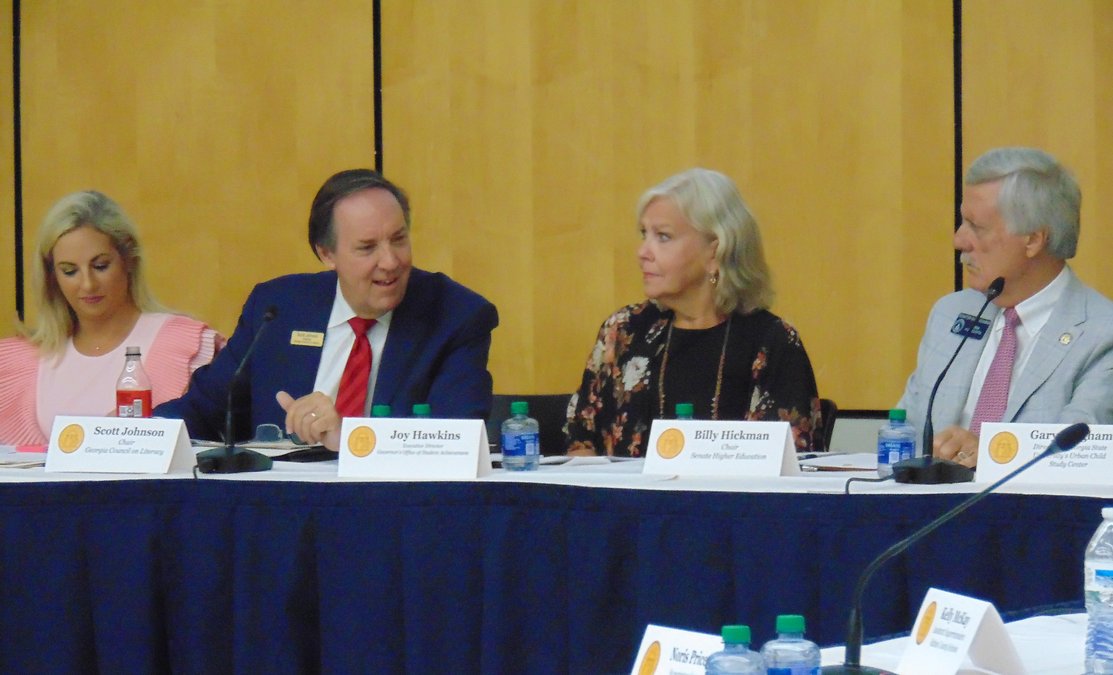
The 30-member Georgia Council on Literacy – created by the state to monitor and drive forward a mandated overhaul of reading instruction in the public schools – came to Statesboro, and specifically the Nessmith Lane Conference Center at Georgia Southern University, on Monday for its first in-person meeting.
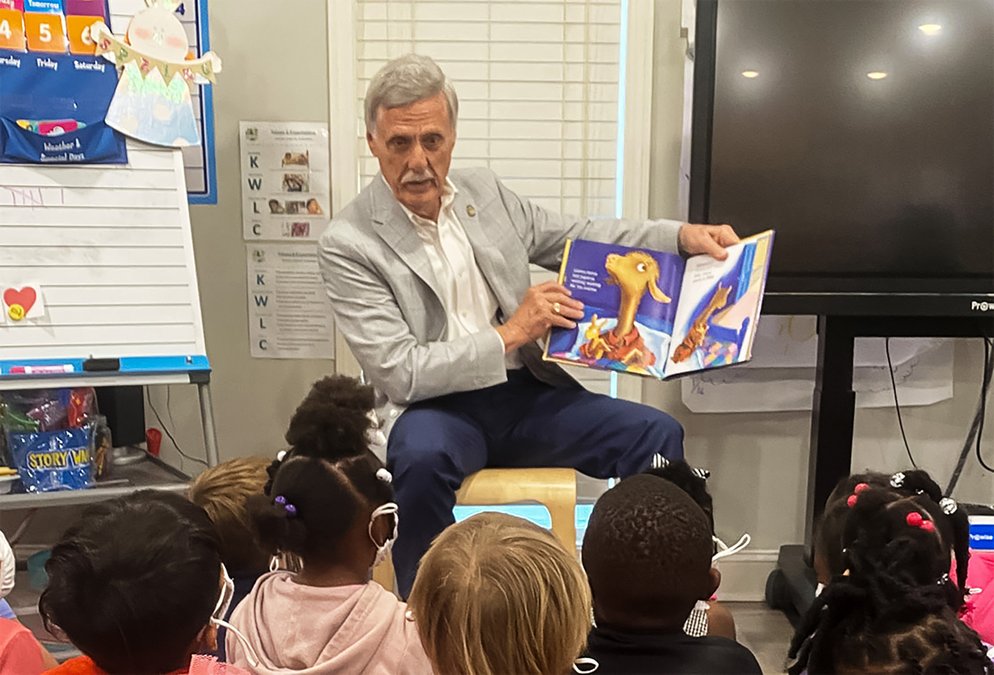
State Sen. Billy Hickman, R-Statesboro, lead sponsor of Senate Bill 211, which formally established the council, said visits he made to children in area schools, such as one in Metter last December with Candler County Schools Superintendent Bubba Longgrear, convinced him of the need.
Hickman had asked to meet a top student, a middle student and a lower-performing student in fourth grade, without regard to race or “what type of car their mama drives,” he said, and wanted them to read their favorite book to him.
“And let me tell you, people, if you believe our children can read, you need to go listen to three children at these levels,” Hickman said Monday. “You’ll learn very fast that two-thirds of our children in these grades are not reading on grade level.”
When children haven’t learned to read by fourth grade, they usually struggle to become proficient readers later, several speakers noted Monday.
Longgrear is now one of several county school superintendents serving as Council on Literacy members. Hickman, who chairs Georgia’s Senate Higher Education Committee, is one of 10 state legislators on the council, also including the chairs of the Senate Education and Youth Committee, Senate Appropriations Committee, House Education Committee, House Higher Education Committee and House Appropriations Committee – all Republicans – plus two Democrats from the House and two from the Senate.
Other council members include local board of education members from various counties; a State Board of Education member; the state librarian, who is also a University System Board of Regents vice chancellor; literacy advocates; some early childhood education professors; and other individuals with “knowledge, skills and experience in literacy or dyslexia education,” as called for in the law.
One of the literacy advocates is Share the Magic Foundation founder Malcolm Mitchell, a University of Georgia graduate and former football player who has authored several children’s books. Drafted into the NFL in 2016, Mitchell played for the New England Patriots when they won the 2017 Super Bowl.
Two new laws
Senate Bill 211 called for Gov. Brian Kemp, Lt. Gov. Burt Jones and state Speaker of the House Jon Burns each to appoint Council on Literacy members fitting certain descriptions. Kemp designated Scott Johnson to chair the council. Johnson previously served 10 years as a State Board of Education member, through 2022, including a two-year term as its chair.
“Folks, we’re about to tackle Georgia’s most solvable problem,” Johnson told the council members Monday.
Senate Bill 211 is a companion piece to House Bill 538, the Georgia Early Literacy Act, which Kemp also signed into law earlier this year. House Bill 538 mandates training in “appropriate evidence-based literacy instruction” for some early child care providers, training on “the science of reading” for all public school kindergarten through third-grade teachers, and the use of “universal reading screeners” – in other words, standard assessments – to check the reading ability of students in those grades multiple times each year.
The legislation’s stated goals are “that all students read on grade level by the end of third grade” and “to create a literate workforce and ready citizenry.”
“It matters for their future. It matters for our state’s future,” Johnson said. “It’s an education issue, but it’s also an economic development issue, it’s a national defense issue, for our children to be proficient in reading when they leave the third grade. We know when we fail to do that that illiteracy leads to crime, arrests, prison and social dependency.”
Science of reading
To some people, the phrase “the science of reading” suggests a historic break from the “whole language” approach to reading instruction that was in vogue 10 to 20 years ago toward a renewed emphasis on phonics and spelling. “Whole language” emphasized learning to read whole words by sight, guessing at new words and writing words before learning to spell them.
“Perhaps by now you’ve heard of the science of reading, an interdisciplinary, decades-old, ever-growing body of research focused on how the brain learns to read,” Ryan Lee-James, a speech-language pathologist and director of the Rollins Center for Language and Literacy, addressed the council.
“From this research we know definitively that children require explicit, systematic, diagnostic and cumulative instruction if they’re going to read, spell and write well,” she said. “However, methods and programs that have been debunked continue to be used throughout our nation’s schools and even in our own state. The whole language approach to teaching reading is based on inaccurate theories and hypotheses about how the brain learns to read.”
Indeed, House Bill 538 lists “phonological” and “phonemic awareness” and “phonics” among the “foundational literacy skills” to be taught. But it also lists “fluency, vocabulary, reading comprehension, spelling, oral language and the intersection of reading and writing.”
Phonics in Bulloch
An attempted return to phonics instruction isn’t a new thing, at least not in the Statesboro area.
“Phonics instruction has been something we have struggled with as a school district for over 10 years, and we have to consider what the kids need and what isn’t working for students,” Teresa Phillips, the Bulloch County Schools assistant superintendent for school improvement, said in an interview.
She was one of dozens of school system staffers from the surrounding counties who, although not members of the Literacy Council, attended its meeting, which also included a “community table” discussion.
Over those years, Phillips said, Bulloch County’s teachers and administrators have had many conversations and looked at data, watching trends and patterns to see what gets results and what doesn’t. Now the Bulloch schools are narrowing the list of phonics programs approved for use in the district.
This year, the school system is implementing a new phonics structure, developed by teachers for UFLI, the University of Florida Literacy Institute, for all kindergarten classes across the county.
Deadlines in law
The Georgia Early Literacy Act sets a deadline of Jan. 1, 2024, for the Georgia Department of Education a to approve “high quality instructional materials” for kindergarten through third-grade reading, followed by an Aug. 1 deadline for the department to publish a list of approved reading screeners. Local school systems will be required to administer the screeners three times a year.
All kindergarten through third-grade teachers, as well as teachers in state licensed or commissioned preschool programs, are required to complete a training program in “developmentally appropriate evidence-based literacy instruction” by July 1, 2025.
Local initiatives
The Bulloch County Schools have received a $50,000 Capacity Building Grant from the state and purchased professional learning modules for teaching teachers in every elementary school approved methods for teaching reading, Phillips notes. The school system also has a consultant serving as a reading coach to those schools.
Other aspects of House Bill 538 require training in “the science of reading” for students in colleges of education studying to become teachers.
Senate Bill 211 gives the Council on Literacy specific responsibilities for monitoring and reporting on these things and coordinating efforts of the state agencies involved, but will abolish the council on Dec. 31, 2026. The law also mentions adult literacy efforts as a topic of study, without giving specifics.
Crystal Simpkins, now in her third year as the Bulloch County Schools early learning and literacy director, noted that the district’s “book bus” promotes literacy to families.
“The bus goes out into the community to deliver books to children as well as give resources to parents on the importance of early literacy and brain development and what they can do,” she said in an interview.
Simpkins works with a Bulloch County Literacy Council, made up of volunteers from several local organizations, who meet monthly to discuss reading initiatives. The council has encouraged creation of “reading nooks” in businesses and similar location.
In brief remarks to the council, Bulloch Schools Superintendent Charles Wilson said the council has placed more than 20,000 books in the community.
The school system received a $125,000 grant from the Georgia Department of Early Care and Learning for these efforts and is also providing professional development training in reading instruction to prekindergarten teachers, Simpkins reports.
“We’re kind of ahead of the game, and we’re proud of that, but we’re right on board with what Senate Bill 211 and House Bill 538 are seeing for the state of Georgia,” she said. “We are proud to say that we’re already doing some of the things that they’re looking at doing, so we look forward to just pushing our literacy efforts ahead.”