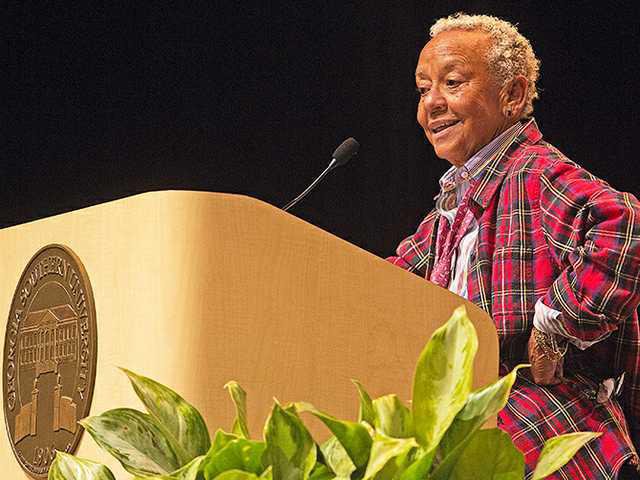
Nikki Giovanni, one of America’s most well-known poets, spoke at Georgia Southern University last week. Besides reciting a few of her poems, she made comments touching on feminism, presidents, writing, race, sex and – believe it or not – space exploration.
Students made up the largest portion of the near-capacity crowd inside the Performing Arts Center, where Giovanni was featured speaker Wednesday evening for the university’s Martin Luther King Jr. Celebration.
Both there and in an interview that afternoon, Giovanni volunteered her age, 73, as a license to say what she pleases. That’s not to imply that Giovanni, often described as an activist as well as a poet, has held back much between the publication of her first poetry collection, “Black Feeling, Black Talk,” 49 years ago, and “A Good Cry,” due out in October.
Appalachian advocate
Giovanni, University Distinguished Professor at Virginia Tech, touted the virtues of black women as the exemplary nurturers of humanity, but also spoke highly of the white people of Appalachia.
“Those are great people, and it makes you sad to look at what somebody like a Donald Trump has done to bring out the prejudice, because these people, they’re not necessarily prejudiced, and Trump has encouraged that, and I think it’s too bad,” Giovanni said in the interview.
Although she grew up in Cincinnati, Ohio, Giovanni was born in Knoxville, Tenn. She attained her bachelor’s degree in history at Fisk University in Nashville before attending graduate school at the University of Pennsylvania and Columbia University. She has taught at Virginia Tech in Blacksburg for 30 years.
She used the Appalachian Trail figuratively to refer to the region, from Alabama to Maine.
“I’ve always said it, but it’s true, if you were black and you were on that Appalachian Trail, and your car broke down, somebody would stop and help you, because they’re good people,” she said. “If we go back in history, if you were a runaway slave, as we know, they would protect you.”
Now, with the region’s coal industry gone, Giovanni said, many Appalachians wonder how they will fit into the future and what the nation is doing for their children and grandchildren.
“I think that a lot of people have taken the greatness of their history and given them hatred for it, and I think that’s sad,” she said.
Two days before President Trump’s inauguration, Giovanni expressed her agreement with Georgia Congressman John Lewis in his nationally reported assessment of Trump. Before his time in Congress, 30 years so far, Lewis was already famous for his role as a young leader in the civil rights movement of the 1960s, during which he was repeatedly assaulted while taking part in demonstrations.
“I have to agree with John Lewis … that Trump was an illegitimate president, so I don’t have a problem with what elected him, because he wasn’t elected,” Giovanni said. “We know that Hillary Clinton was elected; we know that Trump stole the election.”
But when the reporter pressed her for contrasting views of then outgoing President Barack Obama, Giovanni expressed indifference to his administration.
“I’m really sorry now that Obama won’t stand with John Lewis, because John Lewis is a great man and Obama now was just President 44,” she said. “There’s only one John Lewis.”
Obama, Giovanni said, did not come to Appalachia to talk to the people there about his dreams or their concerns.
Presidents, she said, “don’t give a damn about a poet. I don’t give a damn about a president. There’ll be another one.”
Guns and evil
Giovanni’s most infamous student was Seung-Hui Cho, who murdered 32 people and wounded 17 others in the mass shooting at Virginia Tech in April 2007. As stated in news reports at the time, Giovanni had tried to warn authorities about Cho and had had him removed from her class because of his behavior and the violence expressed in his writing.
Asked in the interview how she feels about guns, Giovanni suggested a government program to buy them all, take them somewhere in the middle of the country, like Kansas, and melt them.
“We’ll let the sculptors come and get what they need from that and they can make something of it,” Giovanni said. “They can make a piece of sculpture, they can make something wonderful out of it. Let the artists have it.”
But she supports the death penalty at least in some cases, particularly for Dylan Roof, recently convicted and sentenced to die for murdering nine African-American worshippers in the June 17, 2015, mass shooting at a church in Charleston, S.C.
“I want to see him dead,” Giovanni told the audience at the PAC.
“I’m a Christian, so I’m a fan of good, but I’m also a recognizer of evil,” she had told the reporter. “Mr. Cho was evil, and everybody tried to say, ‘Maybe he’s just having a problem.’ I don’t know what he had. But Mr. Roof, Dylan Roof, is evil. That murderer in Orlando is evil. To go someplace and just kill some people is evil, and I think we’re going to have to recognize evil.”
Fan of black women
Giovanni’s comments on stage were generally more upbeat, and often punctuated with humor.
“I’m a black woman fan, because black women, I think, are God’s greatest gift to humanity,” she said, interrupted by cheers and the beginnings of laughter.
The laughter increased when she added, in a tone of mock humility, “There’s nothing as wonderful, is all I’m saying, as we are.”
Black women, Giovanni said in all seriousness, tried to comfort their people while they suffered and died in the holds of slave ships during the Middle Passage, then set about building community, while enslaved, in a land they hadn’t chosen.
Advocating that young women consider careers in space exploration, she said black women would be best to build community on Mars.
White men, Giovanni commented, amid more laughter, cheers and applause, would just go up there and shoot something.
“Whatever space means to any of us, it’s going to be black women that are going to claim it for the rest of us,” she said. “We have an obligation to love, and black women do that so beautifully.”
She advised students to have good sex lives.
“What is college about if it’s not about that?” she said, laughter filling the entire acoustic space.
Actually, Giovanni advocates for universities being about much more, and not just about preparing people to work.
“Universities are here to allow you, like any other seed, to grow,” she said in the interview, explaining the advertised theme of her talk, “The Right to Dream.”
Parks and King
On stage, she advised writers to forget what they have written previously, so as not to repeat themselves. Her poems she shared included “Cotton Candy on a Rainy Day,” “Deal or No Deal,” and “Rosa Parks.”
Giovanni knew Parks personally. Several lines of the poem begin “This is for the Pullman Porters …,” saluting the black men employed on early 20th century passenger trains for their role in protecting black children in transit and distributing news to African-American communities. The poem concludes with Park’s famous refusal to give up her seat on a bus.
After Giovanni was reminded to wrap up in time to take answer some student-submitted questions, she recited one last poem, “In the Spirit of Martin,” a tribute to King.
Her own sentimental favorite among her books, she said, is “Chasing Utopia,” written during her mourning process after her mother, sister and an aunt died a few weeks apart a decade ago. Giovanni’s upcoming “A Good Cry” contains poetry, prose and recipes.
Herald reporter Al Hackle may be reached at (912) 489-9458.