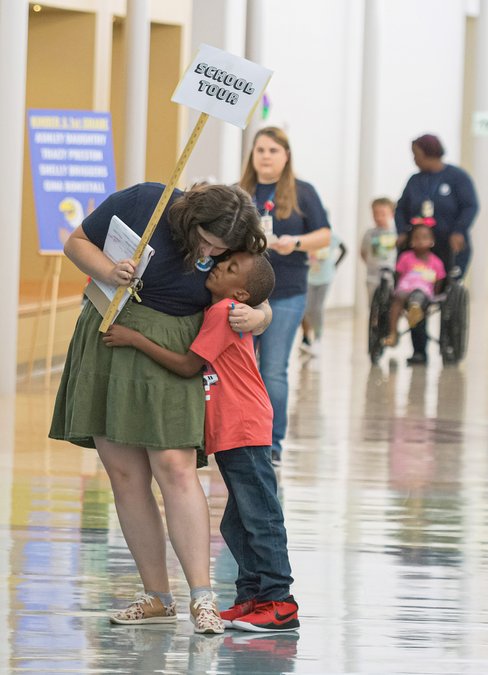
Bulloch County Schools started classes Monday for what is envisioned as an almost completely back to newest-normal, post-pandemic school year. Some emphasis on attendance is even being restored for the school district’s expected 11,000-plus students, 10,787 of whom showed up the first day.
“We’re encouraging attendance because re-establishing that work ethic with our students is really important,” said Superintendent of Schools Charles Wilson. “At the same time, we don’t want to people to come to school if they’re sick or to come to work if they’re sick, so this really is more of a common-sense sort of follow-through.”
At this point, no COVID-specific protocols remain, and the schools are not doing contact tracing or special reporting of cases. The schools are addressing it as a “normal sickness,” and students should stay at home when they are sick and see a doctor when needed, he said. But with COVID-19 still around in a usually milder or now more treatable form, that renewed emphasis on being present may not include the return of perfect attendance awards this year, if ever.
“I think that’s sort of an antiquated concept that we need to just sort of let go to the wayside, because if you stress that you have people encouraging, inadvertently, sick children to come to school,” Wilson said. “Perfect attendance is not the award we want to focus on. We really are more interested in the growth that our students receive, regardless, but we also know you need to be here to be able to learn.”
‘Focused forward’
In the lobby of Mattie Lively Elementary School at 9 a.m., Wilson was asked the time-honored question, “What’s new this school year?”
“Well, the first thing is a refreshed perspective, and focused forward instead of worrying about what’s behind us,” he said. “Now, another thing that’s new, though, in that refreshed perspective … is dealing with, I’d say still the damage that’s been done to our students through all of the things that occurred, whether it’s social and emotional, psychological, whether it’s physical wellbeing or it’s the focus on academics.”
The schools are left to help families address the needs of children who have fallen behind or did not get the support they needed, he said.
“That puts a big challenge on all of our teachers and our schools because the needs are so much greater now, but we’re doing a lot of support from the district level,” Wilson said. “We’re equipping our teachers with the skills and the capacity to be able to work through the needs. We’ve contracted with a lot of counseling agencies for the needs of the students that get beyond just what a school counselor can provide.”
Guided reading
At the elementary schools there is a push to help children catch up on reading skills that will be important for the remainder of their school years and in life.
“Our focus is making sure that we’re moving our kids forward in regards to reading,” said Mattie Lively Elementary School Principal Al Dekle. “We have a reading initiative called guided reading, and we’re making sure we’re meeting kids where they are.”
In the school system’s “multi-tiered system of supports,” this is a Tier 2 approach, for students who need some extra help in small groups. Tier 1 is regular classroom instruction and guidance directed toward all students, while Tier 3 programs are individualized for students needing the most help.
Monday’s interviews were part of a tradition in which the superintendent greets reporters at one of the 15 schools the morning of the first day. Interviews with that school’s principal are also available, and Dekle remained in the lobby as a few children were still arriving with their parents after 9 a.m.
But the school on the north side of Statesboro had been open for children to be dropped off since 7:20 a.m. before the regular start time of 7:50, and Dekle reported “a very smooth opening” with “no major hiccups.”
After requesting a classroom visit with a teacher involved in guided reading, the Statesboro Herald asked kindergarten teacher Shelly Driggers how the pandemic years affected children’s readiness for school and for reading.
Building trust
Driggers, who is working this year with paraprofessional Monica Powell to meet the needs of 19 kindergarten students in their regular classroom, has about 30 years experience as an educator, including 17 years now teaching kindergartners at Mattie Lively Elementary.
“Fortunately, children are very resilient, and most children are like sponges and can catch up pretty quick,” Driggers said. “There was more of a delay in emotional and social. There was some academic for sure, but academic is usually pretty easy to fill in. But when a child has missed some social growth, interacting with other children, that is actually the harder obstacle to overcome.”
Teachers have had to deal with “a lot of trauma,” including even “kids that didn’t have food,” before moving them forward in academic learning, Driggers said. After doing a lot of research and reading, she has come to make trust and predictability her classroom priorities.
“I have got to realize that until a child trusts me, academics really are not ever going to set in, so I have to put a lot of time into building trust,” Driggers said. “As crazy as it sounds, I don’t miss work because I want them to see me every day. You know, I just try to be here, I keep the same exact routine. I want their life when they walk in here to be as predictable as possible.”
She uses visuals, such as a schedule board that has movable vinyl pictures as well as words, to help make each day’s activities predictable for children who are learning to read at different paces. She keeps food items, such as a bowl of fruit, in reach to reassure those who have missed meals in the past.
In guiding reading, she guides children through reading materials designed for their differing reading levels, as determined by assessment and observation. The school system provides teachers training in this approach throughout the year.
Hires and vacancies
Although most Bulloch County Schools teachers, and this year all principals, returned to the same schools as last year, the school system welcomed 225 newly hired employees, including 70 teachers new to the system, this summer.
Not all school bus driver vacancies were filled. Over the last five years the Bulloch County Schools have been short from five to 30 drivers at any time. As of Monday, there were 22 vacancies for bus drivers, with some driving double duty to cover the county’s 99 routes, Greene reported after talking to BCS Transportation Director Janet Tanner.
The school system’s efforts to attract and hire more bus drivers will be reported in a later story.
Also new are athletic complexes at William James Middle School and Langston Chapel Middle School. Paid for with Education Special Purpose Local Option Sales Tax proceeds, the complexes were built by Dabbs Williams Contractors for a total of $5.25 million. Each includes six tennis courts, a combined football-soccer field, softball field, baseball field, concession and restrooms.
Except for continued work on baseball fields, which aren’t needed yet, and issues regarding the readiness of the tennis courts, the complexes were nearly done by the start of the school year, and the softball fields had already been used for practice, Wilson said.