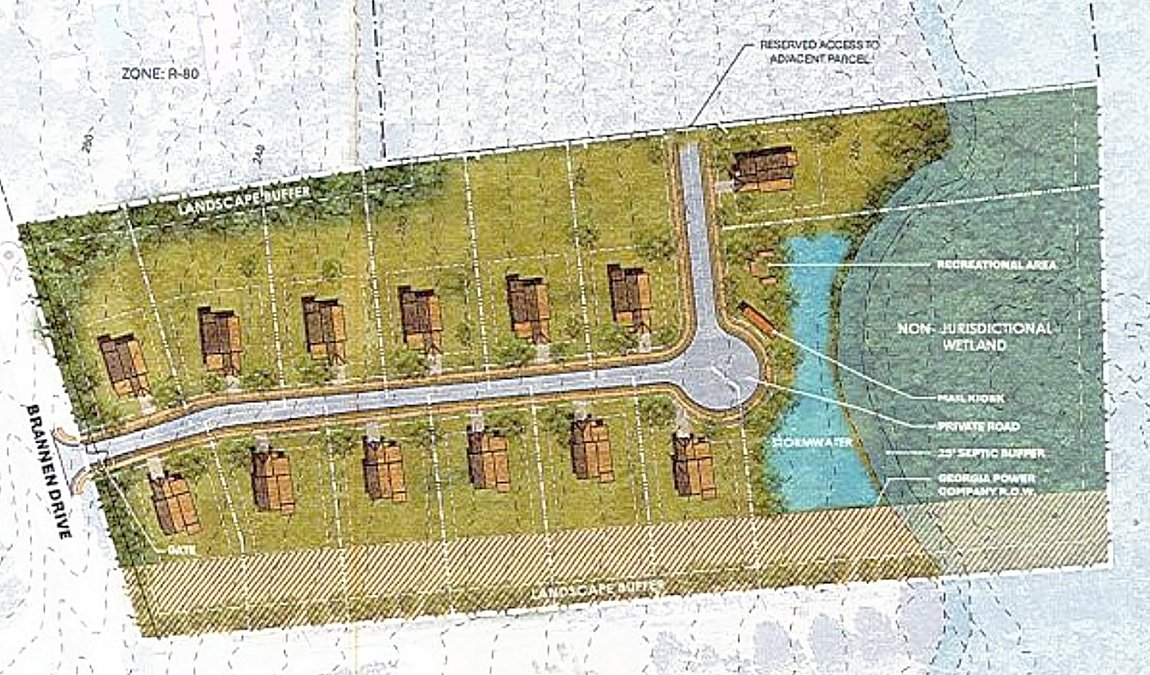
By a 4-2 vote, the Bulloch County commissioners last Tuesday approved rezoning for a subdivision which will now be limited to 10 houses in what officials identified as an already residential area. But proposed development of the site met opposition from neighbors every step of the way.
The 10.5-acre tract at 424 Brannen Drive, just west of Statesboro, was already zoned R-80, a residential classification requiring a roughly 80,000-square foot (about 1.84 acre) minimum lot size, which would have allowed about five houses. This time around, owner Janet Lanier applied for rezoning to R-25 (minimum lot size around 25,000 square feet). In early January, Lanier had a letter of intent submitted by Grace Wooten of Pape-Dawson Engineers stating that rezoning to R-25 would allow for a single-family home subdivision with plus or minus 13 lots “with the intent of a private road and gated community.”
Previous incarnation
But proposals to develop this same property – and some community opposition to them – go back at least a couple of years. In the autumn of 2024, Kyle Hadden’s request was for a change to R-3 “multifamily” zoning to allow for 47 townhome units in eight main structures. According to Nov. 7, 2024 Board of Commissioners minutes, opposition speaker Stacy Webb said that more than 85 citizens had signed a petition opposing that development. Three other people spoke in opposition before commissioners voted 5-0 to deny that one.
So, Lanier’s 2026 request, as presented to the commissioners by Wooten on March 3, was much reduced in density from the 2024 proposal. But a number of the same area residents turned out in opposition. One concern, voiced by Webb and others, was that approval of this subdivision with a proposed access road would provide access to a neighboring property zoned R-2 for townhomes, thus allowing denser development. But county officials noted that owners could build an access road and develop the R-2 property regardless of the zoning of Lanier’s neighboring tract.
March postponement
But the appointed Planning and Zoning Board on Feb. 17 had voted 5-1 to recommend denial of the request. Then the elected Board of Commissioners – after hearing from Wooten and concerned neighbors on March 3 – postponed making a decision, instead asking the would-be developers and the neighbors to talk and try to work something out. A suggestion to approve the change to R-25 but with a restriction to 10 single-family home lots was heard in the March 3 meeting before commissioners moved on.
That was still the proposal when the request arrived back before the commissioners at the Tuesday evening, April 7, meeting. But the county staff had made the restriction to 10 home lots a fifth formal condition to be applied to the development if the rezoning was approved, Planning and Development Director James Pope reported.
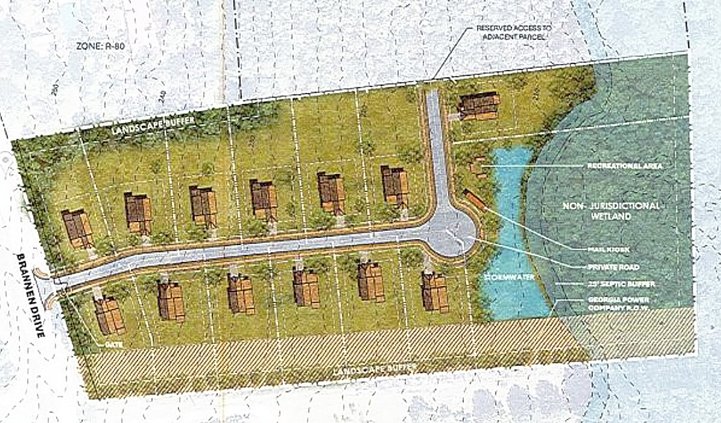
A site plan illustration submitted by the developer Monday, April 6, still showed 12 lots, Pope acknowledged, as this slide was displayed on the screens. In his brief introduction, he also noted several variously zoned residential areas that surround Lanier’s property.
‘Among neighborhoods’
Local attorney Andrew Lavoie also emphasized this as he now spoke to the commissioners on behalf of Lanier and her rezoning application. He said the property will be developed by experienced developer Kelly Lanier, with the goal to create “a picturesque place to live for folks to live and raise their families”
“As we see it, this application if it’s approved would make way for what I consider a neighborhood among neighborhoods,” Lavoie said.
He handed the commissioners, via their clerk, pages that included a little zoning map of the surrounding area.
Neighboring the parcel to the north is the Westbrooke Townhomes tract, zoned R-2 but not yet built out.
A little south of the property is Lancaster Point, which is zoned R-80 but, Lavoie said, already contains 13 developed lots. Across Brannen Drive is Wimbledon subdivision, zoned R-25, reportedly also with 13 lots. South of Wimbledon is Country Squire, zoned R-40, with 14 lots, and south of that is Hazelwood, the large R-25 development with more than 120 lots.
“And that’s actually what the Comprehensive Use Plan contemplates for this part of the county; it’s ‘Suburban Neighborhood’ development,” he said. “That can be as dense as R-2, and actually R-40 and R-80 aren’t part of that Suburban Neighborhood classification. So if anything, we think the Comprehensive Use Plan considers or contemplates this type of zoning in this area… as dense as R-2 (but) can go all the way up to R-25, which is what we’re asking for here.”
Lavoie also asserted that with the previous R-80 zoning the owners could have built “five or six lots … and then of course an access road to let folks in from Brannen Drive.”
The actual limit would have been four or five lots, according to net and gross “estimated lot yield” figures in the county’s report, so the zoning change as approved doubles the capacity.
Lavoie called it “just a handful more” lots than were allowed with R-80, and noted that it would be fewer than in each of the surrounding subdivisions.
He reported that the Laniers agreed to the 10-lot limit and all of the other conditions recommended by county staff.
Opposition speakers
Webb was the first of three people who signed up to speak in opposition.
“While we have no issue with the Laniers’ right to develop their property as it is zoned, we don’t believe that rezoning is a right,” Webb said. “We believe that rezoning is an opportunity that is weighed by the commissioners as to what is good for the property owner as well as the surrounding neighbors and their property, and in this case we believe that rezoning will have several negative impacts for our communities.”
He reiterated eight “areas of concern.”
These included assertions that the increase in housing density 1) was not needed; 2) was not compatible with the county Comprehensive Plan; and 3) would be “precedent setting.” Further, he alleged the development would have 4) negative fiscal impact on the county; 5) contribute to police protection shortages; 6) traffic safety issues; and 7) ground water, water runoff and well pressure issues.
Concern 8 that this development will lead to “duplexes next door,” meaning development in the R-2 area, raising more of the same issues, Webb said.
He asked the citizens attending the meeting who were opposed to the zoning change to stand, and about 20 stood up.
Opposition speaker Shelly Rountree had brought commissioners an “information package” in March. Part of her expressed concern was that the homes would become rental housing rather than owner-occupied. She included photographs of a pair of same-age residences, one in visibly better repair than the other.
“And that’s what happens when you have owners versus renters, and single-family versus denser,” she said.
The one other listed opposition speaker was David Seaman. Ben Buie signed up as “undecided” but expressed concerns. After some brief rebuttable remarks by Lavoie, the question went to the commissioners.
Commissioners vote
Commissioner Timmy Rushing noted that R-40 zoning had been suggested as a compromise between R-80 and R-25.
“You could get the 10 houses on R-40 instead of R-25, and me and a couple more commissioners had some phone calls from people out there who said they were fine with that, and then James (Pope) brought to our attention that the wetlands hadn’t been delineated, so therefore, the best way we could all see to do it was put the number of 10 houses on it.”
Commissioner Ray Davis again alluded to a regional housing needs study, completed by the Center for Economic Development Research, or CEDR, at Georgia Tech more than a year ago, which suggested Bulloch County faced an eight-year "housing deficit" of 7,815 home units. But Pope reported last August that a larger number of units, more than 8,000, were under construction or “in the pipeline” for county or city approval. The units range from house lots to student apartments.
This “shows that we have a surplus of housing,” Davis said. “Every house that’s built has a potential to create a tax increase. Now I realize that four or five houses is not that great of a potential, but I stand on the principle of more houses is potentially a tax increase to the voters of this county.”
Rushing made the motion to approve the R-25 zoning with the condition of no more than 10 houses and the previous four conditions. Commissioner Anthony Simmons seconded. The motion passed with Davis and Commissioner Nick Newkirk voting “no.”
Other conditions
The other four conditions are requirements for 1) a playground or other amenity in a “pocket park or open space,” 2) all structures to be “site-built conventional construction” to state building codes, with no manufactured structures, 3) each lot to have at least one tree of a certain minimum size when planted, in the front yard, with a “diverse mix of tree species” used throughout the subdivision, and 4) the internal road and pedestrian zone or sidewalk system to be privately owned and maintained by a “common interest element.”