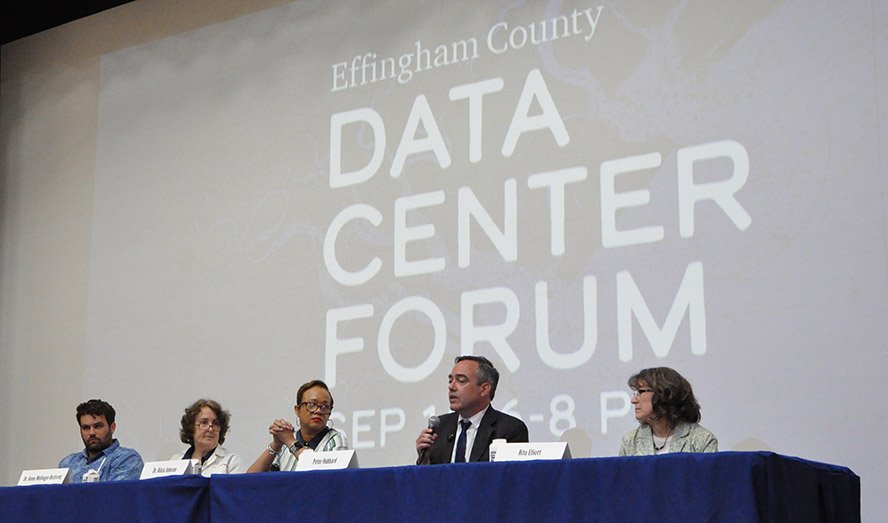
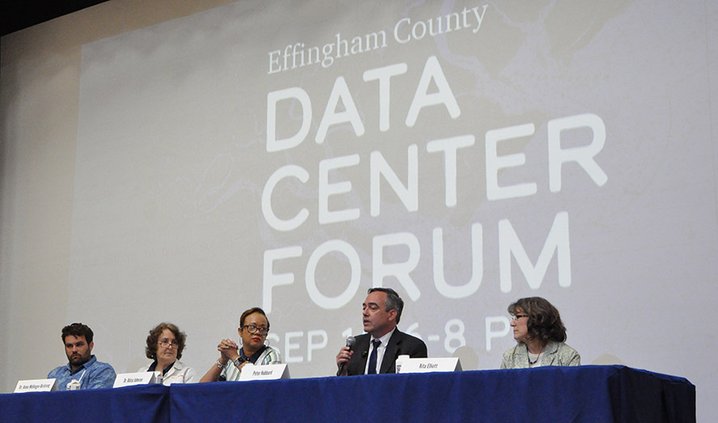
About 100 Georgians gathered at the Mars Theater for a data center town hall Sept. 14, where Georgia Public Service commissioners and environmentalists urged residents to press elected officials and developers for stronger protections as a major data center project moves forward in Effingham County.
Hosted by Georgia Conservation Voters, the meeting was structured as a Q&A allowing attendees – some traveling from around the state – to ask questions about data centers. Panelists emphasized the need for more regulation both across the state and locally to ensure promises made by developers to protect communities become legally enforceable requirements.
The discussion comes as OpenAI moves ahead with Project Camellia, a planned data center campus at the Savannah Gateway Industrial Hub in Effingham County. OpenAI announced in July that it is contracting with Georgia Power for 3.2 gigawatts of power, to be delivered in phases from 2028 through 2032. The company has also pledged $80 million in community benefits and says it will pay the full cost of infrastructure and electric service required for the project.
Alicia Johnson, a member of the Public Service Commission, told attendees that Georgia's approach has largely left local governments responsible for deciding how data centers should be regulated.
“We are seeing the proliferation of data center infrastructure in our state because of the current Republican governor's policy,” Johnson said, Monday. “He believes that we should be on the forefront of this AI bubble and tech bubble that's currently happening in our country. As a result we have given data centers tax breaks to come to our state. What we have not effectively done is put in any statewide framework that regulates or puts guard rails on them.”
Panelists called for Georgia to place stronger regulation, covering issues such as water, air quality, energy use, land use, noise, community benefits and decommissioning. Without such standards, Johnson said, counties and cities may be forced to negotiate individually with companies that have substantially greater financial and technical resources.
Panelists agreed stronger data center ordinances were needed at the local level as well.
Johnson said she provided Effingham officials with a model ordinance, in July when the PSC was given OpenAI’s contract, containing more than a dozen provisions, including water stewardship, community benefits, land use and decommissioning.
OpenAI's publicly announced commitments include annual independent audits, noise studies and mitigation efforts, minimal ongoing water use through a closed-loop cooling system and $80 million in community benefits.
“Our biggest issue from our organizational perspective is that none of those currently exist in the zoning ordinance,” Jeffrey Beauvais, a coastal advocate for nonprofit One Hundred Miles, said. “Everything that we have been told is a promise after the fact and I don't trust promises until I see them. It would be a lot better if the strong ordinance existed first, rather than hoping that this company will stick to the promises that they have.”
Beauvais urged residents to continue advocating even if a project appears inevitable.
“Nothing’s over until that thing is actually put in the ground,” he said. “Fatalism is the worst enemy of advocacy.”
He also called for stronger penalties, saying fines such as Port Wentworth’s $500-a-day noise violation penalty, are insignificant to companies with vast resources.
Peter Hubbard, a PSC commissioner, addressed questions about electricity demand, backup power and potential noise. He said the environmental and community effects can vary significantly depending on the technologies ultimately installed.
OpenAI developers have said it will have battery storage as backup, rather than diesel generators, once construction of the data center campus is complete.
Hubbard said batteries generally produce less noise and air pollution than gas-fired generators but can pose fire risks.
“You can’t throw water on an electrical fire,” Hubbard said. “You have to train up your local fire departments on how to respond.”
Hubbard also discussed how renewable energy can support hyperscale data centers. He said OpenAI has committed to exploring renewable projects in Georgia’s existing pipeline and other portfolios, while also paying for its power and infrastructure.
“There are lots of really smart solutions out there,” Hubbard said.
Hubbard said the site’s wetlands limit the amount of solar that can be built directly on the property, but battery storage and other alternative generation could be used. He said renewable projects could also be located elsewhere and connected through existing transmission infrastructure. Hubbard said he has not yet seen the proposed transmission corridor and is awaiting more information from Georgia Power.
The town hall ended with a broader discussion of political accountability and long-term planning. Speakers urged residents to examine the decisions of county commissioners and economic development authorities, as well as state policymakers responsible for Georgia's broader approach to data centers.
Panelists encouraged attendees to vote in November.
“We are now becoming the fastest growing data center capital of the United States in Georgia,” Johnson said. “How you decide that is about who you put in office, right? And who writes your public policy and who votes on your public policy. You get to answer those questions in November.”
Lucille Lannigan is a growth and development reporter for Morris Multimedia.