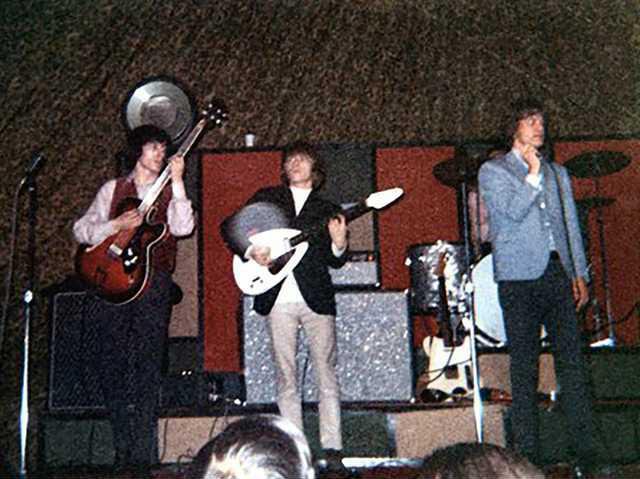

For Jim Hilliard's full, unedited account of the Rolling Stones concert at Georgia Southern, see the full article here.
It’s 9:20 p.m., May 4, 1965 — 50 minutes behind schedule.
The huge, overflow audience in the Georgia Southern College Hanner Gymnasium is restless. The waiting members of the starring band are agitated at a near hour-long delayed entrance on stage. Few things were going as planned, but the moment, finally, was at hand.
A large cargo parachute, borrowed from somewhere, serves as a curtain blocking the view of an audience estimated to be more than 3,500 concert fans. The seating capacity of the gym is half that number. Standing room can barely be found.
On cue, the ropes holding up the cargo parachute are loosed and it drops to the floor just as fraternity
member and master of ceremonies, Ricky Murray, shouts into the microphone: “Ladies and gentlemen, the Rolling Stones!”
The noise is deafening as the original Stones lineup of Mick Jagger, Brian Jones, Keith Richards, Bill Wyman and Charlie Watts hit the stage.
Story behind the story
At that moment, 50 years ago, what is now known as Georgia Southern University became the first American college campus to host an appearance by the hugely popular British rock band.
The performance that night is what is remembered most about the story of the Stones appearing at GSC, but there is so much more to this unlikely tale of a major world attraction finding its way to a small southern Georgia college campus.
I’m Jim Hilliard, but in 1965, everyone called me Jimmy. I signed the contract booking the Stones on behalf of Sigma Epsilon Chi Fraternity for a concert on our campus.
The beginning
The summer of 1964, I became friends with a Waycross, Ga., radio disc jockey by the name of Johnny “Bee” Mosses, who became well known for sponsoring concerts and dances in South Georgia.
Because of his work booking bands, Johnny Bee was connected with other booking agencies, one of them located in Atlanta and owned/managed by a fellow named Jack Martin.
I was told by Johnny Bee that the Rolling Stones would tour the U.S. in the spring of 1965 and were available to play at Georgia Southern on May 4.
“Would we be interested?” Johnny asked.
Only the Beatles were a more popular rock and roll band than the Stones at that time so, of course, I was interested.
I went through the Jack Martin Booking Agency in Atlanta to procure a contract. Jack, in person, confirmed the Stones would be available May 4 so I asked him to go ahead and “ink” us in for that date.
Forming a fraternity
When I proposed that Phi Mu Alpha sponsor the Rolling Stones in concert the idea was rejected. The long-haired rock group was emerging as the “bad boys” of British rock groups and neither the music fraternity nor the GSC music department wanted to be associated with their appearance on the GSC campus.
This decision led to several members joining me in leaving the fraternity in order to form a new brotherhood. A total of 14 of us met and agreed to form a new fraternity which would host the Rolling Stones.
Thus, Sigma Epsilon Chi fraternity, later to become Kappa Alpha, was born. Charter members were Curtis Farrar, Mike Nix, Virgil “Porky” Haynes, Jimmy Brown, George “Butch” Chambliss, Jerry Long, Carl Brooks, Ricky Murray, Albert Green, Holt Johnson, Robert Fullerton, Gilbert Peel, Buddy Wright and me. Johnny Bee was made an honorary member for his assistance to the fraternity.
The contract called for the fraternity to pay the band $3,000 for the appearance and half, $1,500, was due at the signing of the contract. As a new organization, we had very little money in the treasury so I visited First Bulloch Bank, opened our fraternity’s bank account, and then begged for a $1,500, six-month signature loan. I convinced the loan manager that my parents would be responsible for the loan if we could not repay it on time, and he approved the loan.
A long road to success
The first thing we had to do was secure a venue on campus. I met with Coach J.B. Scearce and asked if we could use Hanner Gym for the concert.
As I recall, the gym’s capacity was around 1,500 but we believed we could get around 1,800 inside. We figured if we could sell 1,800 tickets at $2.50 each then we would have enough money to pay the Stones, with some left over for other expenses.
Tickets were printed with a start time of 8 p.m. but later the schedule had to be changed to a 7 p.m. start time.
We met a great deal of resistance from various sources in the college community. The staff of the school newspaper, The George-Anne, was simply not interested in helping us promote the concert. I have often wondered why the George-Anne staff could not get beyond their prejudice against rock and roll.
Perhaps the most help in keeping the publicity alive for weeks and weeks came from Statesboro’s WWNS radio announcer Joe McGlamery (now president of the Statesboro Herald) who was a friend to the fraternity and did all he could, within reason, to promote ticket sales.
By early April we had sold around 700 tickets and paid off the bank loan, plus interest. Still, we were only half way toward having the money needed to pay the Rolling Stones.
All the preparations
Meanwhile, the fraternity agreed to a proposal by Johnny Bee, which featured, at a reduced rate, appearances by the Bushmen and the Roemans as opening acts for the Rolling Stones.
Later, I was approached by a local Statesboro band, “The Apollos,” made up of Statesboro High School students, begging to be allowed to kick off the concert. I thought if we allowed the local band to play, we might attract more high school students living in the area to the concert. I agreed to include them.
It was a decision I later regretted.
The Rolling Stones were expected to take the stage at 8:30 p.m. and play for at least an hour. The schedule I had set with the addition of a third front band was not realistic and it proved to be a fatal flaw in plans for the concert.
On Sunday, May 2, two days before the Statesboro show, many Georgia Southern students and people across the nation were in front of televisions, as the Rolling Stones appeared on the Ed Sullivan Television Show, the most popular show in 1965.
Advanced ticket sales were very brisk the following Monday and during lunch Tuesday, the day of the concert.
Picking up the Stones
Around 3 p.m. the day of the concert, fraternity brothers Jimmy Brown, Albert Green and Jerry Long drove to Savannah in separate vehicles to pick up the five members of the British band, their instruments, one female, said to be the wife of drummer Charlie Watts, and the band’s road manager, Ian Stewart.
“A few minutes down the road Mick asked to stop for eats,” Brown said. “I pulled off at the next place I saw. It was a restaurant attached to a motor lodge and looks very much like the Harvest Restaurant at the motor lodge.”
He added, “I do recall the restaurant being empty at 5 in the afternoon, except for a family with two young teen girls. They recognized the Stones immediately and became all giggly. The waitress had no clue who they were. I checked with Mick first, then went over to the parents and invited the girls over for autographs and photos all around.”
Crazy ticket sales
Meanwhile back at the gym, a few minutes before 6 p.m., I walked to the front of the gym to see how many people were in line to buy tickets. I was stunned to see a line of what looked to be more than 1,000 advanced ticket purchasers leading down the sidewalk toward the tennis courts.
The ticket sales booth was overwhelmed. To keep the line moving along as quickly as possible, buyers handed their money to the ticket sellers without receiving a ticket.
Dollar bills soon filled the collection boxes inside the booth and Porky Haynes, who was working inside, told of the floor being so covered in money that it was up to his ankles.
With the “curtain” up, the Apollos set up their amps, keyboard, and drums. It took longer than I thought it would but at 7 p.m. the curtain crew dropped the parachute as the band was introduced. They began to play and at 7:30, they didn’t want to stop. I had to ask for the parachute to be pulled up at the end of what was to be their final song.
According to Jimmy Brown, the Rolling Stones arrived on campus around 7:20 p.m. He noted the line to purchase admission still was up to Sanford Hall.
The only accommodations we had for the bands were the gym’s men’s locker room. The Rolling Stones went inside and joined members of other bands.
As soon as the Apollos removed their equipment the Bushmen began setting up their equipment. It was around 7:50 p.m. before the band began playing. We were already 20 minutes behind schedule.
Now, it was almost time for the Stones to come on stage and the Roemans had not even begun their set.
Earlier, I walked into the men’s locker room where the Stones were waiting to take the stage. I found their road manager and got a signed receipt for $1,500 in cash, the amount we owed to fulfill our contract.
The Stones were openly hostile at having to wait so long to take the stage. Guitarist Brian Jones had nearly finished off a bottle of something alcoholic and was ready to walk out, but the manager said they would play. I walked out of the room as bassist Bill Wyman gave me a most hated look.
The concert
It took barely five minutes for the Stones to set up. The only change Charlie Watts made to the drums was to reposition the snare drum more to his like. A couple of attempts were made to tune guitars.
The parachute dropped and the Rolling Stones began to play the first song. Immediately there was an issue with the PA system when a blown fuse cut out Mick Jagger’s voice. It stopped the show for a couple of minutes and further aggravated the Stones.
However, once the sound was restored they continued with a set of 10 songs, which did include their most recent hit, “The Last Time.” The audience broke out with its loudest shouts and cheers when they played that song.
The performance lasted about 30 minutes, not the hour I expected. But nothing could be done about it.
It was clear to the audience that the Stones were not happy to be onstage and they made no effort to do any more than play one song after another as quickly as possible. The audience did not respond well to the performance and at the end of their final selection the group simply unplugged their instruments and walked off stage.
Nearly everyone was stunned at the abrupt ending of the long awaited concert. No one was happy — not the audience, not the Stones, not the fraternity, and especially not me.
The concert ended up being a near disaster and it was my fault. I should never have added the third front band.
The abbreviated performance by the Stones did give cause for some immediate disappointment, but in the end it only mattered that the world famous band had appeared on stage at Georgia Southern and that Sigma Epsilon Chi had pulled off what could be considered the most unlikely big time entertainment event on a college campus anywhere.
Today
The Rolling Stones just announced a 15-city summer tour of the United States, starting May 24 in San Diego. Mick and the boys will be in Atlanta on June 9, playing Bobby Dodd Stadium.
For Jim Hilliard's full, unedited account of the Rolling Stones concert at Georgia Southern, see the full article here.