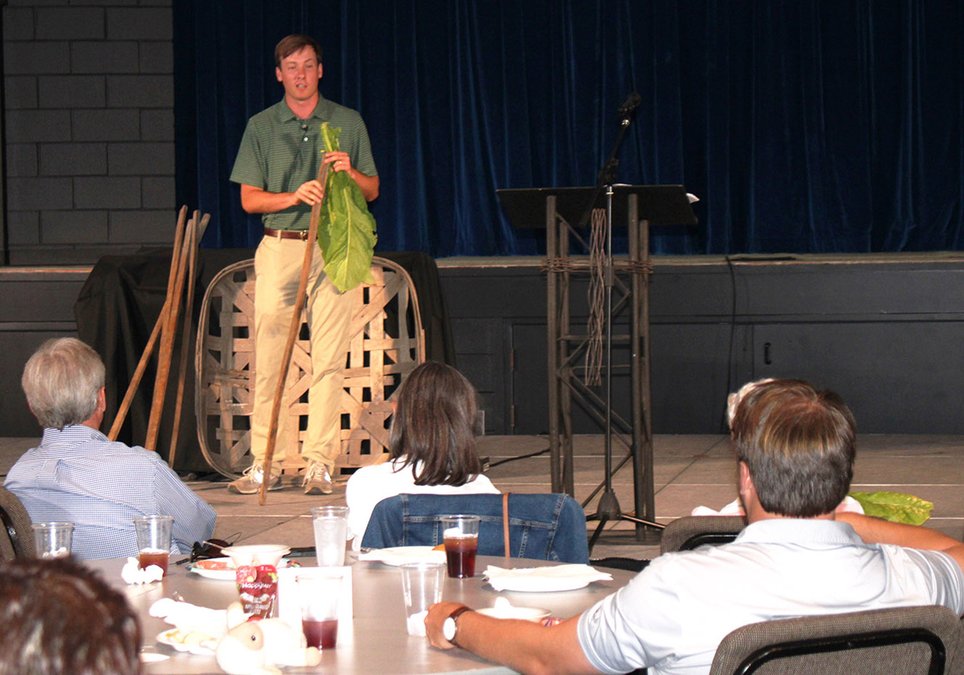
For those who remembered picking tobacco by hand, or the smell of the cured leaves in the old auction warehouses, the timing of Lee Waters’ presentation about the history of tobacco production, both generally and within Bulloch County, could hardly have been more appropriate.
It was the middle of a Monday in late July when Waters, one of the youngest members of the Bulloch County Historical Society and now its secretary, shared his research with a slideshow. The organization’s new president, Tyson Davis, had just noted that although hot, that Monday would likely be the coolest day of a week when heat index values would rise above 105.
“This crop, I know most of this for me is learning about the past, but I know that for many of y’all it was your livelihood,” Waters said. “It was the crop that fueled the Bulloch County economy. Before Erk Russell … got to Statesboro and Georgia Southern took off, this is what paid the bills in Bulloch County.”
In his mother’s side of the family were farmers near Register who grew tobacco, and his father’s family operated, and still does, L.A. Waters furniture, started by the presenter’s great-grandfather, and expanded by his grandfather, Si Waters. Lee Waters works in the family furniture business but maintains an interest in farming, and noted that even the furniture side of things benefited from the summer tobacco market season in its peak years.
“Granddaddy talks about that’s when bills got paid,” he said. “Farmers would say, ‘We don’t have any money now, but when the tobacco crop sells.’ …”
This younger Waters, one of whose previous contributions was a program on sugarcane growing and syrup making, took a similar deep dive into the history of tobacco. But maybe you had to be there to hear some of the details. …
Another ‘cash crop’
Anyway, Sea Island cotton had remained the dominant “cash crop” in this part of Georgia until sometime in the 19-teens or early 1920s.
“It wasn’t until the boll weevil came that farmers really needed to start searching for something else, something that they could make money with,” Waters said.
Railroad companies such as the Central of Georgia actively promoted flue-cured tobacco production to have a high-volume crop to haul, he noted. The Great Depression and President Franklin D. Roosevelt’s agricultural New Deal played a further role, with quotas and price supports for various crops and controlled allotments for tobacco, established in 1933.
“It really created profitability on the farm for small South Georgia farmers,” Waters said, “something they knew that if they made a crop then they could make some money and feed their families.”
That remained the case with tobacco production for about 70 years, he said.
Steps toward harvest
Waters brought with him onto the stage some fresh tobacco leaves and also flowering tops obtained from one of the few Bulloch County farms that still grows the stuff. He displayed these while he talked about steps in the annual work of tobacco production, especially as it was done, with hand labor, through the mid-20th century.
Tobacco seed are very tiny and numerous, like a fine dust, since each plant can produce 100,000 to 300,000 of them, he noted. So the first step in tobacco farming was to sow the seeds in February or March, scattering them, mixed with sand or cornmeal, in “tobacco beds” which could be covered against late frosts.
In April or a little later came “setting out,” transplanting the small tobacco plants to rows in a field. Farmers, their family members or seasonal hires rode a transplanter, pulled by a mule or later a tractor.
Maybe you had to be there to hear details about mid-season tasks such as “topping,” “suckering” and control of tobacco-hungry pests such as the tobacco hornworm, really a caterpillar, tobacco green except for its red horns.
Next, in July and August, came the harvest, “cropping” or simply “picking” tobacco.
Waters was holding some green leaves. “They’re really sticky, and you’d just be covered in tar, tobacco tar, after picking them,” he said.
In the earlier 20th century, freshly picked tobacco leaves were placed on unwheeled “sleds,” and later, wheeled trailers also called “sleds” for transport to the tobacco barns. Then came the “stringing” or “looping” of the tobacco with twine onto wooden “tobacco sticks,” about four feet long. Beginning in the 1950s, open-framed, powered tobacco harvesters, or pickers, came into use, with people in seats on the bottom picking by hand and placing the big leaves on conveyor chains that carried them to a top deck where other workers did the stringing.
In the tall, old wooden curing barns, the sticks loaded with tobacco were hung across the tiered, evenly spaced rafters. The fireboxes of the barns were originally fueled by wood, later by kerosene or diesel fuel. A common sight across Bulloch County through the 20th century, many of the old tobacco barns have collapsed or been torn down, but a few remain.
Waters’ research into historic tobacco barns indicated that tobacco was being grown to some extent in Bulloch County decades before the boll weevil and the New Deal played a role.
He displayed a photograph of the Belcher family’s tobacco barn, built of logs, near Brooklet from “Statesboro: A Century of Progress, 1866-1966,” published in 1969 by the Bulloch Herald Publishing Company. The caption in the book stated that the picture was taken in 1887, in support of a claim that “the first flue-cured tobacco grown in Georgia was planted in Bulloch County.”
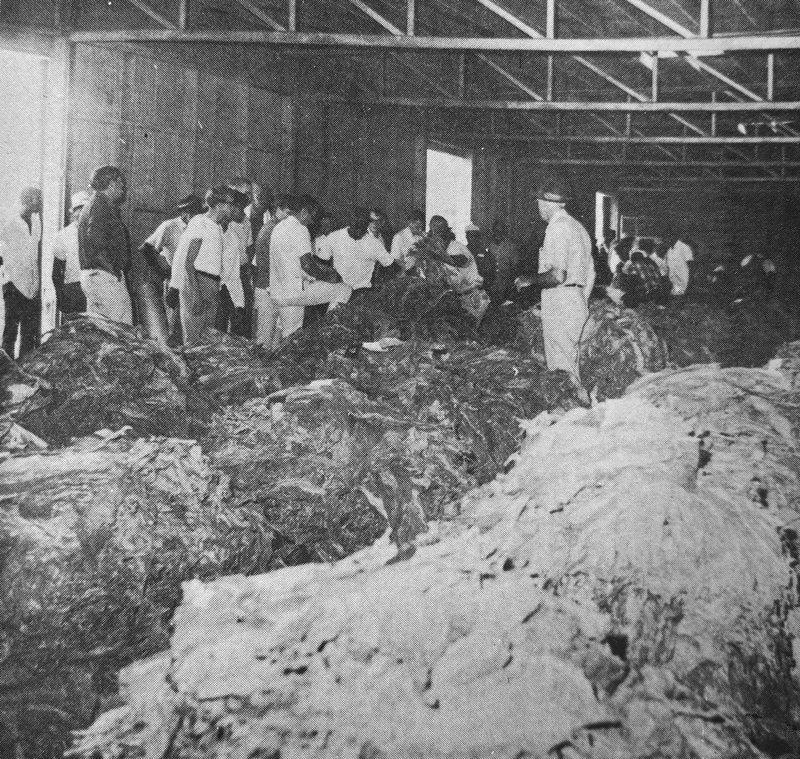
After curing, handfuls, or “hands” of tobacco were stacked into circular piles and tied up in burlap “tobacco sheets.” These were then trucked to town and placed on the floors of the tobacco warehouses, where the sheets were set out in long rows for buyers and auctioneers to walk between.
Statesboro’s market one of state’s biggest
“Then the music started singing,” Waters said. “Many of the buyers came from North Carolina where the really big tobacco companies were. They filled the hotels. The restaurants were full. Money was being spent in Statesboro. Statesboro was the largest tobacco market in the state of Georgia.”
In the heyday, he noted, there were 12 different tobacco warehouses in Statesboro,
“You had the buyers going along, feeling, touching the leaves,” he said. “Then you’d have an auctioneer, who was really a singer of chants, kind of musical, and he would sell it off as they went down the line.”
The warehouses on sale dates, especially at the season opening, often produced a fair-like atmosphere, with boiled peanuts and sodas sold inside the warehouses and out.
“A Century of Progress” also included a chart of annual values for “38 Years of Sales on Statesboro Tobacco Market” from 1928 through 1965. In all those years, combined, the markets here reportedly sold almost 360.9 million pounds of cured tobacco for a cumulative, unadjusted price of just under $154 million. If those were all 1965 dollars, the 2026 value would be more than $1.63 billion, according to www.usinflationcalculator.com.
Waters noted that one branch of the Brannen family owned and operated several of the warehouses. As part of his research, he had talked to Aulbert J. Brannen III about how his grandfather as a young man had gone to North Carolina and worked in tobacco warehouses to learn how they operated.
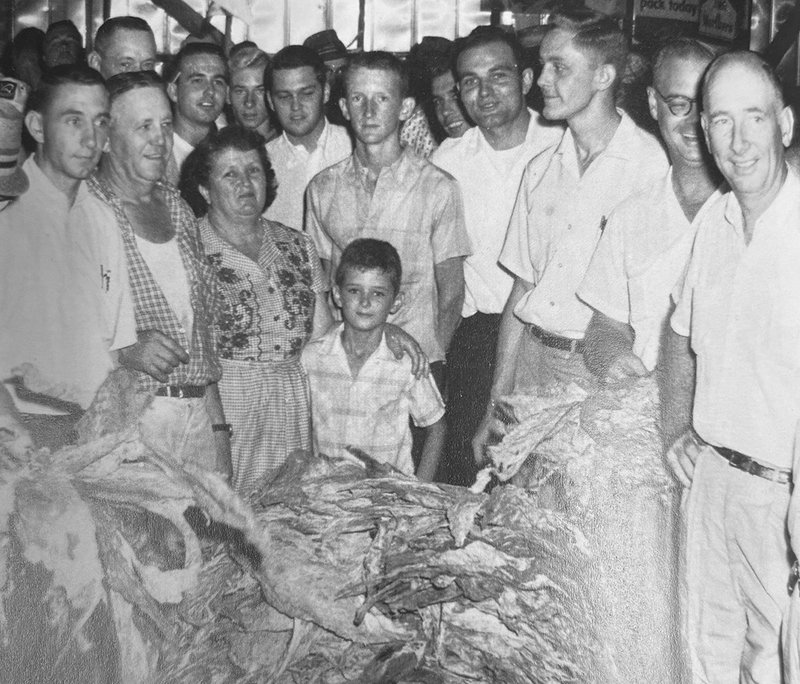
A photo Waters displayed from “A Century of Progress” shows Aulbert J. Brannen Jr., Aulbert J. Brannen Sr. and Bob Brannen, in a crowd gathered inside one of the Brannen’s warehouses for the opening of the 1963 market.
“In their heyday, the Brannens had five Bulloch County tobacco warehouses, and they ended up owning four in Bowling Green, Kentucky, as well, which that was burley tobacco up there,” Waters noted.
The Brannens’ warehouses were in operation from roughly 1940 to 1990. Their last operator, Robert Barry “Bob” Brannen, died in October 2024, at age 86.
Other families owned other warehouses. The Cobb and Foxhall Tobacco Warehouse was on South College Street, where its namesake, The Foxhall event venue, is part of the West District. The New Statesboro Tobacco Warehouse was on Hill Street at Mulberry. The Brannens’ warehouses were on U.S. 301 North, South Zetterower Avenue and South College.
Eventually, the warehouse auction system gave way to direct contracting between farmers and tobacco product manufacturers. This was accelerated by a turn of public sentiment against smoking, culminating in the federal buyout of farm tobacco quotas more than 20 years ago.
“The buyout authorized by the federal government in 2004 is really what put the nail in the coffin for tobacco farming,” Waters said. “(Before then) the federal government was dishing out lots and lots of money to hold up this crop and keep the prices as profitable, and of course lots was learned between 1933 and 2004 about what tobacco does to your health.”
By 2007, he said, 95% of previous growers had drop