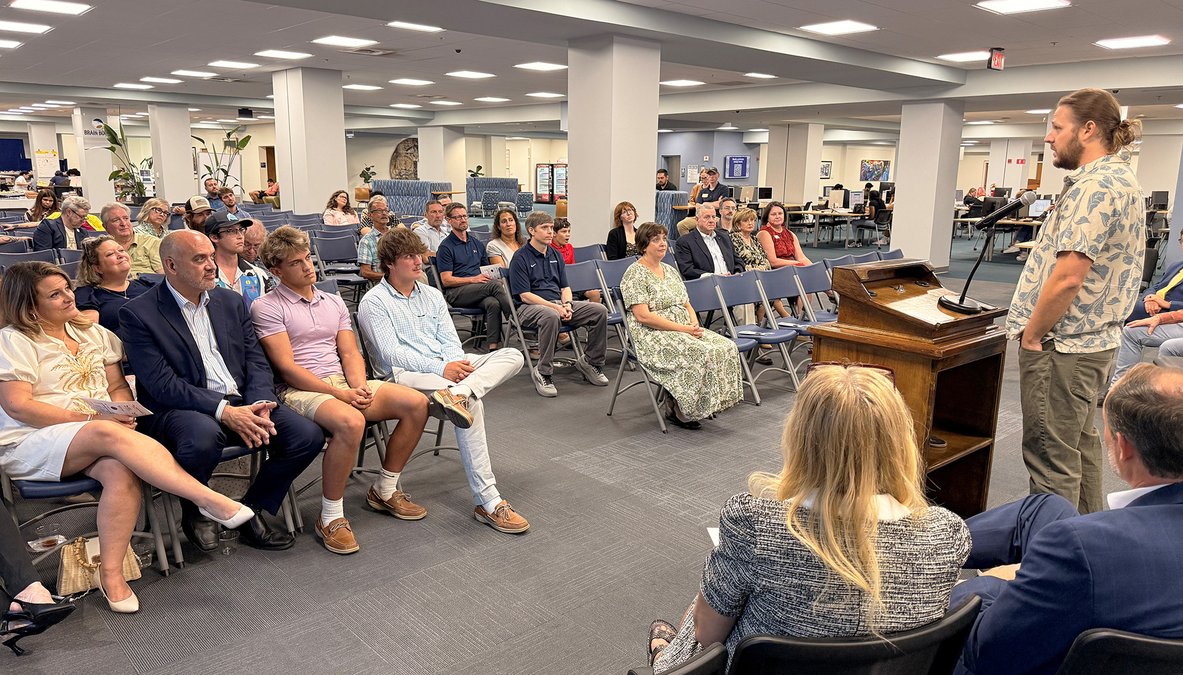
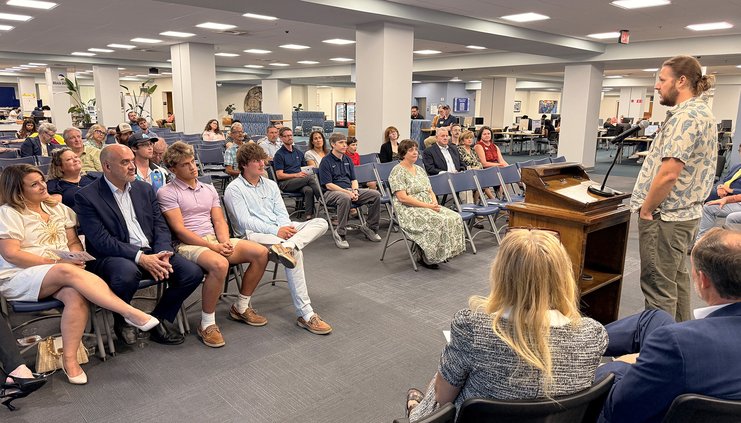
Thursday’s opening event for the “Statesboro Recovery Community, Origin + Evolution” exhibit became a reunion for several members of the family of the late Dr. John Mooney Jr. and Dorothy “Dot” Mooney, who founded Willingway Hospital, with organizations they inspired such as Freedom Through Recovery and Georgia Southern University’s own True Blue Recovery program.
Presented in partnership by the Jiann-Ping Hsu College of Public Health and its Center for Addiction Recovery, the Georgia Southern University Libraries, the Dot and John Mooney Foundation, Willingway Hospital and others, the exhibit occupies a central place in the Zach S. Henderson Library on the Georgia Southern campus. About 50 people attended the reception there the evening of Sept. 3.
This also served as a local kickoff for National Recovery Month.
All three of Dot and John Mooney’s sons – Dr. Al Mooney, Dr. Bobby Mooney and Jimmy Mooney – attended, as did other family members. During the decades when their family owned Willingway, Al Mooney, who became a family-practice physician specializing in addiction medicine, and Bobby Mooney, a now-retired addiction psychiatrist, each served a tenure as the private hospital’s medical director.
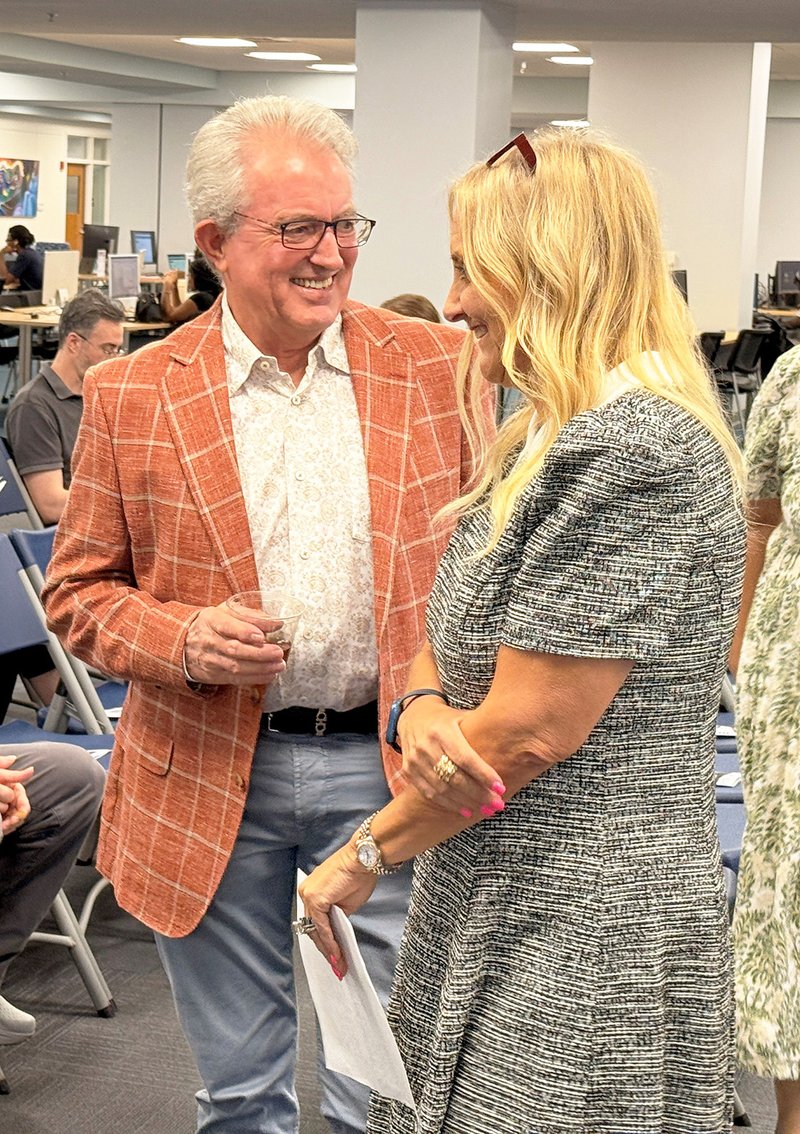
But Jimmy Mooney was the one who spoke as part of the program, one of several professionals who shared their own poignant personal and family recovery stories that evening. He’s the Mooney brother who didn’t become a doctor, instead attained a business degree at Georgia Southern and served as Willingway’s CEO for about 20 years after working his way through other roles.
“The reason that we’re here today is because my dad stood before the judge and was sentenced to two years hard labor because of alcoholism and drug addiction,” Jimmy Mooney said. “I know that was God working in my dad’s life, and I’m sure he didn’t think when he was standing up there that that was God; I’m sure he thought his life was over. But that was God working in his life. Because of that, he was able to save thousands of people upon thousands of people.”
As Dr. Bobby Mooney had explained in an interview, their father, already a second-generation physician, had an alcohol and drug problem since before World War II, when he served as a combat surgeon with the 82nd Airborne. He had injured himself and self-treated with morphine, and when he returned home, the addiction worsened.
That moment before a judge occurred in the 1950s, in a federal prosecution for prescribing narcotics to non-existent patients. Dr. John Mooney was eventually sent to the U.S. Public Service Hospital, a federal treatment center for narcotics addiction in Lexington, Kentucky, and introduced to Alcoholics Anonymous.
“He returned to Statesboro, and it’s a long story, but he got involved in AA and became an advocate for recovery in Statesboro,” said Bobby Mooney, “which for him was extraordinarily unusual, because there was nobody talking about drug-addicted physicians anywhere in the country back then.”
He recalls July 4, 1959 as the date Dr. John Mooney got sober.
Dot Mooney also had become addicted to Demerol and alcohol, but had gotten sober while her husband was at Lexington, said Bobby, and so the couple both participated in AA.
Before Willingway
As they made contacts through AA and word got around, people would call Dr. John Mooney to talk about addiction and recovery, and he turned his medical office on Siebald Street downtown into his first detox center.
He also admitted patients in recovery to Bulloch County Hospital, then on East Grady Street, insisting on private rooms for them. When the hospital administration insisted that he stop this so that rooms remained available for other patients, the Mooneys began taking patients to their family home on Lee Street, where the dining room, with table and chairs removed and replaced by beds, became the detox center.
These developments took place during the 1960s. With help from an accountant and a local group that helped arrange the financing, Willingway was built, originally as a 40-bed facility, and opened as a family-owned, licensed hospital in 1971. Its detox rooms surrounded an area with a chandelier, suggested by one in the family kitchen, so the beds were numbered Chandelier 1, Chandelier 2, and so on.
Ten years ago, the family sold Willingway to Summit BHC, a private network of treatment centers sometimes called Summit Behavioral Health.
Foundation lives on
But the Dot and John Mooney Foundation continues to contribute to recovery programs and scholarships, and the exhibit at the Zach Henderson Library also features other elements of the recovery community as it has grown in Statesboro and beyond.
Much of the exhibit consists of documents, photos, books and a few nostalgic items – such as the original “Willingway” sign – gathered in four display cases. One case contains items from the early years of addiction treatment and recovery programs, particularly the national origins of Alcoholics Anonymous and how it came to Statesboro. There’s even a rare early edition of the Alcoholics Anonymous “Big Book.”
Two central display cases feature items from the origin and growth of Willingway Hospital. Nearby, a small stand holds an audiovisual tablet that will play a recording about the origins of John’s Place – which unlike privately owned Willingway, is a public facility, but was named for Dr. John Mooney. The recording features Nancy Waters, RN, who helped Mooney develop that program.
Recovery on campus
The final display case contains materials that highlight the establishment and evolution of the Center for Addiction Recovery at Georgia Southern and its collegiate recovery program.
Speaking at the exhibition opening, Dr. Stuart Tedders, dean of the Jiann-Ping Hsu College of Public Health at Georgia Southern, traced the center’s origins back to the beginnings of the JPHCPH, formally launched as a college at the beginning of 2006. The college’s creation was made possible with an endowment from Dr. Karl Peace, biostatistics professor, and named in honor of his late wife, Dr. Jiann-Ping Hsu.
At the time the college was launched, its founding dean, Dr. Charles Hardy, and Peace visited members of the foundation, with the original topic being the analysis of hospital data. With an initial investment from the Dot and John Mooney Foundation, the Center for Addiction Recovery was established in 2008.
“And that partnership made perfect sense because substance abuse and addiction are a public health problem of epidemic proportions,” Tedders said. “Addiction is not simply an individual problem, it’s a public health issue that affects families and communities, work places, healthcare systems and ultimately all of us either directly or indirectly.”
Dr. Robert Bohler, current executive director of the Center for Addiction Recovery, shared his own recovery story and talked about the center’s growth and evolution.
“Originally we were a collegiate recovery program, which is a program that supports college students who are pursuing higher education, and since 2008 we have supported hundreds of college students who are now thriving in recovery and they’ve gone on to have many successful careers,” Bohler said in an interview.
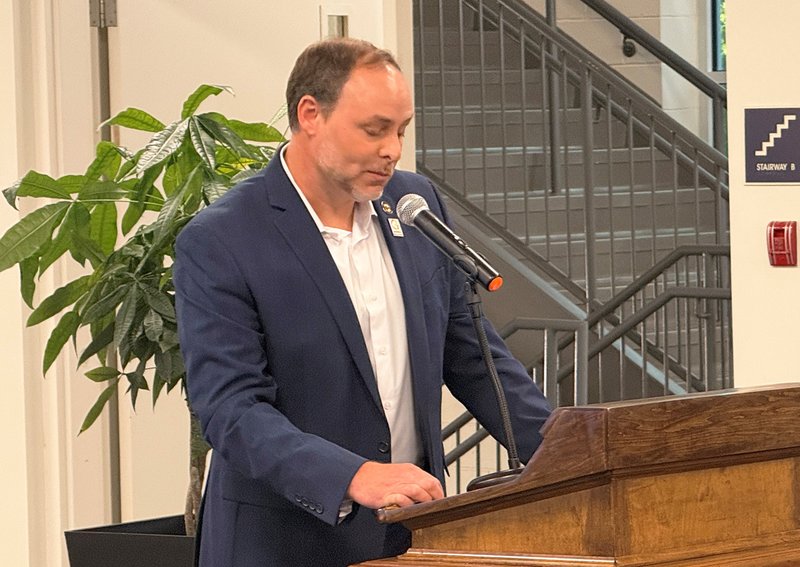
In the past couple of years. the center has “made a pivot” to be more of an academic center for the college, he said.
“So we’ve secured about $2 million in funding to do applied research initiatives around substance abuse and addiction, but we still have our service arm, which is our collegiate recovery program, … now called True Blue Recovery,” Bohler said.
Catherine Tootle, executive director of Freedom Through Recovery, told her own recovery story and how this independent, nonprofit Recovery Community Organization, or RCO, provides support for people in all recovery pathways.
Bret Frazier, now technical assistance coordinator with the Association of Recovery in Higher Education, described his own pathway from being a student in recovery at Georgia Southern through working as the coordinator of its collegiate recovery program. He graduated with a BBA and MBA from Georgia Southern on the way to his current role with the nationwide organization.
Other speakers included Doug Collins, CPA; Rachel Mooney Spence, who is a member of the Dot and John Mooney Foundation board, named for her grandparents; Tracie Smith from Willingway Hospital; and Dr. Lisandra R. Carmichael, dean of the Georgia Southern University Libraries.
Carmichael called the Statesboro recovery community “a beacon of hope” that “lights the way for thousands of individuals living in recovery” and said the exhibition “honors the early pioneers who … laid the foundation for a culture of healing.”