
Officials of Bulloch County and its four municipalities – Statesboro, Brooklet, Portal and Register – are planning to place a countywide referendum on the Nov. 8 ballot for a five-year renewal of the 1% Transportation Special Purpose Local Option Sales Tax.
As first approved by a majority of Bulloch voters in May 2018, the T-SPLOST penny could have continued to be collected until Sept. 30, 2023. However, the original Georgia law that authorized a tax of this kind for individual counties also capped the tax dollars collected at the amount stated in the local referendum.
In the 2018 referendum, Bulloch County’s five-year T-SPLOST cap was set at $60 million, and because of growth in the monthly revenue over the past four years, that limit appears certain to be met next spring, three to six months before the Sept. 30 deadline.
“To our surprise, that’s exactly what’s happening. …,” County Manager Tom Couch said in an interview earlier this week. “We think it may expire anytime between April and June, it just depends on what comes in, but there’s little doubt it will.”
Not a fuel tax
The T-SPLOST is not a tax on gasoline or diesel. In fact, purchases of fuel, both “for propulsion of motor vehicles on the public highways” and for off-road uses such as agriculture or construction, are specifically exempt from this tax, according to a Georgia Department of Revenue summary. Instead, the T-SPLOST is collected on retail sales of most other goods, such as food, clothing and household items, as well as newly purchased vehicles.
But it’s a “transportation” tax in the sense of how the money is spent. Local governments are allowed to use the revenue only for transportation purposes, such as building or improving streets, roads, airports, sidewalks and bike paths or buying buses and other equipment for public transit.
At this point Bulloch County’s T-SPLOST, in less than four years since it took effect in October 2018, has yielded almost $48 million and is collecting $1.2 million or more each month on average, Couch reports.
Back in 2018, local officials were confident of a $48 million revenue projection, and so made that the level for a “Tier 1” T-SPLOST funding category. But they set $60 million as the high-side
limit they thought would not be reached before Sept. 30, 2023 and designated any revenue in excess of $48 million as “Tier 2.”
Web tax helped
Then came the state government’s enactment in January 2020 of the Marketplace Facilitator Law, which applied state and local sales taxes to Georgia residents’ purchases from online retailers that had previously been out of reach.
“That’s just a fancy way of saying that all of these online retailers like Amazon and Wayfair had to start paying taxes to the county of origin of purchase,” Couch said. “So that’s when T-SPLOST and SPLOST really started accelerating.”
Recently, inflation has probably also become a factor in a continued rise in sales tax revenues, he and other local officials have noted.
Fast-track process
In 2017-2018, several months of negotiations led to a formula for the distribution of the revenues before the call for a referendum was issued. This time, county officials have recommended, and representatives of the four cities appeared to accept as of Friday, keeping the distribution percentages unchanged from the 2018 distribution but dropping the Tier 1 and Tier 2 structure for the proposed 2023-2028 T-SPLOST extension.
So, the distribution would remain 51.3% to the county government, 43% to Statesboro, 3.2% to Brooklet, 1.6% to Portal and 0.9% to Register.
The 2018 agreement, still in effect until the $60 million cap is reached, “frontloaded” Brooklet, Portal and Register 80% of their potential revenue, in other words their shares of the $48 million Tier 1 projection, before Statesboro and the county began receiving theirs. So those three smaller towns now stand to get their allotted percentages of the remaining $12 million, their Tier 2 money, as the current tax approaches its cap.
Under the draft intergovernmental agreement presented Friday, the cities and county would each continue to receive their percentage shares on a monthly basis, with no tiers or frontloading, for the next five years.
No cap this time
An overall revenue projection of $72 million revenue is stated in the proposed agreement, but this will not be a cap. Because of a change in state law, a revenue limit is no longer required when an intergovernmental agreement is involved, explained County Attorney Jeff Akins.
However, after that same legislation, the law regarding T-SPLOST referendums no longer mentions the possibility of a March referendum in an odd-numbered year such as 2023, Akins said. In Georgia, odd-numbered years are regular election years for cities but not for counties and the state.
The apparent lack of a March referendum possibility, along with the approaching exhaustion of the tax under the old $60 million cap, are reasons county officials cite for putting the referendum on this November’s ballot.
If that ballot were missed, the next opportunity appears to be November 2023, Akins said. Restarting the tax would then take several months, resulting in the local governments missing nearly a year of T-SPLOST revenue, Couch said.
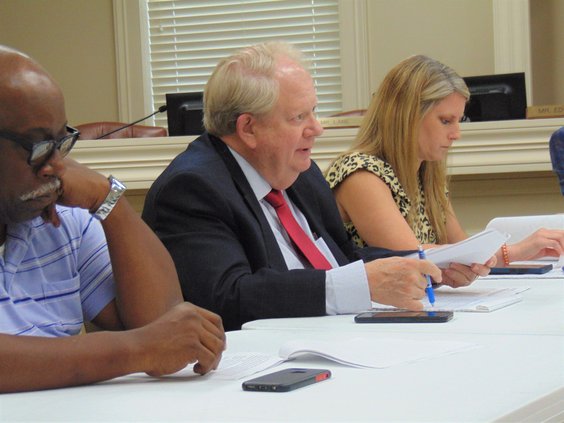
Key officials of all four towns and the county attended a “meet and confer” session at 3 p.m. Friday at the County Annex, and the date, June 17, was noted in the draft agreement. Those present included Register Mayor Donnie Roberts, Portal Mayor Billy Boggs and Portal City Clerk Mike Arrieta, Brooklet Mayor Pro Tem Nicky Gwinnett, Statesboro City Manager Charles Penny, who had Mayor Jonathan McCollar on the phone, County Commissioners Chairman Roy Thompson, Commissioner Anthony Simmons, Assistant County Manager Cindy Steinmann, Couch and Akins.
Brooklet’s request
Gwinnett asked if the percentages were negotiable and said Brooklet officials were hoping for 4%.
“The roads in town are getting in severely bad shape, traffic has increased and we need to do more paving contacts, and obviously we don’t have a large budget,” he said. “We can hardly afford to resurface roads, other than try to keep up with some patchwork.”
In 2018, the three smaller towns were allotted revenue shares somewhat larger than their portions of the county population, but there has been no recalculation based on the 2020 census.
However, county officials warned Friday that new negotiations could delay the referendum.
“Time is of the essence right now as far as getting this done, but I think all of us, we all want to feel good about it when this is over with, because one thing is for certain, we don’t want to go a whole year plus without collecting sales tax dollars,” Thompson said.
Penny and Couch said they will look for other ways to help Brooklet and the smaller towns, such as by including their projects in Statesboro’s or the county’s larger bid packages, which tend to result in lower unit costs. Gwinnett said he was sure Brooklet would not want to delay the referendum process.
The proposed timeline is for the city councils to approve the intergovernmental agreement before July 5, when the county commissioners would approve it during their regular meeting. The commissioners would then adopt a referendum resolution July 19 so that the Board of Elections and Registration can act to place it on the ballot at least 90 days before the election.