The Bulloch County Board of Commissioners and staff recently started taking another look at the possibility of having a county ordinance regulating data centers that would be something other than an outright ban.
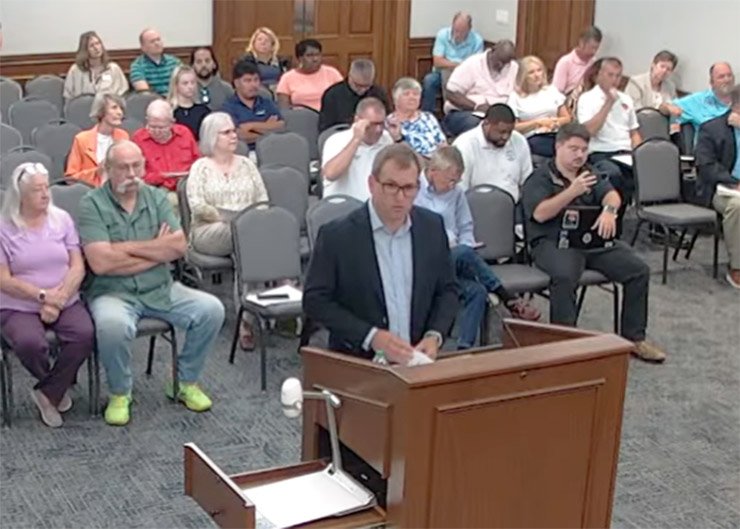
To be clear, the county government’s moratorium prohibiting zoning for data centers anywhere in county’s unincorporated area, previously extended to Dec. 31, remains in effect. As indicated with the item on their Aug. 18 agenda, the elected commissioners took no action on data centers that day. But they did hear and discuss a presentation, led by county Planning & Development Director James Pope, about a potential zoning ordinance amendment on data centers.
Aug. 18 was the same day that Statesboro’s mayor and City Council, by a 3-2 vote that evening, approved rezoning a 26-acre site in the edge of the city limits for a data center proposed by developers. As may need emphasizing during the ongoing controversy about this topic, the city and county governments are separate, especially in regard to their zoning and development rules.
“The intent is just to continue this ongoing discussion that we’ve had about data centers,” announced county commissioners Chairman David Bennett. “When we started our moratorium almost six months ago, one of the things that we asked Mr. Pope and the planning and zoning staff to do was start looking into some zoning regulations that we could put in place to make sure that we are protecting the people of the county, but we’re making a clear rulebook for folks that are looking at putting something like this in the county as far as what they could be allowed to do.”
In fact, the staff had a draft of such an ordinance prepared and posted online back on May 5, when the commissioners held a hearing for possible extension of the moratorium, originally imposed in mid-February for 90 days. But during the May 5 meeting, the commissioners not only extended the moratorium to the end of 2026, they also voted 5-0 to “start the process,” as Commissioner Nick Newkirk put it, for a zoning amendment prohibiting data centers in Bulloch County outright.
Pope and County Attorney Jeff Akins then led in drafting a zoning text amendment they thought would do that. It defined data centers but then added a statement that they are not allowed in each of the zoning districts where they might otherwise have been permitted. The appointed county Planning and Zoning Board voted that ban amendment forward with a recommendation for approval, but the commissioners during their Aug. 4 meeting tabled that proposal by a 3-2 vote.
Meanwhile, a presentation of a revision of the previous draft ordinance was placed on the agenda for the Aug. 18 regular morning meeting.
‘Pro’ as alternative revenue source
“There are pros and cons to data centers,” Pope said. “Probably one of the greatest pros for a community could be lower property tax rates, and so there’s a lot of communities out there that are basically doing away with their homestead property taxes, and some of those are here in Georgia.”
What he meant is, because the computer equipment and other hardware in a data center can be very expensive and is taxable as the business’s “personal property,” in addition to the taxable real estate of the building and grounds, data centers can produce a large amount of property tax revenue. But they generally employ very few people relative to the size and value, thus requiring fewer local government services, such as law enforcement and school operations, than residential developments.
“Those jobs are fairly high paying; again, there’s not many jobs created at … a data center, once it’s in place, but that’s less infrastructure pressure for us, with much higher property taxes that we would collect,” Pope said.
So, some communities have looked to data centers as a way to alleviate taxes on residential property, in some cases allowing a complete exemption for most owner-occupied homes.
“Data centers have been around for a long time, for several decades,” Pope continued. “Northern Virginia is kind of the epicenter for data centers, and so in the planning world they’re doing a lot of things to really show how data centers can work in cohesion with the neighboring communities.”
So those areas, which are near Washington, D.C., have learned to mitigate a lot of the negatives, he suggested.
‘Cons’ are mainly environmental
“But the cons: Of course there are potential environmental issues if you don’t put guardrails on data centers,” Pope said.
This was his bullet list of “issues” or concerns with data centers: noise, the power grid, water use, downstream discharge, land use and land conversions, waste after abandonment and air quality or emissions.
“So our ordinance attempts to address each of those items, minus the power consumption, but power consumption obviously is not something that a local government has much control over unless you’re a city that has its own electrical company,” he said.
Overlay districts
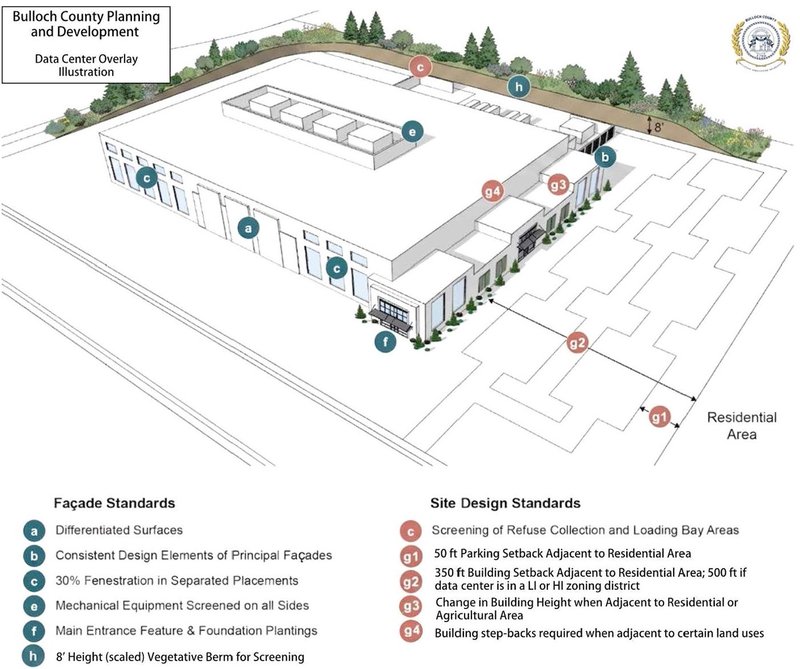
The county staff’s draft ordinance proposes allowing data centers as “permitted by right” but only in certain overlay zoning districts drawn just for this purpose. This is different from Statesboro’s city ordinance, which allows them only as a “special use,” requiring hearings and council approval, in four zoning district classifications.
Under the county’s draft, smaller-scale, “medium” data centers would be allowed in the Highway Commercial zone only as a “conditional use,” requiring Board of Commissioners approval, also within an overlay district.
The county staff proposal also calls for design standards, including requiring a concept site plan from the property owner or developer and facades and screening to hide or disguise exterior equipment, plus building height limitations and setbacks.
The minimum setback would be 350 feet from most adjacent properties, but 500 feet in industrial zones.
To address noise concerns, the draft proposal would establish decibel-level limits, restrict the use of onsite generators to emergencies and limit generator testing to certain hours. Testing would be required to determine that noise is within limits before a certificate of occupancy could be issued.
For light and glare reduction, a photometric plan and 100% downcast lighting would be required. Landscape buffering also would be required.
Closed-loop cooling systems and municipal sewer and water system connections would be required, under the most recently suggested version.
The areas where data centers could go in Bulloch County could be limited somewhat by where power companies’ high-voltage transmission lines are located, Pope suggested. He showed a map with the several 115-kilovolt lines, which he said are considered the minimum for data centers, drawn in red, and only one 230-kilovolt line set, the kind of line he said Georgia Power would prefer to use for data centers, in purple, crossing the middle of the county west to east.
The proposed ordinance could be improved in some ways, Pope said.
Newkirk asked what would happen if noise levels shot up after a site was approved and a center built. Pope said an annual compliance report would be required, with testing ordered and code enforcement deployed.
“I’m not for this, anyway,” Newkirk said. “Well, but I think we’ve got to have something in place where we can shut these places down if they violate our rules. I mean, these people don’t mind paying a thousand dollars in fines, probably, if that means they can keep making billions of dollars a year.”
County Manager Chris Eldridge said noise levels at some existing types of industrial sites, here and in other communities where he has served, far exceed those of data centers Bulloch officials visited during a fact-finding trip.
“Just like the concrete batch plant, an asphalt plant, anything else, that’s going to have noise, and I mean, our experience going to visit (data centers), they don’t compare to that,” he said. “I mean, a batch plant or a rock crusher, any of those type things are far more impactful on a neighborhood to what we saw,” Eldridge said.
Bennett asserted that the zoning by overlay districts, designating only a few areas of the county where data centers could be allowed, would be a way to protect residential and farming areas.
“The intent here is to make sure that they are not put next to a residential neighborhood and that they’re not going to go and use up ag land to put a data center on it,” Bennett said.
Commissioner Anthony Simmons called the staff proposal an attempt to “make the citizens safe.”
“We are dictating where they (data centers) can go, how they can come, and it’s not going to be any detriment to the citizens,” Simmons said.
However, Newkirk had an added slide shown beyond Pope’s basic presentation. It showed the results of two similar ballot questions included on both political parties’ Bulloch County ballots back at the May 19 primaries. These were nonbinding, party position questions, like an opinion poll.
The Republican ballot asked, “Should elected officials allow the building of data centers in Bulloch County?” The result was 5,214 voters, or 76% of those responding, checked “No,” while 1,645, or 24%, marked “Yes.”
The Democratic ballot asked simply, “Should data centers come to Bulloch County?” The result was 2,992 “No,” or 77.75%, to 856 “Yes,” or 22.25%.
“That’s what I intend to uphold,” Newkirk said. “I’m not going to sit up here and tell the citizens that I’m more smarter than the citizens out here. The citizens elected me, and I’m going to do what I can to protect them. … We are elected to serve the citizens of this county, and that’s what the citizens of the county said, and that’s what I’m going to push and fight for until we get this done.”
Bennett said he appreciates Newkirk’s position but had heard from citizens who said they had voted on that question but “after looking at data, listening to facts about this issue, they have changed their minds since then.”
“So … are we elected to serve the people? Absolutely,” Bennett said. “Part of that service is to look at the facts of every issue and consider them.”