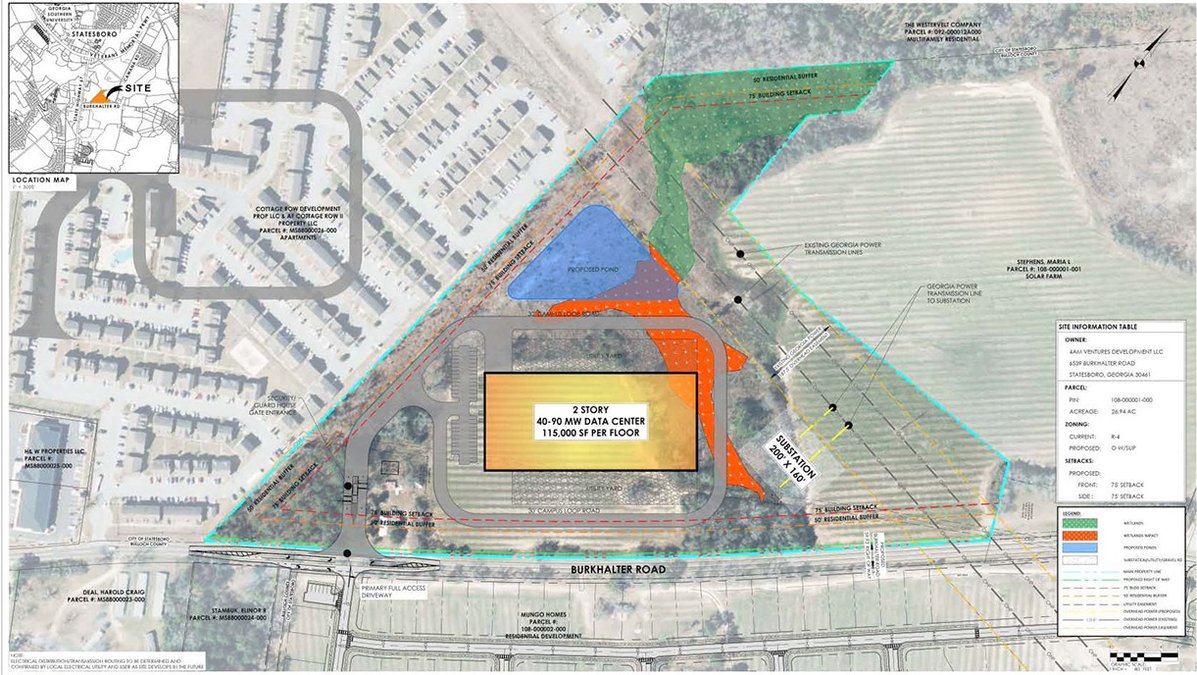
An attorney for property owners 4AM Development LLC, seeking to place a data center along Burkhalter Road on the edge of Statesboro, filed a motion last week asking the Bulloch County Superior Court to dismiss a zoning challenge brought by Coastal Communities United and 11 individual citizens.
William J. Keogh III, of the Augusta-based Hull Barrett law firm, filed the "motion to dismiss and request for expedited hearing" Oct. 6 on behalf of 4AM Development, whose publicly identified owners are Charles Way, from Savannah, and Bobby Bagwell, from Appling, near Augusta.
Their motion responds to the complaint that Robert Abney Fricks Sr. of the Warner Robins-based firm Fricks, Person, Tourville filed Sept. 17 for the 11 "concerned citizens who reside at properties in varying proximity" and nonprofit Coastal Communities United seeking to have the city's Aug. 18 rezoning decision reversed.
Statesboro's city government is expected to file a response of its own but had yet to do so as of Monday, Oct. 12. Meanwhile, City Attorney Cain Smith said city officials and staff are "staying all action" regarding a special-use permit for the data center project.
Previous actions
Statesboro City Council, on Aug. 18 by a 3-2 vote including Mayor Jonathan McCollar's tiebreaker, approved the rezoning from R-4 high-density residential to O, or office and business, for an almost 27-acre site owned by 4AM Development. That was after the council, by a 3-1 vote June 2, amended its Unified Development Code to allow data centers on sites up to 50 acres, as a special use only, in zoning classifications HOC, or highway-oriented commercial; LI, or light industrial; and MX, or mixed use; as well as O.
The ordinance prohibits centers larger than 50 acres, describing them as "hyperscale" centers.
As a special use, data centers are not allowed automatically in any of the classifications but must comply with special rules and requirements and obtain further approval from City Council.
In the Sept. 17 complaint challenging the rezoning decision, Fricks characterized the 11 "citizens and business owners in Statesboro" by subgroups as variously "concerned owner petitioners," "sightline owner petitioners" and "nearby owner petitioners." While making no specific monetary claims, the written complaint asserted that damages could be determined by a judge or jury, and it named both the city of Statesboro and 4AM Development LLC as defendants.
Citing concerns about air and light pollution, noise and vibration, water and electricity usage, Fricks alleged that the city's rezoning of the site for the data center constituted "spot zoning" and amounts to a "taking" of petitioners' property values by "inverse condemnation."
Challenges 'standing'
But Keogh in his written response on behalf of 4AM Development asserts that the petitioners, or plaintiffs, lack legal standing to bring such a challenge to the zoning decision. He cites a ruling by the Georgia Court of Appeals just this year in which one or more appeals judges opined, "Standing is not dispensed in gross. That is, plaintiffs must demonstrate standing for each claim that they press against each defendant, and for each form of relief that they seek."
From another Court of Appeals case ruling, from 1984, he quotes an opinion that to challenge a zoning decision, "First, a person claiming to be aggrieved must have a substantial interest in the zoning decision, and second, this interest must be in danger of suffering some special damage or injury not common to all property owners similarly situated."
But Keogh asserts that community-wide interests and harms "common to all property owners similarly situated" are the only kinds that Coastal Communities and the 11 individual petitioners allege.
'Constitutional' notice lacking
The second major argument Keogh levels on behalf of 4AM Development LLC, as a defendant, is that the plaintiffs in the suit failed to provide the city government "fair notice of a constitutional challenge."
"Georgia law is clear that a constitutional attack on a zoning classification cannot be made for the first time in superior court," Keogh quotes from a 2004 Appeals Court decision.
But he observes that only one of the 11 named defendants in the Sept. 17 complaint, Lorraine Braselton, was on record as speaking against the rezoning request during the City Council hearing. Keogh also asserts that none of the plaintiffs notified the city of a constitutional complaint before their suit was filed.
In a paragraph requesting an "expedited hearing" on the motion to dismiss, Keogh asserts that the plaintiffs in the rezoning challenge "seek to prevent 4AM from utilizing the rezoning which has been properly granted to them.
"This delay interferes with 4AM's vested property rights, and this delay is being foisted by parties that do not have standing to assert this litigation," he wrote. "Indeed, upon information and belief, all but one of the Plaintiffs failed to even voice an objection at the public hearing on the rezoning request before the City and none complained of an alleged constitutional injury."
Not a city response
The property owners' response is not a response from the city government, which was named first and equally as a defendant. The Statesboro Herald, in an email Monday, asked Smith, the city staff attorney, if he or other lawyers for the city would be filing a separate response or if the city's stance would be to let the property owners defend the zoning action.
"We must reply or default judgment will be entered against the City," Smith replied. "We will reply as required by law."
That means the city is expected to file a response within 30 days after the date that city officials were formally notified of the lawsuit, or "30 days from service," as Smith put it. After the suit was filed on a Thursday, a sheriff's deputy served the notice at City Hall on Monday, Sept. 21, so the city apparently needs to respond by Tuesday or Wednesday of next week.
Asked if he concurred with the main points of the 4AM response, Smith said he had no comment on that, and "no," he had not received notice of a hearing or otherwise learned when the court may schedule one.
The final question was whether other aspects of the city permitting process, such as a council hearing on the special use permit, can move forward while this suit is pending.
"We are staying all action regarding the processing of any special use permit," Smith replied.
So one of the plaintiffs' assertions, that the court challenge would halt further city action on the data center for the time being, appears to have been acknowledged, in effect, before a day in court.