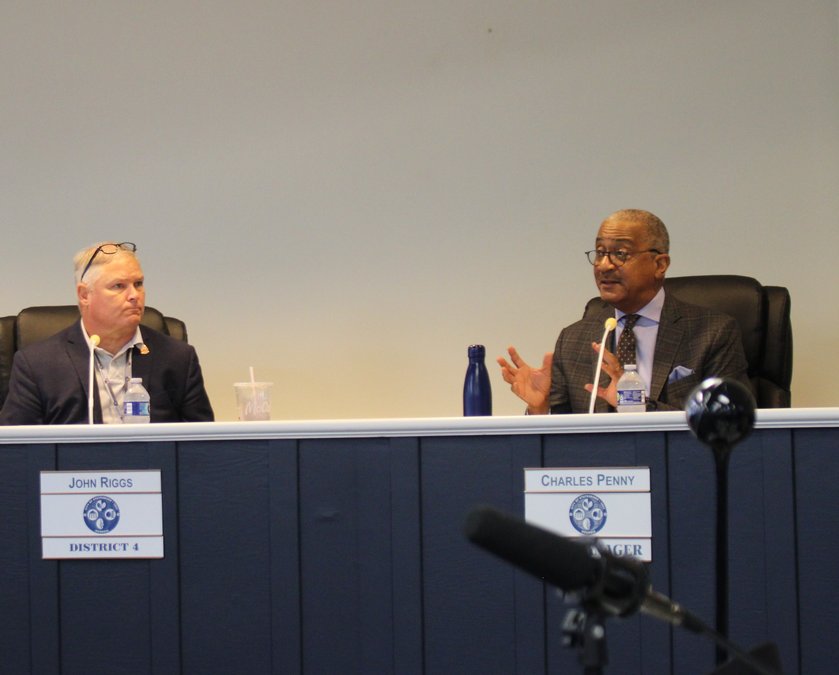
Statesboro City Council on Tuesday morning approved the recently modified version of an amendment to the current-year city budget, cutting budgeted expenditures by roughly $929,000 but restoring city employees’ $500 holiday bonus, among other things.
After the council in mid-September voted to hold the city’s property tax rate unchanged at 8.625 mills instead of increasing it to 9.6 mills as City Manager Charles Penny had requested, Penny in early October proposed current fiscal year spending cuts totaling $1.34 million. Among the proposed reductions he first presented were “suspending” the employee bonuses expected to cost about $180,000, as well as the entire Downtown Live concert series for spring-summer 2027, the Youth Connect summer work experience program directed through the city Human Resources office and the Statesboro Village Builders initiative of the Youth Commission.
Other suggested cuts came from department heads after Penny directed all to reduce their budgets.
However, Mayor Jonathan McCollar from the first argued for adding back about $121,000 for the two youth programs and a reduced Downtown Live series. Council members, such as District 5’s Shari Barr and District 4’s John Riggs, then said they wanted to restore the bonuses – to be distributed during a November pre-holiday event – because many employees have come to count on these.
The mayor, council members and Penny discussed the budget revision further during an Oct. 20 afternoon work session. After the elected officials informally directed him to add items back, the formal budget-reduction amendment was placed on the agenda for the Tuesday, Nov. 3 regular 9 a.m. council meeting.
As approved, the amendment still cuts almost $868,000 in planned spending from the fiscal year 2027 general fund budget, which has been in effect since July 1, and trims $33,420 from the fire service fund and $27,550 from the central services fund. It also authorizes a $175,000 increased transfer from the solid waste collection fund to the general fund.
But about $296,000 in spending was restored prior to the final amendment. This includes $52,000 for Youth Connect, roughly $14,000 for Village Builders, $50,000 for up to four Downtown Live concerts (but not six or seven like before) and roughly $180,000 for the bonus of $500 each to the city’s approximately 360 current employees.
Unless there are further savings or discoveries of other revenue, the nearly $300,000 would come from the city’s general fund balance.
Further savings sought
“We still need to reduce the budget further, but we believe we can hopefully make up that difference of $300,000 by when vacancies occur, and we will be taking up measures to reduce the budget further so we don’t go into the fund balance,” Penny said Tuesday. “If we have to spend some fund balance, it would not be as bad as spending $1.3 million, but it should not be anywhere close to what we were talking about.”
Barr, who made the motion to adopt the revised budget amendment, and District 1 Councilmember Tangie Johnson, who seconded it, simply said, “Thank you,” to Penny for the revision. Riggs and District 3 Councilmember Ginny Hendley joined in the “yes” vote, which was unanimous at 4-0, with a special election underway Tuesday to fill the vacant District 2 seat.
The city government’s general fund budget, prior to the more than $1 million reduction, forecast more than $32 million in spending, having doubled from about $16 million in 2019.
Projected ’27 freeze
In Penny’s initial Sept. 28 budget reduction memo and a further note to the council he signed Oct. 1, he also recommended a salary freeze, but not for the current, July 2026-June 2027 fiscal year. City employees had already received the 2% “pay plan adjustment,” or across-the-board raise, that was included in the current budget. They also remain eligible for “pay for performance” raises based on their annual reviews during this fiscal year.
But Penny recommended a freeze on both types of raises for fiscal year 2028, in other words for the budget not written yet that will begin July 1, 2027.
Meanwhile, he is set to retire Jan. 1, with the mayor and council having recently selected Assistant City Manager Jason Boyles as sole finalist to become the next city manager, effective that same day.
Asked about the budget amendment after its adoption at Tuesday’s meeting, Riggs said he felt good about the final version, especially since it restores the bonuses. He said he has a number of friends among the city employees who called him about the earlier proposal.
“They call me freely and tell me what they feel, and they have all said that they understand some of the cuts that we may have to do next year, like not being able to do pay for performance. …,” Riggs said. “But they were really concerned about the bonus. So many of them count on that for, you know, that’s Christmas presents right there. That can be somebody’s whole Christmas budget who’s only making $18 an hour.”
Employees had already expressed appreciation after hearing that council members wanted to restore the bonuses.
“So I feel good,” Riggs said. “We’ll have happy employees, and happy employees means a good running city, and a good running city keeps constituents happy.”
More background
With the millage rate held at 8.625 mills instead of being rolled back to offset inflation in property values, the city’s property tax is still estimated to be 22% higher than last year’s. But without the increase to 9.6 mills, that was projected to yield $1,341,600 less revenue than would have been needed for the budget prior to the $929,000 in cuts and the $175,000 transfer from waste collection income.
However, the general-fund bank balance – needed as a reserve against natural disasters and other unexpected events – had already fallen below the city’s policy of maintaining a balance of 25% of current-year spending, to about 20%, Penny said in October.