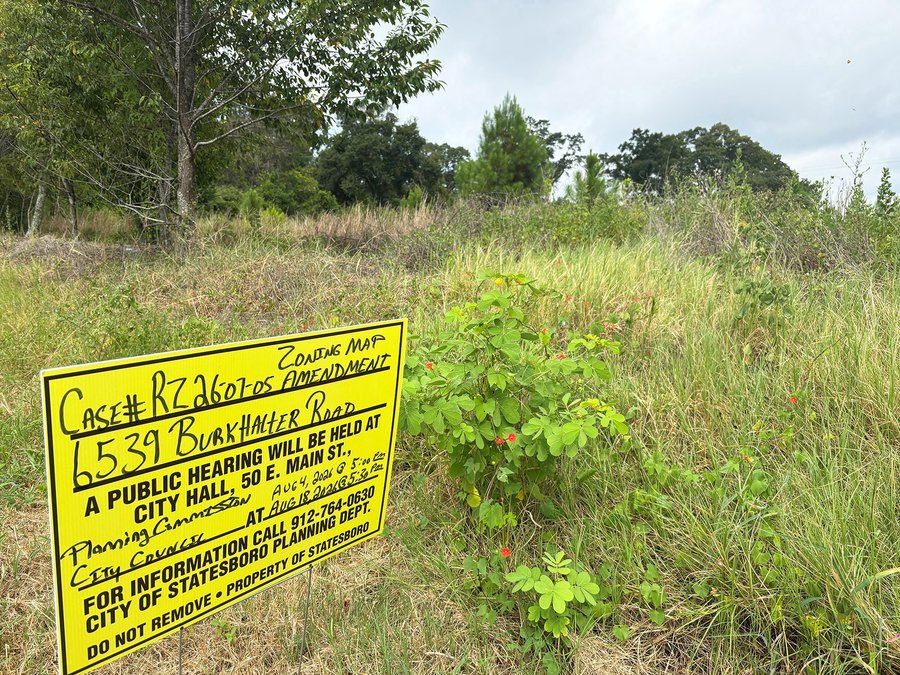
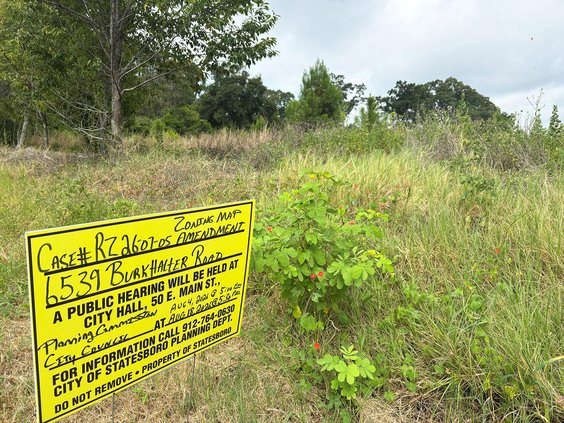
With 10-year capital investments by the developers and a yet-to-be-determined end user projected in a study at $1.2 billion — yes, "billion" with a "B" — the data center proposed for 6539 Burkhalter Road is one Statesboro officials have had in mind since May or earlier.
The city Planning Commission on Aug. 4 voted 5-1 to recommend approval of a zoning change for the almost 27-acre parcel from "R-4" high-density residential to "O," office or business district, as requested by 4AM Development LLC and owner partners Bobby Bagwell of Augusta and Charles C. Way of Savannah. Now the zoning question is slated to go before City Council during its 5:30 p.m. Tuesday, Aug. 18, meeting.
"O" is one of four zones where data centers may be allowed as special uses under the Data Center Ordinance enacted by City Council on June 2. If the zoning change is approved, a special use permit, requiring another hearing, will still be required. However, the developers already have some of the documents, such as a water use study and economic impact report, ready for that step in the process, as Way and Bagwell revealed during the Planning Commission meeting and conversation with reporters afterward.
The Statesboro Herald asked the dollar value of the total investment.
"That will depend a lot on how it's ultimately designed, but it will be somewhere in the high hundreds of millions of dollars," Way said. "We did an economic impact study. We spoke to the … Development Authority and they directed us to a company, and we asked them to prepare an economic impact study for the site, which they did."
Fiscal impact study
In fact, what the Development Authority of Bulloch County, or DABC, obtained for the developers from Economic Impact Group LLC, based at Flowery Branch, was a 10-year "fiscal impact" analysis using the trademarked LOCI model and software. The report, released by the city of Statesboro's Planning and Development Department, is dated May 2026 and names the Development Authority of Bulloch County as the client for the fiscal analysis "for Bulloch County, the Bulloch County School Board and the City of Statesboro" regarding "a hypothetical data center" to be located in the city.
With information provided by the developer through the DABC, the project model was run for a facility to be phased in over two years, with the investment in "real property," meaning the land, building and certain long-term fixtures, "anticipated to be $524.9 million." The analysis also added estimates of business "personal property" such as the digital electronics and other equipment in the data center. This included "class 4 personal property" with a projected initial value of $325 million, and class 2 personal property valued at $100,000.
Those would add up to a one-time value of $850 million. But Economic Development Group's analysis doesn't tally the investment that way. Instead, after noting that the class 4 property is expected to be replaced every five years, the study's overview states that the total investment over 10 years would be $1.2 billion.
It also passes on information "provided by the client" that the data center is expected to employ just 12 people and have a total annual payroll of $1.2 million.
County and schools
That data centers employ relatively few people means that they also create little new demand for public services, such as law enforcement or schools. That, and the purported very high values of the taxable property, are what make them attractive to some local governments.
Somewhat ironically — considering that the Bulloch County commissioners have taken tentative steps to ban data centers in the county unincorporated area and the Board of Education has no direct role — the analysis indicates that the data center in Statesboro's city limits would produce higher positive fiscal impacts for the school system and county government than for the city.
This is because both the school board's property tax and the county government's property tax — with the exception of the county fire service millage — are levied on property in Statesboro, as well as countywide. But the city, which collects its tax only on properties within the city limits, has a lower millage rate.
With the data center expected to bring just four new households to Bulloch County, the study projects resulting 10-year expenses to the county government of just $139,200 but 10-year revenues of $28.8 million, for a "net benefit" of $28.7 million or 10-year NPV (net present value) of $22.3 million. Similarly, with the center projected to bring just three new students to the Bulloch County Schools, it projects, through 10 years, $26.3 million school system revenue and $128,000 added expenses for a net benefit of $26.2 million (NPV $20.4 million).
For the city of Statesboro, with just one resulting new household expected in the city limits, the 10-year projections are $35,300 city expenses but $21.8 million revenue, for a $21.7 million net-benefit (NPV $16.9 million).
Is it realistic?
In a phone interview this week, Development Authority of Bulloch County CEO Benjy Thompson was asked whether he thinks the $1.2 billion investment projection is realistic.
"Well honestly, I don't know if it's realistic or not," Thompson said. "I've never worked a data center project. So those numbers were provided to us by the developers. So we took those numbers from them, and the study kind of took it where it takes it from their inputs."
He confirmed that the 4AM Development LLC investors requested the study and said the company reimbursed the DABC for it.
Of course, most of the projects the Development Authority has been involved in bringing to Bulloch County over the years are manufacturing-type industries, the size of which is measured in the number of jobs created, as well as capital investment. The data center is projected to create just 12 full-time jobs.
No comparison
But the Herald asked how the $1.2 billion would stack up against the capital investment value of previous developments in the area.
The two projects Thompson mentioned first were the Ajin Georgia automotive body parts factory in southern Bulloch County and, of course, the huge assembly plant it helps supply, Hyundai Motor Group Metaplant America in northern Bryan County.
"Relative to some of the projects we've had around here, you know in Bulloch County we've never had anything $1.2 billion," he said. "I think our largest capital investment number would be Ajin, which was $317 million, so that's as large as we've seen through the Development Authority."
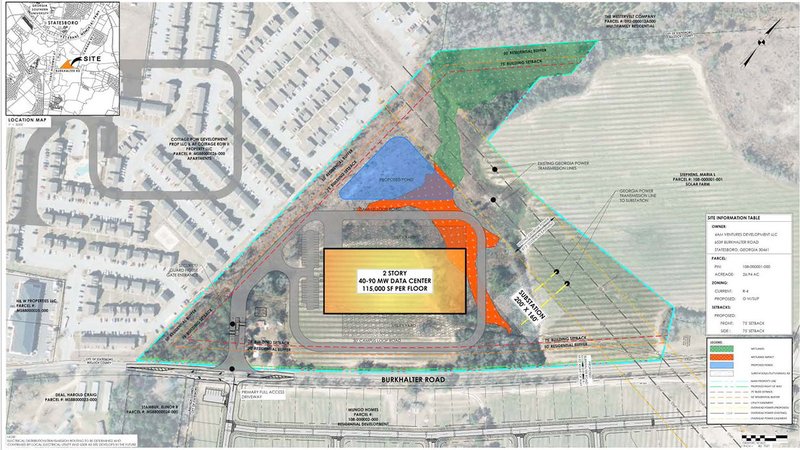
Even with its possible local-record capital investment, the proposed Burkhalter Road data center, in a two-story building, each floor measuring 115,000 square feet on a 27-acre site, would still be much smaller than OpenAI's recently announced 1,400-acre data center campus planned for the Savannah Gateway Industrial Hub in Effingham County. OpenAI has reportedly contracted with Georgia Power for 3.2 gigawatts (in other words 3,200 megawatts) of power for that project. Bagwell and Way have applied to Georgia Power for a 99-megawatt maximum supply from the existing transmission lines beside their site.
"In the region, of course, the Hyundai project, $7.6 billion was their commitment for that entire project," Thompson continued, "and now you've got the Effingham data center thing, which is kind of way out there, with $20 billion."
No user known
Despite the predicted $1.2 billion, or at least "high hundreds of millions" investment, the 4AM Development LLC owners said last week they have no customer, no big artificial intelligence or information technology company, lined up to operate it.
"We're not sure yet," Way said when asked who it will be. "We've been talking to a couple of them, but the operators of these places don't really engage until it's been through the public zoning process. So we're trying to get it through that process, and then we would bring an operator on for the final step of getting the special use permits and all the plans approved."
Someone else asked him who is behind it all.
"We don't have anybody driving this process except for us," Way said. "There's no Microsoft or Open AI working in the background, talking to commissioners. It's just Bobby and I. Thomas & Hutton is a local engineering firm, and we've been working on this with the city directly."
So far, Way and Bagwell are mainly residential developers, establishing subdivisions and sites where homebuilders do the construction. They plan to take a similar approach to the data center, Way said, either selling the property, once it's fully permitted, to a data center builder and user, or partnering "with somebody who is an expert in building these things."
Whoever operates it will have to abide by the development agreement these developers sign with the city, they said.
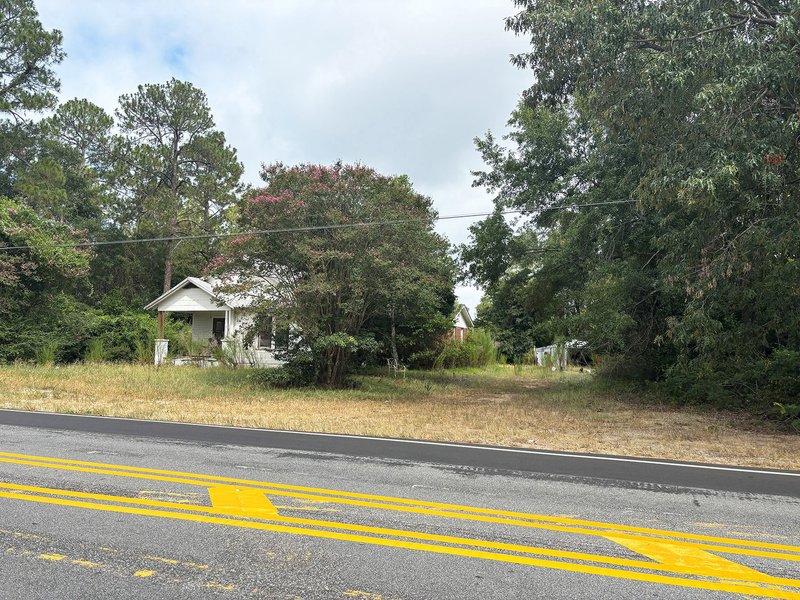
In fact, they purchased the property from a group of Statesboro-based investors who successfully had it annexed into the city in 2024 and rezoned to R-4 for high-density housing. That the 285 housing units it was already approved for would contribute far more traffic in the already stressed Burkhalter Road corridor than a data center with 12 employees was something the developers emphasized during last week's Planning Commission hearing.
'An alternative use'
"Tomorrow we can submit a set of plans to the city for the 285 apartments and we can go through there and we can build all those," Way said to the planning board and citizens in the audience. "Our goal in this was, we saw an alternative use, that we generally know may be less impactful than what it's already zoned for. … This was an honest dialogue that we had with the city, with city staff."
Bagwell, after the hearing, mentioned another factor in their change of direction, the growing local housing supply.
"We kind of dove in, the market in Statesboro got really saturated, so we started looking at alternative uses," he said.
Planning and Development Director Justin Williams, in an interview this week, acknowledged that city staff saw the shift away from more high-density housing as better for the location.
"We do realize that, yeah, there's significant impacts," Williams said. "Burkhalter's just a problematic road, so the opportunity to put something there that could help naturally reduce that (traffic) is a positive overall."
He also acknowledged that the city's research on data centers and drafting of the ordinance started months ago, and said that these particular developers were present at most of the meetings.
"This isn't new to our community that we're talking about this," Williams said. "It's unfortunate that it's kind of where it is right now, but the information being out there is relevant, and I kind of hope the public gets more involved and learns more about what's being proposed."