Visit Statesboro, otherwise known as the Statesboro Convention & Visitors Bureau, is always making a pitch for more visitors on Statesboro and Bulloch County’s behalf. Recently, the bureau’s leadership made an initial pitch to City Council for an increase in the city hotel-motel tax from the current 6% to 8%.
The Visitors Bureau receives 100% of its funding from the city and county “lodging” taxes, noted its Vice President for Marketing and Operations Justin Samples. He did most of the talking for a presentation, with slide projection, during the Sept. 15 mayor and council work session after a few words of introduction from the bureau’s President and CEO Becky Sanders. They are two of Visit Statesboro’s four full-time staff members, and it also has two part-time employees.
The Downtown Statesboro Development Authority and the Averitt Center for the Arts also receive shares of Statesboro’s city lodging tax revenue. But Visit Statesboro currently receives a roughly 50% share, including 41.67% “restricted … by law” to be used for tourism and visitation promotional purposes only, Samples said.
The remainder, earmarked for “product development,” is currently going to pay for the previous construction and renovations for the Farmers Market facility, which he said should be paid off in the spring.
Meanwhile, the Convention and Visitors Bureau also gets 60% of the county’s 5% lodging tax. Smaller shares from the county tax go to such “other partners” as the Chamber of Commerce and Splash in the Boro.
“In a nutshell, our elevator pitch is that we promote anything that will increase tourism and visitation and visitor spending in Bulloch County and Statesboro,” said Sanders. “The focus is obviously a lot in Statesboro because most of the stuff that visitors want to do is within the city limits, and most of the hotels are within the city limits.”
But the bureau promotes events, dining, lodging and attractions throughout the county. It also highlights attractions and events at Georgia Southern University, since the university is a major reason why visitors contribute such a significant share to the local economy.
Visitors do 13% of local spending
In the 12 months that ended Aug. 22, 2025, visitors, as distinguished from residents or commuters, accounted for 13% of spending in Statesboro and Bulloch County, according to a market segment analysis the Visitors Bureau shared from Zartico spending data. Visitors’ dollars made up roughly 80% of spending for accommodations (motels, hotels, bed-and-breakfasts), 19% of spending for outdoor recreation, 12% for food and beverages, 11% for gas and service stations, 10% for retail sales, 9% for health care, 7% for arts and entertainment and 2% for transportation.
Visit Statesboro does “research-based marketing,” Samples emphasized, and shared several different types of data collected for these efforts.
$174 million worth
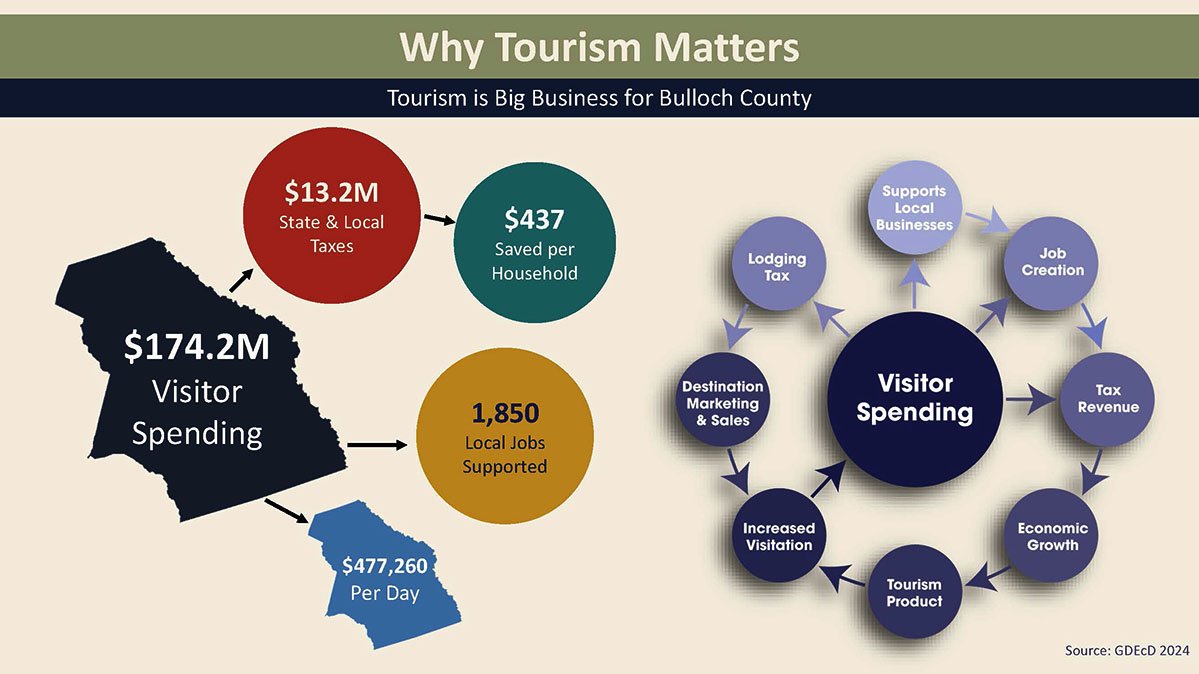
In 2024 alone, visitor spending brought $174.2 million to Bulloch County, according to figures the Visitors Bureau cited from the Georgia Department of Economic Development.
“That generated just over $13 million in state and local taxes, and that went to fund services that residents benefit from without putting the burden on our local residents,” Samples said.
The $13.2 million in 2024 tax revenue consisted mainly of state and local sales taxes, not the lodging taxes. Statesboro’s hotel-motel tax brought in about $1.59 million in 2025 and about $1.4 million in 2025, as noted elsewhere in his report.
By itself, the Visit Statesboro center on South Main Street receives about 30,000 visitors each year, but the organization tracks a much larger number of visitors through hotel-motel data, as well as the interest seen through social media. Statesboro lodging revenue to the hotels and motels topped $16.9 million in 2019, then fell to just under $12.4 million during 2020 with the COVID pandemic. Then the lodging revenue started climbing again, hitting a new peak of almost S31.6 million in 2024 before slowing a little, to just short of $30.5 million, in 2025.
The Visitors Bureau channels its marketing efforts through three routes: “owned media” such as the organization’s website, visitor guide and social media accounts; “paid media” such as print, digital, and social media advertising, pre-roll video and streaming television; and “earned media” such as news reports, influencer features and travel writer visits.
Samples and the slideshow noted some specific, innovative efforts. “This is Statesboro!” is a mobile game app with a Jeopardy-like appearance. To add to visitors’ experiences while in town, the BBQ Trail bases a competition in logging visits to all the local barbecue restaurants, among other trail and contest-type programming. The Sip & Soar campaign highlights the city’s open-container area.
‘Southern Possibility’
But Visit Statesboro’s presentation to the mayor and council highlighted one major campaign with the caveat that the bureau cannot repeat it with its current level of funding.
During the pandemic, the Statesboro Convention & Visitors Bureau was discouraged from promoting in-person gatherings of all kinds but continued to receive some lodging tax money.
“We had a little bit of a pandemic reserve that we had saved up,” Samples said, noting that the money still had to be used for promotional purposes.
After consulting some other Georgia tourism organizations about how best to use the money, the Visit Statesboro leadership launched a “brand campaign,” which was not a “rebranding,” he noted. The bureau hired a marketing agency and produced a campaign that melded the idea of “Southern hospitality” with the variety of experiences available here to promote “Statesboro: A Place of Southern Possibility.”
He showed the council the 60-second video that was the maximum-length TV streaming production. Shorter clips and digital ads had also been released. These featured couples, children or family groups kayaking at Blackwater Preserve, frolicking at Splash in the Boro, visiting the Georgia Southern Museum, meeting a bald eagle at the Raptor Center, and – in one scene – adults raising glasses of wine in celebration.
There was even a “rolling billboard” with scenes wrapped onto a transfer truck.
The slideshow included graphs tracking how the two separate releases, or “flights” of the campaign in fall 2024 and spring 2025 triggered surges of traffic to the Visit Statesboro website lasting two to three months. The spring surge brought more than 40,000 visitor sessions to the site in April 2025, and with the campaign there were roughly 84,000 sessions, nearly 10 times the usual traffic, over the course of two years.
The real payoff was 480 hotel-motel bookings for 870 room nights, Samples said.
“We can’t run this again on today’s funding,” the next slide proclaimed.
The ‘ask’ for 8%
“Of course, there is an ask,” he said.
The slide after that carried a section header, “The Case for 8%.” It included an estimate that increasing Statesboro’s lodging tax from the current 6% to 8% would net more than $531,000 each year in “new visitor-funded revenue.”
According to information the local Visitors Bureau obtained from the Georgia Department of Community Affairs and showed as a bar chart, 8% is the rate levied by 122 communities, making it the single most common rate among the 298 Georgia communities that collect a lodging tax. Second most common is 5%, the rate in 107 communities. Only 25 communities levy a 6% lodging tax, 22 a 7% tax, 21 a 3% tax, and just one community, a 2% tax.
So 41% of the communities with any such tax charge 8%, but Visit Statesboro reported that 85% of those with a tax authorized under the same state law as Statesboro’s already levy the full 8%.
In a comparison chart for area cities, the presentation noted that Swainsboro, Sylvania and Vidalia each have an 8% lodging tax, while Metter has a 7% tax and Statesboro 6%. Waynesboro, Sandersville, Claxton and Glennville levy 5%.
While Statesboro in 2024 collected $1.4 million with a 6% tax, Sylvania collected about $27,000 and Vidalia about $42,000 with their 8% taxes, Visit Statesboro reported.
However, Samples asserted that Statesboro’s competitors are really Georgia’s top 10 visitor market communities. Eight of those, including all of the top six – Atlanta, Savannah, Cobb County, Gwinnett County, College Park and Alpharetta – have an 8% lodging tax.
Statesboro City Manager Charles Penny noted that the local legislation passed by the Georgia General Assembly would be necessary for Statesboro to increase its hotel-motel tax. Samples said City Council would need to start the process but that the request already has support from the area’s legislative delegation.
City Attorney Cain Smith said a city resolution would probably need to be worded as a request to the legislators, and Penny said this could be discussed further during another city work session in October.
Doug Lambert, local developer involved with the Creek on the Blue Mile plan, said its supporters could be interested in backing the increase if a portion from the hotel-motel tax could go to an element of the creek plan as was done for the Farmers Market facility.