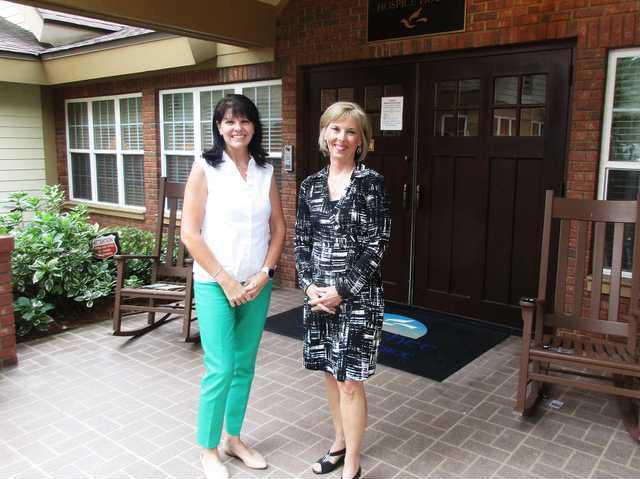
Next week when Ogeechee Area Hospice founder Nancy Bryant retires a second time as the hospice's executive director, she won't exactly be leaving it in the hands of a newcomer.
Incoming executive director Linda Upchurch taught through last semester as an assistant professor in Georgia Southern University's School of Nursing, but has also been working with the hospice since late 2004.
"Linda is so highly respected by our staff that it is going to be, and has been, a wonderful transition, and she really is going to take Ogeechee Area Hospice into a great future," Bryant said. "Hospices have a lot of challenges now, all over the country, a lot of challenges, but Linda is ready for them."
Upchurch takes the lead at a hospice that has been in existence for 22 years and now has 85 employees and about 100 volunteers. Completed in two phases, in 2005 and 2012, the hospice's $7 million in-patient and residential facility on Grady Street in Statesboro has 25 beds, but Ogeechee Area Hospice's emphasis remains on providing in-home care when possible.
"The coordination of care is extremely complex whenever you have, on any given day, 70 or 80 patients at home being cared for, and on any given day, with residential and in-patient, an average census of about 12," Bryant said.
The only nonprofit hospice in its service area, which includes Bulloch, Candler, Evans, Jenkins, Screven and Tattnall counties and parts of Bryan, Effingham and Emanuel counties, Ogeechee Area Hospice now receives about 450 patients a year.
Add the challenges of funding that care primarily from Medicare, Medicaid and private insurance, but in an organization that also serves people who have none of those payment sources, for some idea of the responsibilities.
"There could not be a better person, I think anywhere, to take over this position, than Dr. Linda Upchurch," Bryant said.
It's her specialty
Upchurch holds a doctorate in nursing practice and has made hospice care her specialization. Attaining her bachelor's degree in nursing at Georgia Southern in 2003, she first worked as a nurse in the intensive care unit at East Georgia Regional Medical Center. Then she joined Ogeechee Area Hospice for the first time, full-time, as a registered nurse case manager.
After receiving her master's degree as an adult nurse practitioner, with a focus in hospice and palliative care, from Vanderbilt University in 2007, Upchurch joined the GSU nursing faculty full-time. But she continued to work part-time for the hospice, transitioning to the role of nurse practitioner. Meanwhile, she continued her studies, and was one of the first 11 nurses to attain Georgia Southern's Doctor of Nursing Practice, the highest nurse practitioner degree available, in May 2011.
Ogeechee Area Hospice has always maintained a close relationship with the GSU School of Nursing. Bryant taught there for four years before founding the hospice, and current GSU Interim President Jean Bartels, who came to GSU as chair of the school of nursing and then became dean of the College of Health and Human Sciences, chaired the Ogeechee Area Hospice board for several years.
Upchurch was one of two faculty members university-wide to win the 2015 Award for Excellence in Instruction.
"I had a great experience at Georgia Southern, but I always knew that there was something more for me," she said. "Hospice has always been my home."
In teaching, she made a point of having every student in her class do a rotation in hospice care, with rotations available both at Ogeechee Area Hospice and Hospice Savannah.
"What I found is that we teach our nursing students about care of the whole person, but they were leaving out one of the biggest parts of that, and that was end-of-life care, and so I feel very proud that I was able to take that into that role as an educator in teaching our new nurses about end-of-life care," Upchurch said.
Most nursing students, she said, come in and want to take care of babies, and aren't thinking at first about taking care of people at the end of their lives.
"It's an important aspect of life," Upchurch said. "It's not just death, it's life, until a person dies, and so how do we help people to live until they die? That's what we do here. We focus on life and living, and how can we help somebody to do that in the way that they choose."
They sound alike
In all of this, Upchurch sounds a lot like Bryant, and they traded praise when interviewed together.
Bryant, who has a bachelor's degree in nursing and a master's in community nursing, both from Georgia Southern, was a registered nurse for about 10 years before starting the hospice.
"My main two areas of practice were intensive care and home health, and during all those experiences I realized that there was a better way and that patients and families really needed a lot of support and care at the end of life, and wanted to stay home," she said.
The hospice movement had started in England in the 1960s and spread to the United States by the mid-1970s. But in Statesboro and the surrounding area in the early 1990s, the idea of hospice care was not well known, Bryant said. The nearest hospice agencies were Hospice Savannah and one in Augusta.
"In 1994, here, most people had never heard of hospice care, and at that time if you died at home it was a coroner's case," Bryant said. "And so it was quite a transition that people experienced, little by little, one family to the next, as far as how being at home could be very, very helpful and intimate."
Bryant did the research needed to establish protocols and standards that continue to guide the hospice, her successor observed. She built a team approach involving social workers, chaplains, nurses, nursing assistants, a doctor as medical director, and volunteers.
"It takes vision to create something like this," Upchurch said. "I don't know if she understands, even, the impact that she's had on this community and in the lives of patients and families in this area."
Funding concerns
Before the 2012 addition, the hospice's in-patient facility, with 12 beds, provided only short-term care for acutely ill patients and respite care to give home caregivers a break.
The 13 added residential beds are the one area where the hospice charges fees not covered by Medicare, Medicaid or most insurance.
Room and board in these is $125 a day.
Capital campaigns provided cash for the two phases of the building, although the hospice also has a mortgage.
Thursday, supporters are holding the first-ever campaign to raise funds for the hospice's operating expenses.
"We can no longer rely on our traditional funding from Medicare, Medicaid, private insurance," Bryant said. "It's really dwindling, and we're having a lot of challenges with private insurance. ... We do a lot of indigent care, and it's mounting every year."
Bryant previously retired in January 2015, but when her first successor turned out not to be a good fit for the organization and resigned after a few months, the board asked Bryant to return, said Ted Wynn, Ogeechee Area Hospice board chair. With Upchurch, he said, the board is confident of its decision.
"The two of them have actually worked together, so we feel really confident that Linda is going to step into those big shoes and fill them well," Wynn said.