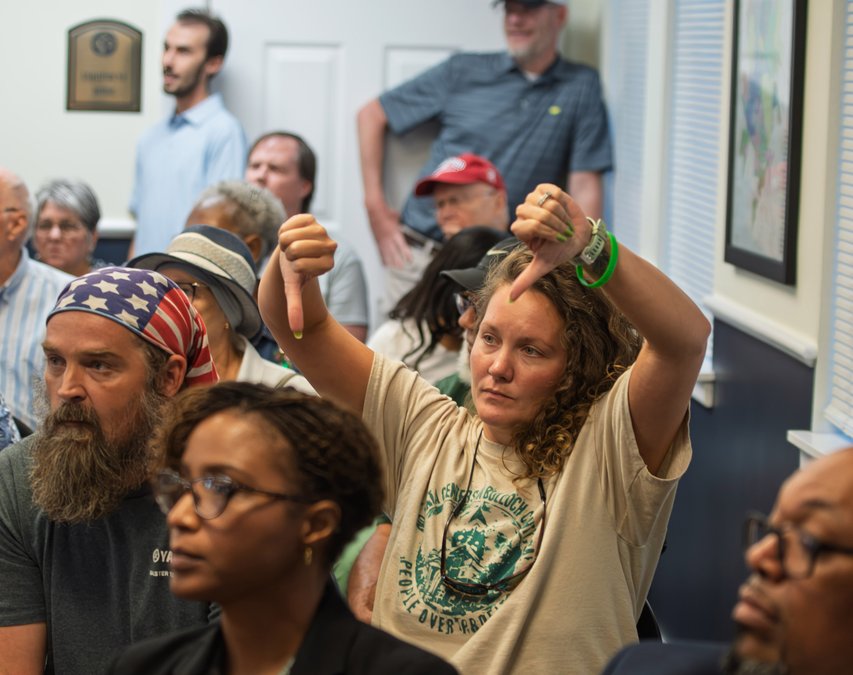
Eleven individual citizens and the nonprofit organization Coastal Communities United filed a petition Thursday seeking to have the Bulloch County Superior Court reverse the Statesboro city government’s rezoning of an almost 27-acre tract on Burkhalter Road as the potential site for a data center.
City Council, by a 3-2 vote Aug. 18, approved a request by the owner and would-be developer of the site to rezone the property from a previous “R-4” high-density residential classification to “O” for office and business. This was after the developers submitted a sketch or a two-story data center with roughly 230,000 square feet of floor space.
“In making this zoning decision the City of Statesboro disregarded its own procedural rules, regulations and ordinances, as well as those propounded by state Legislature,” Coastal Communities United stated in a release to media organizations Friday morning.
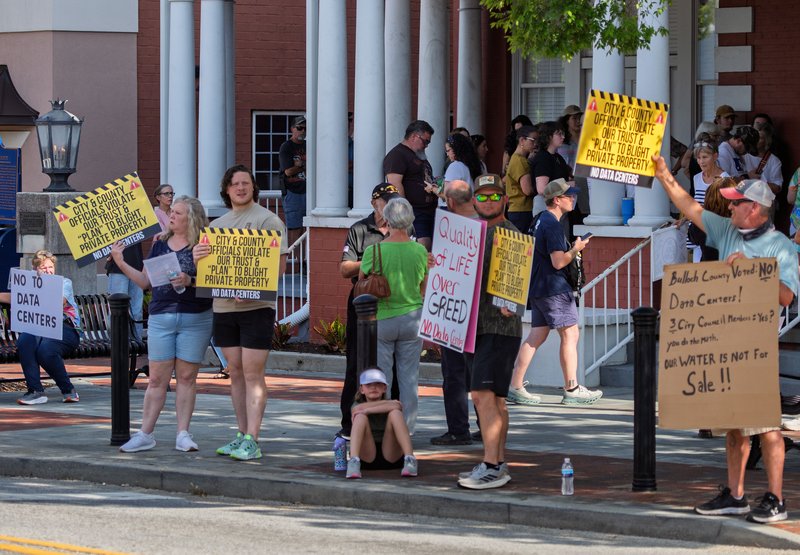
The Statesboro Herald then obtained, through the Superior Court’s online database, a copy of the actual complaint filed with the court.
Filed to meet a 30-day deadline, the Sept. 17 complaint is titled a “petition for review/appeal and request for declaratory judgment,” and names both the city, as a municipal corporation, and 4 AM Development LLC, owner of the 6539 Burkhalter Road site, as defendants.
Described in the complaint as “concerned citizens who own and reside at properties in varying proximity to” the site, the petitioners assert that they “will suffer permanent, irreparable injury and damage” if the zoning decision stands.
Seeks to void rezoning action
“Accordingly, Petitioners request that this Court … find and declare the Zoning Decision by the City of Statesboro to be void, in violation of its own rules and applicable law, and that the Applicant be prohibited from constructing and operating a data center campus on the Subject Property,” states the final sentence on Page 2 of the 30-page petition.
(Original legal-document capitalizations, although preserved in the previous paragraph, are standardized to Associated Press style in some subsequent quotations.)
At this point, the complaint does not state any claim for monetary damages but refers to petitioners having “suffered damages in an amount to be determined” by a judge or jury.
The complaint was signed by Robert Abney Fricks Sr. of Warner Robins as attorney for the petitioners. In the document, he named subgroups of petitioners as “citizens and business owners in Statesboro” or “concerned owner petitioners,” and “sightline owner petitioners” and others as “nearby owner petitioners.”
Close to ‘hyperscale’
As noted in the petition, City Council on June 2 passed an amendment to its Unified Development Code to permit data centers, with certain requirements and limitations.
In fact, this was called the Data Centers Ordinance during city discussions. The “O” or office and business district zoning was one of four classifications where data centers, on lots up to 50 acres, could be allowed as a special use, requiring a special permit approved by the council. At this point, the Burkhalter Road site has been through the zoning process but not the special-use permit process.
“The City of Statesboro's actions through City Council and mayor were an abuse of its zoning powers,” Coastal Communities United asserted in its media release. “The city was made well aware of its failure to follow procedures, potential constitutional violation and citizen upset before making this decision. The public must have due process.
“The city's amendment to allow data centers in O zoning prohibits hyperscale data centers, yet this development is only one megawatt under the hyperscale definition,” the release continued. “These centers do not belong near already built, permitted, and approved condensed housing developments.”
One section of the formal complaint also asserts that a 99-megawatt data center “sits right on the edge of the standard threshold … frequently categorized as ‘hyperscale,’” but a later section states that some of the petitioners purchased their property “never thinking that such a monstrosity like a hyperscale data center would be their neighbor.”
Alleged harms
The complaint asserts that such a data center could hurt the watershed and the Floridan Aquifer both through water usage and wastewater seepage with added chemicals from the center’s cooling system. It asserts negative impacts on neighboring and nearby property from noise and vibrations, increased traffic and a departure of wild animals. The document includes separate lists of “damages unique” to each petitioner subgroup, but lists a reduction in property values first both for “sightline” petitioners and “in varying degrees” for “nearby” owner petitioners.
Attorney Fricks, on behalf of the petitioners, is alleging that the city’s rezoning of the site for the data center constitutes “spot zoning” and amounts to a “taking” of petitioners’ property values by “inverse condemnation.”
Seeks hold on
other decisions
In the closing paragraphs, the petitioners ask that the court declare the zoning decision “invalid, void or stricken.” Citing a provision of state law, the complaint also asserts that filing such a challenge should “stay all legal proceedings in furtherance of the action.”
As of midday Friday, the only other documents on file for this case in the court’s online database were those Fricks had filed Thursday, including minutes and agenda materials from the zoning decision and notices for summonses to be served on city officials and 4AM Development.
Phoned separately between noon and 1 p.m. Friday, City Attorney Cain Smith and City Manager Charles Penny said they had not been served or seen the complaint.
“I’ll review it upon receipt and comment when appropriate,” Smith said.
“We’ve only seen a press release,” Penny said. “We haven’t been served or anything like that, so that’s all I know.”
He noted that he had informed the mayor and council members so that they would not be surprised by media reports.
“The council zones property and that’s what they do,” Pennyadded. “In land use, that’s what council is authorized to do.”