After hearing impassioned citizen opposition to an almost 1-mill property tax hike, Statesboro City Council voted 4-0 Tuesday evening to keep the tax rate at last year’s 8.625 mills. For property owners whose assessed values have risen because of inflation, that’s still about a 20% tax increase above the rollback rate.
However, it won’t be the almost 34% overall increase that had been predicted to result from the previously proposed rate hike. If property values had remained the same, the now abandoned hike from the 2024 and 2025 rate of 8.625 mills to a new rate of to 9.6 mills would have been an 11.3% increase.
But there was inflation in real estate values, and Statesboro’s city “rollback rate” this year, as determined by the Bulloch County Board of Tax Assessors staff, would have been 7.165 mills. So, in proposing a rate of 9.6 mills, the city government had acknowledged a potential increase of 33.98% in its formal notices. Under a Georgia law known as the Taxpayers’ Bill of Rights, local governments that do not reduce their millage to counteract inflation in assessed values must advertise any resulting increase as the difference from the potential rollback rate.
Over the course of the council’s three mandatory public hearings on the tax increase proposal, a total of 10 citizens signed up and spoke against it. The first two hearings were at noon and 6 p.m. Sept. 8, and the final hearing was part of the Tuesday, Sept. 15 regular 5:30 p.m. council meeting, where the council’s vote to set the millage followed.
Between the citizen speakers, Mayor Jonathan McCollar spoke at length to defend the city officials’ truthfulness, transparency, and compassion for citizens in a time of inflation and financial hardships. “Statesboro, we’re better than this!” he said, while stating that some recent criticisms of himself and the council members crossed the line into personal attacks and groundless accusations.
Council’s ‘options’
When the time came for council discussion, the four current, voting members from the council districts spoke only briefly.
District 1 Councilmember Tangie Johnson asked what would happen if the council kept the rate at 8.625 mills instead of increasing to 9.6.
City Manager Charles Penny noted that, during budget discussions earlier in the year, he had said that without a tax increase, the city government would have to cut the jobs of 60 employees. It was never specified whether this would be at the full rollback rate or would also apply if the millage were only kept the same.
“You have two options. …,” Penny said, in answering Johnson’s question. “You could cut the funds to do it, but I would need to cut 60 positions…. So if the council is interested in doing that, I could still do it. I could cut those employees, so out of 360 people, I’d have to cut 60 people in order to be able to cover that.”
The second option he suggested was spending from fund balance.
In his presentation of the tax increase rationale, Penny had stated that the city’s general-fund balance, needed as a “rainy day” reserve for disasters such as hurricanes or other unexpected events, had fallen below the council’s own guideline of 25% of current-year budgeted expenditures. It is now around 20%, he reported.
Even the increase to 9.6 mills would not have rebuilt the balance to 25%, but it could have prevented further erosion, according to Penny.
“If you leave (the rate at 8.625 mills), then we’re going to be short about $1.4 million, and you can pull that out of fund balance, so again, your fund balance right now is below your policy. …,” he told the council members. “At $6.5 million you’re at 20 percent, so if you pull $1.4 million … you’re going to drop it to 15 (percent). … So then we’d also have to look at changing the policy.”
That will be necessary to satisfy auditors, he said.
‘Keep it the same’
“I would agree on the side of keeping it the same and pulling from the fund balances so we keep all of the people if possible,” District 3 Councilmember Ginny Hendley spoke up. “I feel like it’s crept up so much and a lot of people are hurting … I’d make a motion to keep it the same.”
District 5 Councilmember Shari Barr indicated she was on board for this.
“And I think we need to be very clear, with this motion,” McCollar interjected, “in regards to the two recommendations that Mr. Penny has provided for us … because we’re not letting nobody down. We’re not letting anybody go.”
Hendley then worded her motion to call for “the same millage rate that we’re at now without letting any employees go.”
Barr seconded the motion. Johnson and District 4’s John Riggs also voted “yes.”
In the city manager’s remarks near the end of the meeting, Penny said wants to have a proposed policy change away from the 25% minimum fund balance developed for the council’s consideration in October.
This will require some calculation, he said. The effects of the current-year decision on where the millage rate will end up in 2027 after a full year’s revenue is received from the new Floating Local Option Sales Tax also remain to be determined.
With about $3.5 million projected from a full year of FLOST, Penny and staff had predicted that if the property tax rate had been increased to 9.6 mills this year, the city would be able to roll it back by about 2.1 mills, to around 7.5 mills, next year.
Rate hike rationale
Before each hearing, Penny presented the city’s rationale for the property tax increase. He and McCollar cited, as the main reason, the split with the Bulloch County government more than a year ago over funding of fire departments. That removed about $2.7 million the city would have received from the county for service by the Statesboro Fire Department into the former five-mile fire district. Then a three-year federal grant that the city was awarded in 2023 to hire an additional 12 full-time firefighters expired in August, amounting to another $703,000 loss in annual funding.
In 2025 and early 2026, Statesboro officials explored the idea of charging a monthly fire service fee to all in-town addresses to make up for the “gap” first estimated at $4.3 million, in the SFD’s funding.
But the council shelved the fire fee idea in April after learning that some Georgia cities and counties have rescinded their fees and had to make refunds after lawsuits from property owners.
Five months of FLOST revenue supplied $1.4 million, and the city staff reduced the predicted property tax rate increase to 2.129 mills. Then growth in the tax digest – from construction of new businesses and homes and building improvements in the past year – came in at about 13% instead of the 8% prediction used in budgeting. So, until Tuesday, the final proposal was a 0.975-mill increase.
The budget includes no new positions for additional employees in any city department, but it does provide a 2% across-the-board raise – Penny called it a “pay adjustment” – for existing positions.
Outspoken citizens
But citizens who spoke were unimpressed.
Up first Tuesday, Sarah Thompson, who has called other city and county actions or proposals unconstitutional, again made that assertion, and said the council “is operating out of order” and unable to take valid actions because the District 2 seat is currently vacant. She also cited the “Charter of 1866” and had copies given to council members.
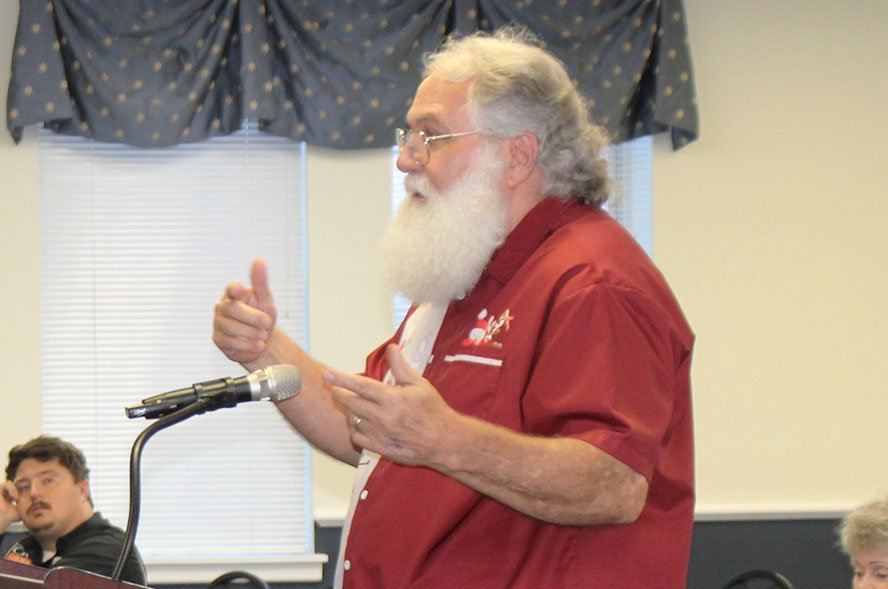
Kenneth Jackson, real estate agent, brought a red plastic bucket with the bottom removed to say money would fall through it, as a metaphor for the city’s budget. He suggested the city could sell off real estate it owns to raise money.
Kathleen Keehner, one of three candidates vying for the vacant District 2 council seat in a Nov. 3 council election, asserted that the city manager and other staff members “are grossly overpaid,” creating “huge holes in the budget.”
Capt. Joseph Charron said he was speaking strictly in his personal capacity as a Statesboro homeowner and private citizen, but noted his U.S. Army position as a NATO communications staff officer to inform the council he was “a fellow holder of public trust.”
“In my line of work, integrity means owning your mistakes,” Charron said. “If I mismanaged my budget or allowed an operational partnership or a contract to lapse, I don’t get to shift the burden onto the personnel in my command.”
Referring to “the fire agreement fracture,” he said the city had two years to find a remedy but “chose to pass 100 percent of that administrative failure straight to the taxpayers.”