Siblings Irene Parrish Dowdell, 95, and Charles Jonathan “C.J.” Parrish, 93, felt strongly enough about the Willow Hill community they left behind as young children to make the trip back to Georgia for the first Willow Hill Heritage Festival.
Saturday’s opening included the dedication of a historical marker on U.S. Highway 80 and a ribbon cutting for the school’s rebirth as the Willow Hill Heritage & Renaissance Center with its museum exhibits. Today, the festival continues with children’s games, food and crafts vending, a health information exhibit and live music from noon to 6 p.m.
Mr. Parrish travelled from his home in Westchester, Ohio. Mrs. Dowdell made the trip from Jacksonville, Fla., where she attended nursing school and now lives in retirement after a long career in nursing. Their great grandparents, Moses Parrish (1842-1930) and Isabella Donaldson Parrish, were among the four families of former slaves who founded the Willow Hill School in 1874, nine years after the Civil War.
When C.J. Parrish attended first grade there in 1923-24, the school was “a little shack” with one classroom. It stood “down there a piece” from the current building, he said, indicating the direction.
His memories of that year include one colorful incident that was painful at the time. Some older boys, his cousins, were playing baseball at school one day using a plank for a bat and a homemade rag ball. His cousin John swung at the ball and knocked the 5-year-old Parrish out flat. He can still point to a scar over his eye, 88 years later.
He also recalls that the principal, Professor Kemp, as a stern disciplinarian.
“Professor Kemp was the main man. He was the one that wielded the stick to the bad boys,” Parrish said. “It was legal then.”
His sister, now Mrs. Dowdell, attended the school only one summer session. They remember taking a buggy ride to catch the train in February 1924 when their parents, William Washington “Doc” Parrish and Maggie Carraway Parrish, moved the family to Cincinnati. Although a large landowner at the time in Bulloch County, William Parrish left for a factory job in Ohio after struggling to feed his family as a farmer, his son explained.
“The boll weevil had eaten up all the cotton and there was no way to make a living,” he said. “At Christmastime we didn’t even have food to put on the table”
Younger sister Geraldine Parrish Cheek, 75, also joined them for the festival although she never called Willow Hill home. She now lives in Hampton, Va., and the three of them are the survivors of the 10 Parrish children.
Faculty honored
Dr. Alvin Jackson, president of the Willow Hill Heritage & Renaissance Center Inc., welcomed them as part of the opening ceremonies. He also publicly recognized several teachers and a principal who served at Willow Hill.
Among them, Julius Abraham, a Statesboro resident, was principal in the 1960s. Sarah Lee, who taught third grade in that time period, still lives nearby. Agnes Young taught at Willow Hill from 1955 until the school closed temporarily for desegregation in 1969-70, then completed a 32-year career at the Marvin Pittman, Sallie Zetterower and Julia P. Bryant schools.
“It’s good to preserve history like this,” Young said. “Dr. Jackson has been doing wonderful work and I hope he gets the support he needs to make it suitable as a community center for everybody, with daily activities. I hope it develops into that kind of thing.”
As the new historical marker notes, Willow Hill School was founded by members of the Donaldson, Hall, Parrish and Riggs families. The first building was a former turpentine shanty. The school remained family-owned until 1920, when the Bulloch County Board of Education purchased the property for $18.
The current building, the sixth at Willow Hill, was constructed in 1954 and remained a school for black children until desegregation in 1970. It then operated as a racially integrated elementary school until 1999, when it closed, after 125 years, as the oldest school in the county.
This weekend’s festival marks the culmination of efforts begun in 2005, when Willow Hill alumni and descendants of the founding families purchased the school at auction.
Marker dedication
“This is a historic moment for the Willow Hill Community!” shouted Jackson, standing in the intersection of U.S. Highway 280 and Willow Hill Road.
Willow Hill supporters and local officials gathered there for the dedication of the historical marker that launched the festival at 9 a.m. Saturday.
“This is really, really a very special day,” Jackson said. “It’s very special because it’s a great example of many, many people in the community and in the county coming together to create this event.”
Made of cast aluminum with letters in gold leaf, the marker is the first of many the Bulloch County Historical Society plans to place around the county, said Bill Waters, a Historical Society board member and chairman of the historical marker program.
The next, to be placed this month, will be at the Darby Lumber Co. mill site in Statesboro, and the third, commemorating the site of Old Portal, will be dedicated during the Portal Turpentine Festival, Waters said.
His wife, Virginia Anne Franklin Waters, is the Historical Society’s project coordinator. Georgia Southern University Museum director Brent Tharp worked with the Waterses and Willow Hill Heritage & Renaissance Center volunteers to provide the historical summary on the sign.
They joined in the opening ceremonies, as did Portal Mayor Larry Motes, Statesboro Mayor Joe Brannen, state Sen. Jack Hill, and representatives of the Chamber of Commerce and other organizations. Chairman Garrett Nevil of the Bulloch County Commissioners read a proclamation that also included a historical summary.
Commissioner Ray Mosley, a Willow Hill alumnus, helped plan the event as a member of the Heritage & Renaissance Center board.
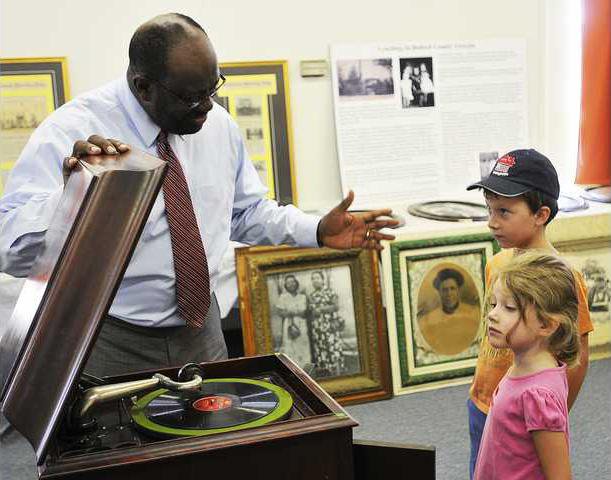
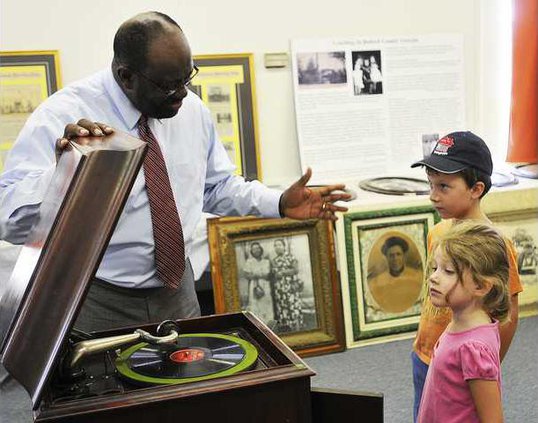
Inside the center, volunteers had installed historical exhibits, some of which will remain as part of the center’s permanent museum.
The museum
A photo gallery entitled “A Walk Through History” preserves images from the school’s history. One picture shows the charred post that remained after the Ku Klux Klan burned a cross outside the school in 1946 in an effort to intimidate black citizens who were meeting inside. Undeterred, many voted in the next day’s state election, the first time black citizens had voted in Bulloch County since the Reconstruction period just after the Civil War.
Also preserved are recordings Jackson has made in interviews has made over the past 25 years with older black citizens from Willow Hill, throughout Bulloch County, and beyond.
Organizers hope the center will become a venue for continuing education and community health programs, as well as the museum. They are also hoping that this year’s festival will be the first of many, recurring annually. About 120 people were on hand for Saturday’s ribbon cutting, which followed a parade from the historical marker led by the Portal Middle-High School Band.
“We have a great turnout. We just had a great parade, and everything is just going as planned,” said festival chairperson Patricia Harden Willis.
Bulloch history comes alive at Willow Hill Festival
Alums, ancestors celebrate school, common heritage