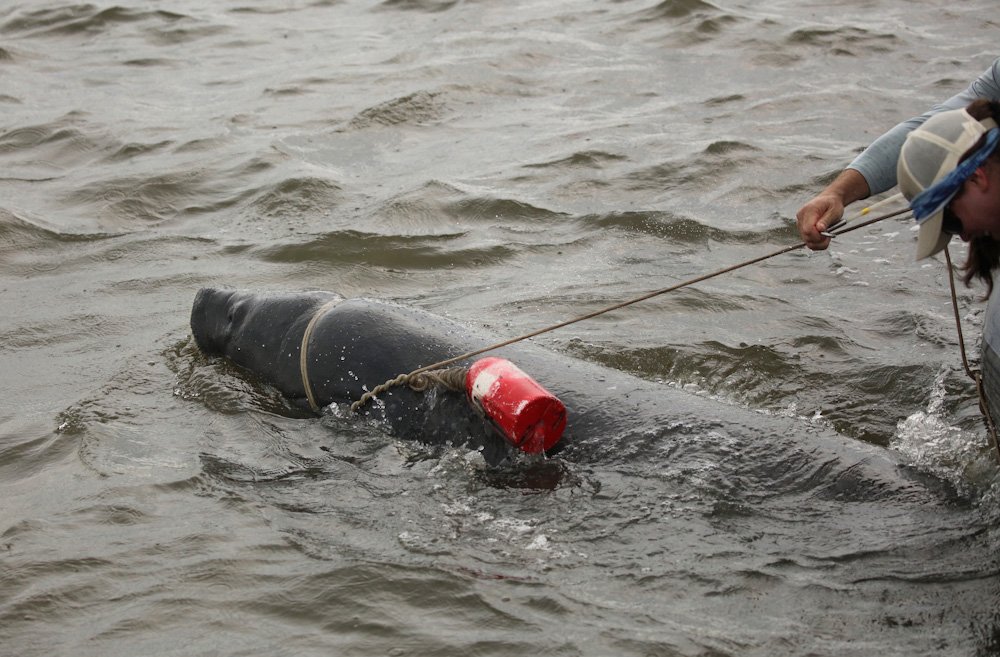
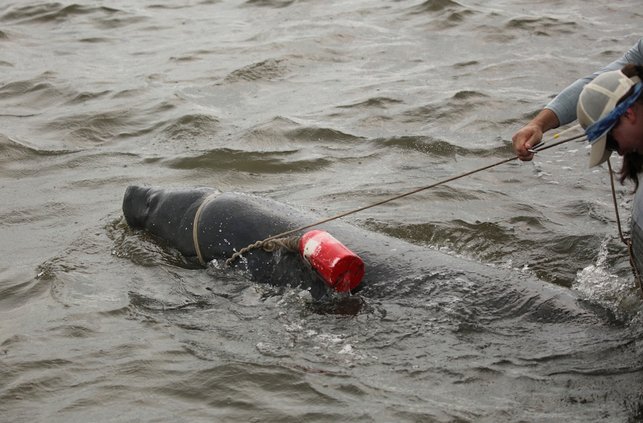
BRUNSWICK – A manatee is swimming free again thanks to a fishing guide who reported the animal tangled in crab trap lines and the team of Georgia wildlife experts that rallied to rescue it.
The drama played out over two days last week on the Mackay and Hampton rivers off St. Simons Island and Brunswick.
Though often unnoticed in turbid coastal waters, Florida manatees are 1,000-pound-plus, federally protected marine mammals that migrate from Florida into Georgia and the Carolinas each spring into early fall to feed on abundant marsh plants and algae.
But the call and photographs from St. Simons’ Capt. Davis Galland on July 29 revealed a rarity: the first documented entanglement of a manatee in Georgia. The adult female had the line and buoy from a commercial crab pot wrapped tightly around her body, just behind the head and encircling her right pectoral flipper, said senior wildlife biologist Jessica Thompson, who leads the Georgia Department of Natural Resources’ Marine Mammal Program.
DNR officials responded quickly, attaching a satellite tracking tag and cutting away the anchoring crab trap before a storm chased the crew and Galland, who stayed to see if help was needed, off the water.
The next day, a three-boat, multi-state group including DNR, the Florida Fish and Wildlife Conservation Commission, Clearwater Marine Aquarium Research Institute, the U.S. Fish and Wildlife Service and the Savannah State University Dolphin Sciences Lab managed to completely free the manatee.
It wasn’t easy. The plan was to pull the manatee onto Florida FWC’s manatee rescue boat using a specialized net so she could be assessed and all gear removed. Yet two smaller manatees – at least one was a calf – stayed too close for this approach.
The group worked through alternatives, keeping the safety of the animals and staff in mind. Although usually slow and docile, manatees are powerful and under stress can be unpredictable and move fast.
By early afternoon, members had removed the buoy and remaining line, which was beginning to cut into the manatee’s skin. Thompson said the successful effort involved skills learned in disentangling dolphins and North Atlantic right whales from commercial fishing gear, and highlighted the group’s collaborative approach and experience in working with marine mammals.
“We knew the entanglement was life-threatening without human intervention, and that intervening posed a very high risk for the responders and the manatees,” said Jessica Thompson, Marine Mammal Program manager with DNR’s Wildlife Resources Division. “I am grateful for our DNR team and for being able to call on colleagues whose collective expertise gained during years of manatee rescues and captures, field observations of manatee behavior, and marine mammal disentanglement made this a success.”
If you see or photograph an entangled, entrapped, injured or dead manatee, contact (800) 2-SAVE-ME (800-272-8363). Provide the date, time, location or coordinates, plus photos, if possible. Do not try to intervene: The on-call biologist will assess the situation.