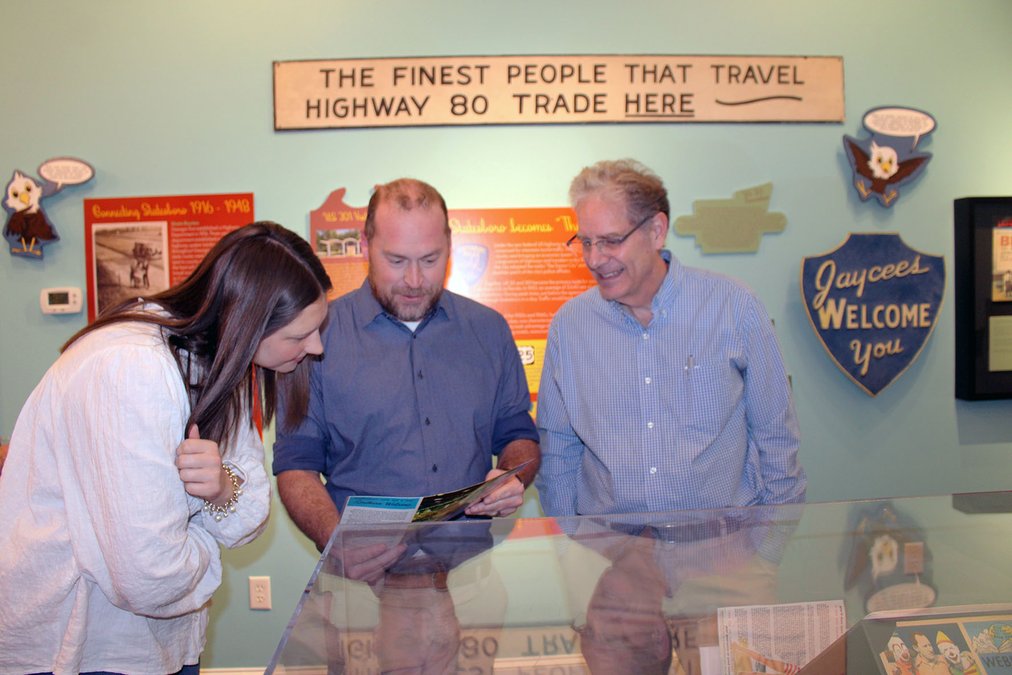
“Statesboro, the Tourist City,” the latest museum exhibit at the Visit Statesboro Center on South Main Street, celebrates the larger tradition that the center is part of, and has opened in the Statesboro Convention & Visitors Bureau’s 40th anniversary year.
Now, Statesboro is no Orlando, not quite a Charleston or Savannah, certainly not a Washington, D.C. or a Hollywood. So maybe by the end of their run those “Statesboro, the Tourist City” patches that graced the shoulders of Statesboro police officers’ uniforms for a few decades, up into the 1990s, drew some wondering smiles.
But if you researched it, as exhibit creator Dr. Brent Tharp and some of his friends at the Visitors Bureau and the Bulloch County Historical Society certainly have, you would find that Statesboro has a robust, more than century-long history of welcoming and accommodating tourists.
The railroads arrived in the 1890s, and it’s not for nothing that the Visit Statesboro Center’s permanent attractions include a bench out in front with a nearly life-size statue of Blind Willie McTell.
When McTell, the Piedmont blues singer-songwriter, in the original 1928 recording of the “Statesboro Blues” sang, “Big 80 left Savannah, Lord, and did not stop …” that was a locomotive pulling a passenger train, as the blues man apparently went “up the country” on the now long-vanished Savannah & Statesboro Railway.
Of course, the Jaeckel Hotel, which opened in 1905 and now serves as Statesboro City Hall, was originally a hotel for travelers arriving by railroad, and it wasn’t Statesboro’s first. You can read the names of other hotels from the era, some built in the 1890s, in the “Railroads and Hotels” portion of the exhibit.
First Golden Age
But the “Golden Age of Travel Tourism” when Statesboro gave itself the “Tourist City” nickname, came later. After the Good Roads Movement of late 1870s to the 1920s led to highways being built across the United States, Statesboro missed out on the original north-south Dixie Highway route, which was charted through Sylvania on the other side of the Ogeechee River.
But then the Dixie Overland Highway, which became U.S. Highway 80, was built from coast to coast, including through Statesboro. After U.S. Highway 301 was paved through town in the late 1940s, Statesboro boomed as a stopover at the confluence of three federal routes. U.S. 301/25 funneled traffic from northern states to Florida, and 80 provided a connection eastward to Savannah and Tybee Island.
So “The Tourism City” nickname was introduced.
“It was a nod to this incredible fact that U.S. 80, U.S. 25 and U.S. 301 all crisscrossed right here in this city and made it the Tourist City. I think by the ’90s or so, when they finally quit using that title, ‘The Tourist City,’ people probably didn’t understand what that meant anymore,” Tharp said, in an interview at last week’s exhibit opening.
However, during that golden age, Department of Transportation studies “showed that at peak times 40,000 cars a day were traveling through Statesboro,” he said. “They would back up for miles on either side of town. I think people who didn’t know that would be shocked.”
At the time, the highways had only two lanes.
You can see one of those SPD shoulder patches, stitched with a tiny map showing the nexus of highways, beside a menu from Mrs. Bryant’s Kitchen in a display case at the exhibit. Mrs. Bryant’s, which opened in 1954, was one of the best known of the now vanished, locally owned restaurants that catered to travelers.
A panel near a corner acknowledges that through much of that age, restaurants and motels remained racially segregated. Beside it, a holder contains a book with selections from the “Green Book” guides that were published for African American travelers from 1936 until 1966.
On the end wall, a large vinyl graphic map of Statesboro displays postcard images and locations of a number of Golden Age businesses: the Aldred Hotelcourt, Long’s Resaurant, Lee’s Restaurant, the Biltmore Lodge & Restaurant, Stuckey’s, Howard Johnson’s and others.
Help from his friends
“Frank Parker and Walt Strickland and Virginia Anne Waters all did a lot of work and helped me to research it,” Tharp said, “and they all knew about those hotels and restaurants and trying to locate them all and get them all on the map, and Virginia Anne’s postcard collection helped us to visually search, and it’s been great.”
Those project contributors are members of the Bulloch County Historical Society, of which Tharp is a past president. Waters, the society’s executive director, owns the largest known collection of Statesboro and Bulloch County-related postcards, from which the images on the map were chosen.
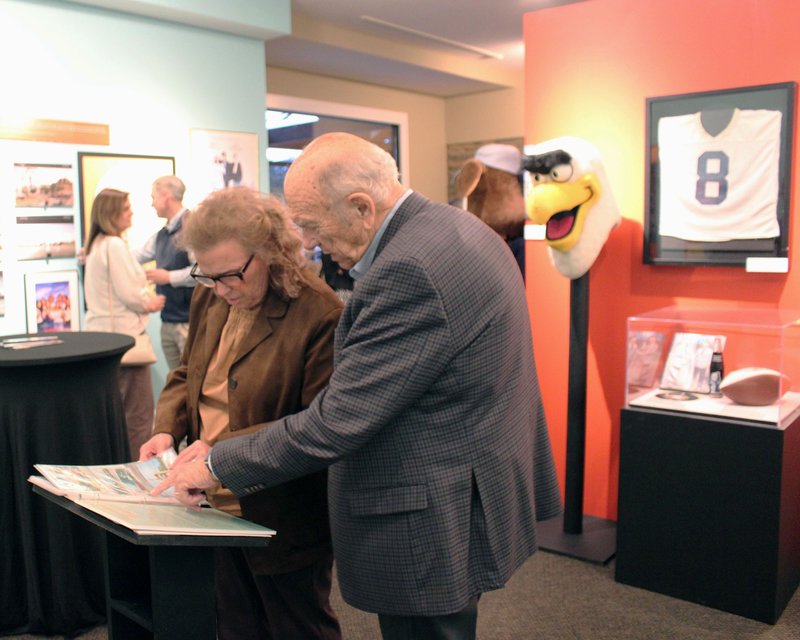
Strickland also had postcard collection and contributed those placed in a binder on the pedestal in front of the map.
Tharp also credited graphic designer Courtney Meihoff and Visitor Center Manager Murphy McRae for their work on the exhibit.
Not a student project
Tharp, who retired last summer as director of the Georgia Southern University Museum, helped establish the Museum on Main tradition at the Visit Statesboro Center around the time the center opened in 2014. Graduate students in the Museum Studies classes he used to teach did the research and designed the exhibits, such as the one in 2019 on the musical career of the Georgia-born singer-songwriter Otis Redding and a 2024-2025 exhibit about the Battle of Brier Creek, fought near the Savannah River during the American Revolution.
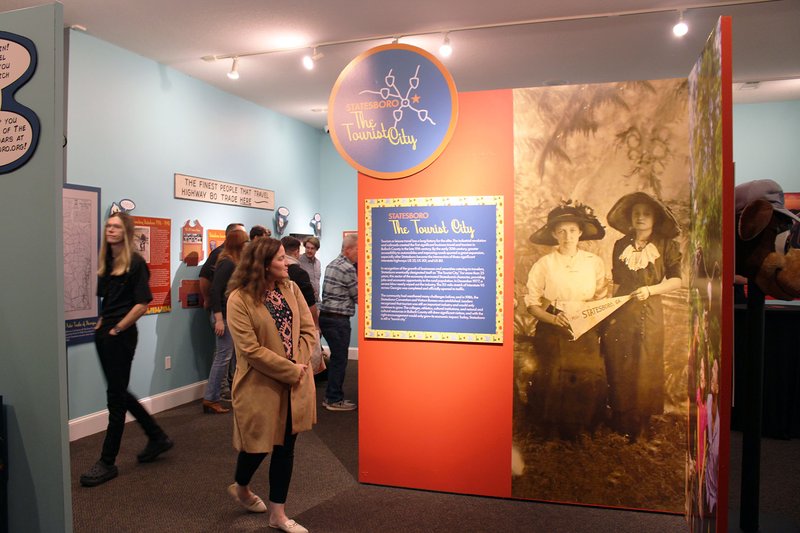
However, the “Tourist City” exhibit, which debuted Nov. 18, is not a student project. The most recent GS Museum Studies exhibit instead went up at the university’s Interdisciplinary Academic Building. Meanwhile, Tharp remains a member of the Statesboro Convention & Visitors Bureau board.
“That left us without one here, and so I told the staff, no problem, let’s put together an exhibit on our own that will be here until we see what the new setup is, and the perfect thing was the 40th anniversary of the SCVB is this year,” Tharp said.
In fact, he had already been doing a little research on tourism-related materials with those fellow Historical Society members.
Second Golden Age
“So I said, how about a history of tourism? I mean … it will be a great time to look at this Golden Age of Travel Tourism that was sort of 1946 or 1972 or so, and then the fact that really that second golden age was when they realized that we don’t need to just rely on people passing through on their way to Florida and that in fact, we’re a destination ourselves,” Tharp told the Statesboro Herald.
The first Golden Age had been brought to a close by the completion of the interstate highways, I-95 and I-16, in the mid-1970s. Tourist traffic through Statesboro vanished almost overnight.
Then it was “heritage tourism and sports tourism, and all the things we have with the establishment of this CVB, that created this second golden age,’ Tharp said.
So there’s a wall panel in the middle of the exhibit about the role that Georgia Southern Eagles sports, and especially football since the rebirth under the renowned Coach Erk Russell in 1982, played in making Statesboro a destination. One of Tracy Ham’s jerseys, circa 1986, is hanging there.
Along the front wall of the visitor center, hinged panels display images from seven movies shot in part in Statesboro and Bulloch County. Visitors can try to identify the movies, then lift the panels to see the names.
During the reception, current Statesboro Convention & Visitors Bureau Chairman Bryan Davis spoke in recognition of the bureau’s 40th anniversary and introduced Doug Lambert, as “the person who helped start it all” in 1986.
Lambert, the SCVB’s charter president, noted that the Georgia General Assembly in 1985 passed a law allowing cities and counties to propose a hotel-motel tax, with the money to be used for promoting tourism.
“Well, I was on the state hotel board at the time, and that sounded like a pretty good deal to me,” Lambert said. “But at the time we were the smallest community in the state of Georgia to have a hotel tax, and we formed it in 1986.”
The Visitors Center was created 28 years later through the renovation of the former Shoney’s restaurant building.