By a 3-2 vote, including Mayor Jonathan McCollar’s tiebreaker, Statesboro City Council on Tuesday evening approved a request from 4AM Development LLC to rezone its almost 27-acre site on Burkhalter Road for a two-story data center with roughly 230,000 square feet of floor space.
District 5 Councilmember Shari Barr first made a motion, seconded by District 4’s John Riggs, to deny the request that the property be rezoned from “R-4” high-density residential to “O” for office and business. But then District 1 Councilmember Tangie Johnson spoke up to say that she works in a place that includes a data center – she meant at Georgia Southern University – and is not opposed to them.
“I’ve been in much prayer regarding this data center,” Johnson said. “I work for a facility that has one. This facility houses students, and it’s right here it the city of Statesboro. I use the technology from a data center. Anytime you hit ‘save’ on any device that you have, if you’re saving something, it has to go and be stored somewhere. … I’m not against data centers.”
She also noted the existence of a “mini” data center on Brannen Street near the Walmart Supercenter, and said she would support the zoning for the larger proposed data center.
Then District 3 Councilmember Ginny Hendley spoke.
“I also don’t have a problem with the zoning; it’s staff approved, and staff knows what they’re doing,” Hendley said. “I don’t see a problem with it.”
So the vote to deny was split 2-2, and McCollar voted to defeat that motion.
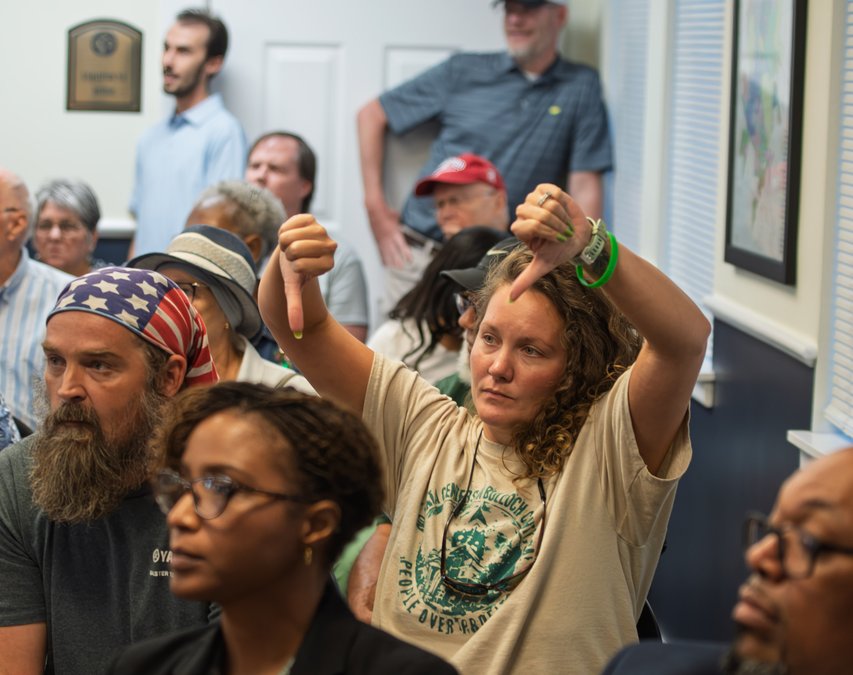
As often happens when motions are made in the negative and go down to defeat, this caused some confusion. So at first, people opposed to the rezoning applauded.
But the mayor explained the situation. Then Hendley made the motion to approve the rezoning with the one recommended condition, Johnson seconded, and McCollar broke the tie with a “yes” vote, approving the rezoning.
The 4AM Development company owns the site on the edge of Statesboro’s city limits.
The company’s owner partners, Bobby Bagwell of Augusta and Charles C. Way of Savannah, mainly residential developers until now, have said they have no big artificial intelligence or information technology company – no Microsoft or Open AI – lined up to operate the data center. Instead, they say they have been talking to a couple of potential operators and intend to select one now that the zoning approval is in hand.

This led some of the opposition speakers to assert that the data center would be built “on spec,” and Riggs asked if that were so.
“This is not going to be built on spec,” Way said. “The fact is that most data center users and operators generally do not get engaged until after a property is sufficiently zoned, and so we are zoning it speculatively, but there is zero chance that they’re going to build this speculatively.”
Beyond the zoning change to “O” for office, the project will still face another hurdle, the “special use” requirement of the city’s Data Center Ordinance, in effect since June 2. “O” is one of four zones that such centers, up to 50 acres and no larger, are allowed in, but only as special uses requiring a further hearing process and council approval.
“The only thing we’re talking about tonight is rezoning. …,” the mayor had said before either of the motions and his two tiebreaker votes. “Tonight is not an end-all, be-all situation. I think it was mentioned a little bit vicariously earlier, but the request would have to come to us via a special permit. … The last stand is they’ve got to come back and apply for a special permit and this body gets to say yay or nay to that.”
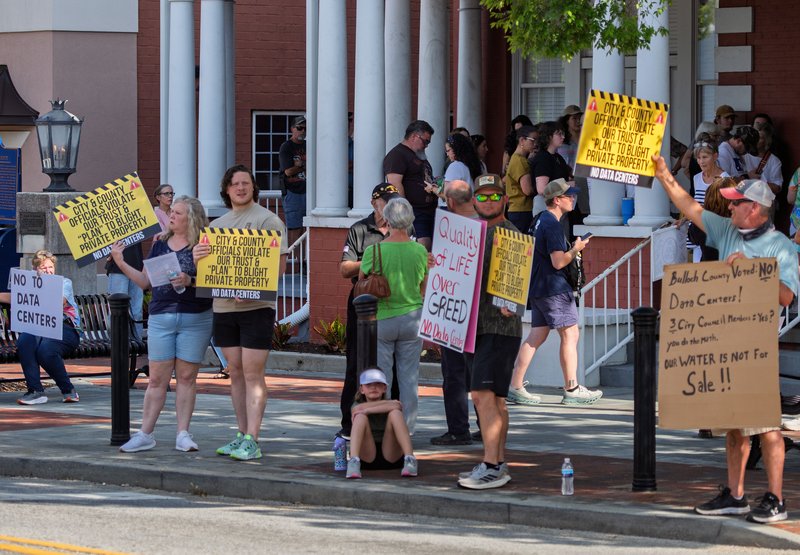
During Tuesday’s hearing, which was part of a longer meeting, citizens opposed to or concerned about the data center proposal filled the council chamber and the second floor corridor of City Hall to their 133-person fire code capacity, while others waited downstairs in the lobby and a crowd protested outside.
Even inside the meeting, muffled chants and honking of vehicle horns could occasionally be heard.
Concerns voiced by citizens during the hearing centered on noise, water usage, environmental impact and alleged conflict with the area’s Developing Neighborhood character area designation in the city’s Comprehensive Plan.
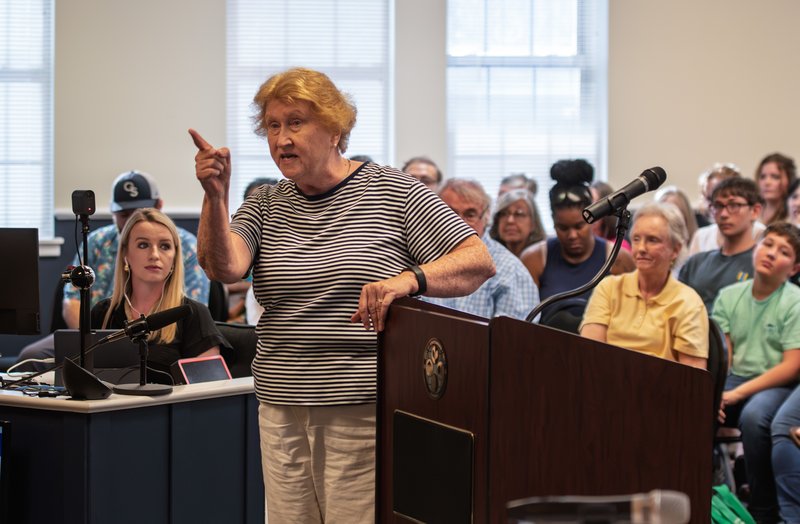
Some of the opposition’s concerns and comments are being reported in a separate story.
Supposed $1.2B project
Private investment in the data center project will depend on the ultimate design but would be “somewhere in the high hundreds of millions of dollars,” Way has said. A “fiscal impact” analysis conducted by Economic Impact Group LLC for the Development Authority of Bulloch County, at the request of and funded by the developers, suggested a $1.2 billion total 10-year investment.
But the data center is projected to have only about 12 full-time employees and thus to create relatively low demand for public services. So, the analysis projected 10-year “net benefits” in tax revenue of more than $20 million each to the Statesboro city government, Bulloch County government and Bulloch County Schools, above related expenses.
Further requirements
Under the Technological Facilities and Data Centers Ordinance, a city law enacted by a 3-1 council vote on June 2, any data center is required to use a closed-loop system for cooling and city water and wastewater connections, not a private well or septic system. It is also required to have a water management plan.
Ambient noise limits at the property line are to be enforced with testing around a roughly 50-decibel level. An economic impact report showing positive results for the community and a decommissioning plan for eventual shutdown are required.
The 4AM Development LLC developers have already submitted the “fiscal impact” report completed in May and a water feasibility management plan, dated July 8.
The water management plan, prepared for the developers by the local engineering firm Thomas & Hutton, projects a 6,000- to 10,000-gallon closed-loop cooling system with a 1% loss rate, requiring 30 to 100 gallons per day of “makeup” water to replenish for evaporation and other losses.
But the average daily “domestic” need, such as for employee restrooms, is projected at 300 gpd, for total average daily cooling and domestic consumption of 330-400 gpd, and a peak total demand of 1,000 gallons per day, but an average of 12,000 gallons a month.
However, the initial system fill-up was not included in those figures, but estimated separately, at 10,000 gallons, and added to the daily estimate for a total estimate of 156,000 gallons per year.

Apartments would use more water
But the water management plan report contrasts this with a “residential equivalent demand” for a 240-unit housing development of 72,000 gallons per day, 2.16 million gallons a month, or 26.28 million gallons a year.
“This number represents approximately 170 times greater water demand than the anticipated yearly demand of the proposed data center development,” Thomas and Hutton’s report notes.
The 4AM Development owners purchased the tract from a Statesboro-based ownership group that had the land annexed into the city in January 2024 and rezoned to R-4 for high-density housing, up to 285 units.
Both the current developers and some city staff members have presented the data center as an “alternative use” that would use less water and produce much less traffic than the apartments.
Noise regulation
During the previous Statesboro Planning Commission hearing on the project Aug. 4, city Planning and Development Director Justin Williams noted that the developers had preliminary work done on a sound study. They found the noise level near the existing Cottage Row housing development, which borders the triangular shaped more than 26-acre parcel to the west and northwest, to be nearly 50 decibels from existing sources, such as traffic, Way said.
Required setback distances, planted buffers and the building’s design would limit sound emanating from the data center, the developers said, and further testing will be required.
The appointed Planning Commission had voted 5-1 to recommend approval of the rezoning with one condition, which had been recommended by city staff. That condition, also affirmed in City Council’s vote, will require 4AM Development LLC to provide a 10-foot-wide strip of property along the Burkhalter Road frontage to the city for roadway improvements.
Power usage
The concept plan included with the city staff report labeled the proposed two-story data center as having a 40- to 90-megawatt power requirement.
Way previously noted that the developers have applied to Georgia Power for 99 megawatts, as the maximum from the company’s transmission lines that border the property to the east and northeast. A 3/4-acre rectangle for a Georgia Power substation is included in the sketch for the data center property.
The site includes wetlands, still undergoing a U.S. Army Corps of Engineers review.