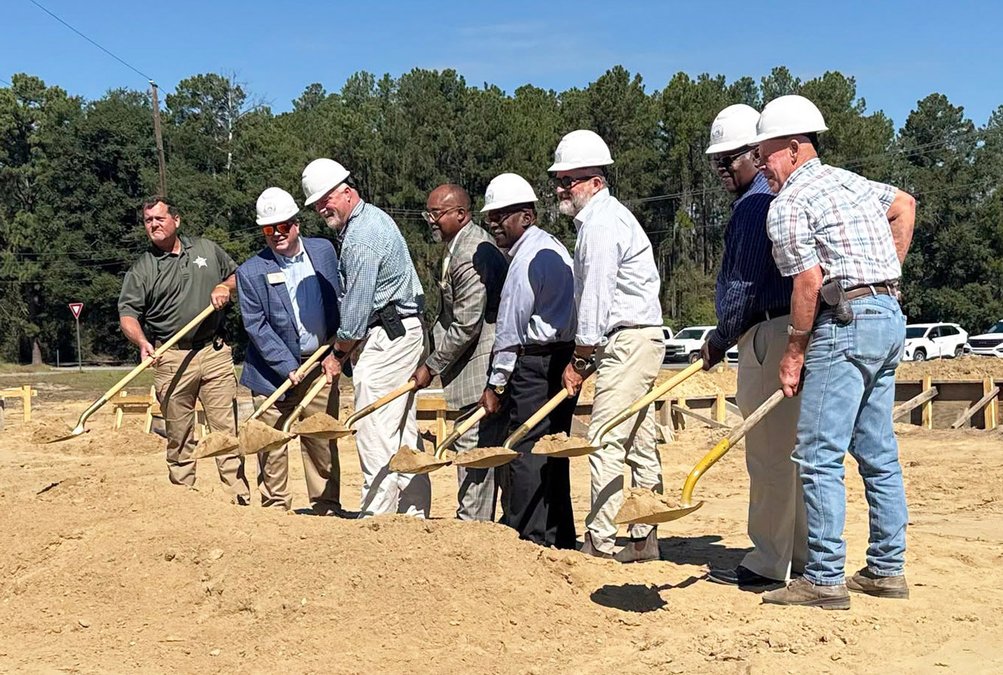
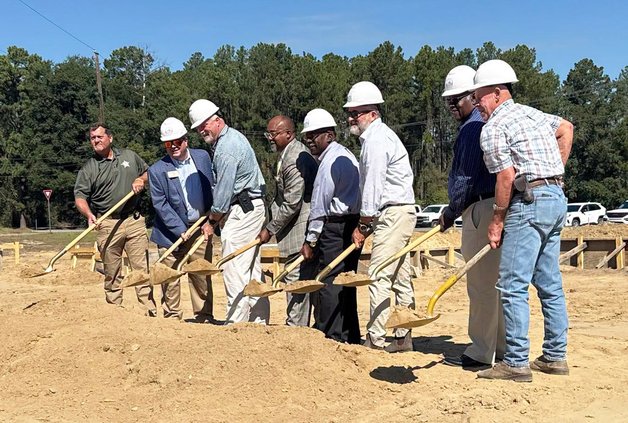
Other Bulloch County officials joined county Coroner Chuck Francis and staff members Oct. 1 in breaking ground for the county’s first official modern morgue and freestanding coroner’s office.
Budgeted with about $500,000 from sales tax revenue, the building according to some county officials could cost nearly twice that if not for the money saved through the use of inmate labor. Ground had been leveled and a temporary wooden retaining wall prepared for the concrete pad at the site on Randy Lowery Road, behind the Georgia Department of Drivers Services office from U.S. 301 North.
The steel structure is planned to measure about 2,800 square feet total under the roof, with about 1,500 square feet of that being “indoors,” according to Francis. The enclosed cooler space, or morgue, is planned to measure 16-by-16 feet, or 256 sq. ft., which he said would be enough for nine bodies, but that could be “pushed to 12,” although he hopes such capacity will never be needed.
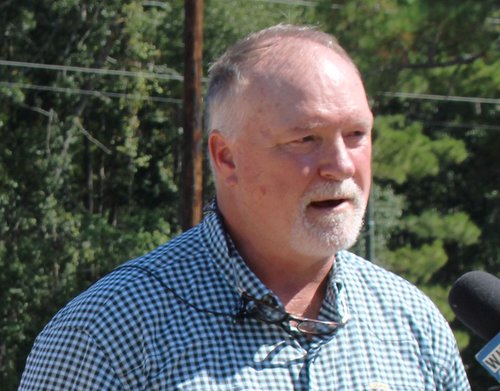
Another feature he described is meant to bring a little funeral home-like comfort to one of the grimmest real-life scenes ever depicted in a TV police procedural or mystery movie.
“We’ll have a really nice place set up to do the viewings,” Francis told reporters. “You know, unfortunately sometimes identification is an issue, and instead of having to do it out on the side of the road or in some obscure place, we’ll have a nice place that will feel like home where we can extend our sincere condolences.”
Who will build it?
“Well, we’ve got the county engineers, and the county will contract for the steel, and then I think the work camp will come in and do the construction stuff on the inside, …” Francis said. “It will be a county-built facility.”
By “the work camp,” he means Bulloch County Correctional Institution, the county-owned prison housing state inmates under contract with the Georgia Department of Corrections.
Besides doing road work and other outdoor chores, BCCI inmates have in recent years been deployed on several building projects for the county, such as renovations and expansions of Bulloch County Fire Department and Emergency Medical Service stations. Some inmates come to BCCI with knowledge of building trades.
“We’re doing the construction,” confirmed County Manager Chris Eldridge. “It’s all inmate labor. So, we just ordered the metal building. We’ll finish it out, do the whole thing. I think we’ll block it up.”
A county crew had already installed a sewer line connecting the site to the Statesboro city system after city personnel helped locate the main.
“It will go up quick,” Eldridge said, “and I’m not overselling how much money that C.I. saves the taxpayers. I mean, it’s amazing. They more than pay for themselves just by operating the kitchen out there for the jail. Then there are all of these projects.”
(The Herald hasn’t fact-checked that next-to-last sentence, but Correctional Institution inmates do most of the work in the kitchen that feeds them as well as all the more-or-less temporary residents of neighboring Bulloch County Jail.)
Agency in transition
Like many smaller and more rural counties, Bulloch has long relied on funeral homes and the state’s crime labs for services that would be provided by a self-contained coroner’s office or police morgue in larger cities and metro counties. But Bulloch, 2026 population estimate 88,300 according to worldpopulationreview.com, is in a transitional phase, with an elected, still part-time coroner working with four on-call deputy coroners, but now the beginnings of a full-time office.
Francis’s literal, physical office is currently just that, office space inside the County Annex on North Main Street.
Meanwhile, a private service contracts with the county government for his agency’s body transportation and climate-controlled storage needs, he said. That private service, based in Bulloch County, is Curtron Transport Services LLC, owned by Richard Pylant, one of Francis’s deputy coroners.
So, the new facility should eventually save the county something on storage costs, Francis said. But he plans to continue having Curtron provide transportation, he told reporters. He called the firm “very professional” and “well versed in chain of custody and evidence.”
“They’ll continue to do what they do. They’re going to still continue to transport for me,” Francis told the Statesboro Herald. “A big part of our transportation needs involves getting folks from what will be our morgue to the Crime Lab and then back to our morgue so that funeral homes can pick them up.”
The state Crime Lab he was referring to is the Georgia Bureau of Investigation’s Coastal Lab at Pooler.
Francis said he isn’t certain about the timeline but hopes to see the new Bulloch County Coroner’s Office facility “kind of turnkey finished and done” within the next year.
Unburied concern
One problem that won’t necessarily be solved by having a new county-owned facility is the disposition of the unclaimed remains of indigent deceased persons. In other words, there are people who die without money handy in their estate to pay for even a simple burial and no kin stepping forward to claim them.
“With indigent care, once we determine they are indigent, the county by law has to afford a humane burial,” Francis said. “Our office uses cremation, but once the cremains are obtained, they come back to me and I have to store them.”
What to do with the unclaimed cremains has been a quandary for Francis and his predecessors for years. In fact, longtime coroner Jake Futch, who retired in May 2023, was discussing options with commissioners literally a decade ago, as seen in a 2016 Herald file story.
Francis, a deputy coroner for 22 years before being elected to the top role in November 2024, also brought up the idea of a ceremony, such as for urn burial or ash scattering, during his first year in office.
“We had planned to,” Francis said last week. “We are still trying to confirm how all of that is going to be happening and us do it within the law.”
Now under his watch, the county continues to store the cremains of more than 50 individuals, each in a separate box bearing a small placard with the name and date of death.
In addition to his years as a deputy coroner, Francis brought experience as a paramedic and registered nurse to the job.
The deputy coroners are Craig R. Tremble, Michelle Rupar-Smith, Lisa Bowers and Richard Pylant. Tremble, who was the other candidate for coroner in the 2024 general election, now has 29 years’ experience as a deputy coroner and is owner and director of a funeral home. Pylant served as coroner by appointment from Futch’s retirement until the end of 2024 but did not seek the elected office.
Interviewed after the Oct. 1 ceremony ended, Chairman David Bennett of the Bulloch County Board of Commissioners joked that his only question had been, “When are we starting?”
“This is one of those things that, this was put in the budget before I even took office, and this has just been sitting and marinating, and I’m like, ‘Y’all, we have the funding for this, we need to make it happen,’” Bennett said.
First full-time staff
He also noted that the coroner’s office now has one full-time staff member, administrative specialist Cheryl Crummett. She started Sept. 15, 2025, working the county’s regular office hours Monday through Friday.
“When we took office, you know, Chuck, he’s still a part-time coroner, but they had no full-time representation,” Bennett said. “So one of the first things that we did was get Cheryl hired so she could be there full-time, and she started taking all of the coroner’s cases that they had that were just old, analog paper files and digitizing those.”
Some of the records, from as far back as the 1980s, were in file boxes “scattered” to various places in the county, according to Bennett.
“So we’ve got them centralized now to where the records are all in the basement there in the county (annex), and we’ve got them an office to work out of, so people when they have a need, whether it’s a death certificate or finding out what’s going on with a death investigation, they have somewhere to go during regular business hours,” he said. “That’s been a huge help.”
Now the freestanding building, being built on a county-owned site where a dilapidated old building was recently removed, is the next step. A fence will also be built around it for security, he said.
Bennett called it “probably a million-dollar building that we’ll get for half that,” through the use of inmate and county employee labor.