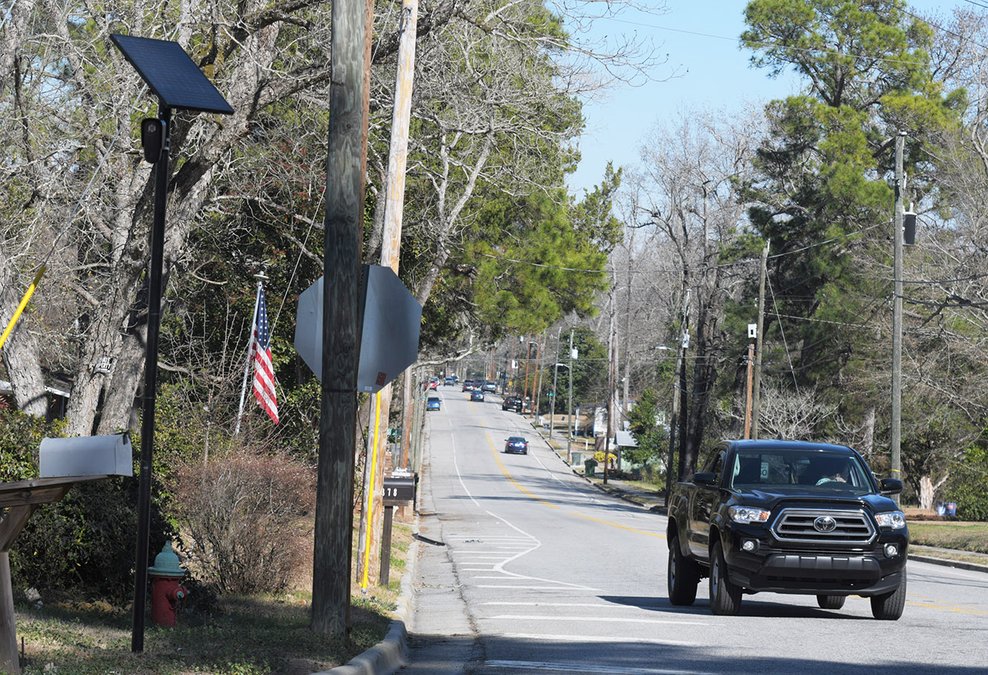
With its original grant for Flock license plate reader cameras expiring, the Statesboro Police Department is seeking a five-year renewal of its contract with Flock Safety for 54 of the cameras and other features, at a total cost of almost $1.15 million.
In addition to the LPR, or license plate reader camera function, the contract would include the existing gunshot detection sensors with reportedly two square miles of coverage and Flock’s continued service and support.
Interim Chief of Police Jared Akins noted the expiration of the grant and advocated the contract renewal in a memo, dated Aug. 3, to City Manager Charles Penny. The memo and “order form” for the new five-year contract with Flock Safety then became part of the agenda packets for the 5:30 p.m. Tuesday, Aug. 18 City Council meeting.
“Flock information has become a critical part of SPD’s activities, from the investigation of ‘hit and run’ crashes to homicide investigations,” Akins wrote.
“As a sampling,” he reported, “Flock has contributed significantly to the investigation” of 22 stolen vehicles recovered, four missing persons, three robberies, one kidnapping, 12 aggravated assaults and eight homicides.
“Two of those homicides would have been extremely difficult to solve absent the Flock technology,” Akins stated.
Four-year history
The memo correctly notes that the SPD has been using Flock Safety technology since 2022.
However, the department’s earliest usage was done on a trial basis in cooperation with Georgia Southern University, and the system expanded significantly after the first year. In early February 2024, the Statesboro Herald reported that Statesboro then had 30 of the Flock LPR cameras “on short poles topped by small solar panels across the city,” with ultimately 36 expected at that time.
These were being leased from Flock for three years and reportedly paid for with $382,500 out of a $565,942 Community Violence Reduction Grant the city accepted from the Governor’s Office of Planning and Budget in June 2023. That grant, ultimately federal money expanded to the states under the American Rescue Plan Act of 2021, also included $183,442 for a couple of other police technology items, one of which was the gunshot detection system.
Already 54 in use
Eighteen more Flock LPR cameras have apparently been added to Statesboro’s network beyond those in the early 2024 announcement. But the 54 cameras, total, in the new contract have been in place for some time now, and none are being added, Akins said when interviewed by phone and email Monday.
“During the grant period, we added cameras in stages. At the time, each stage was on a different billing cycle with different due dates,” he said in an email. The new “agreement consolidates those billing cycles into one that coincides with the beginning of the fiscal year in July. In addition to consolidating our due dates with Flock, this contract prevents any year-over-year price increases that complicate annual budgeting.”
According to the order form, the new contract would extend from Aug 1, 2026 (so retroactively from the beginning of this month) to July 31, 2031. Meanwhile, the final grant installment of $57,537.33, noted in the memo as on its way, has since arrived, he said.
The new contract will cost $229,500 annually, or $1,147,500 over five years.
The LPR cameras are programmed to read the license plate and snap a picture of every vehicle that comes by. Police can also enter a specific plate number into the system, and if that car (say, a reported stolen vehicle) rolls past, officers in patrol cars can be notified immediately. The gunshot detection system uses acoustic sensors to detect the sound of gunshots and triangulate the location where shots were fired.
Concerns acknowledged
Flock camera usage has become more controversial in the last couple of years, both with concerns about information on individuals’ movements being held by a technologically advanced corporation and officially acknowledged abuses by some law enforcement officers.
“SPD recognizes that access to Flock technology comes with great responsibilities,” begins the final paragraph of Akins’ memo. “This agency has a written policy which names Flock data as protected and prohibits, under penalty of termination and prosecution, misuse of the data. This message has been reinforced by the Interim Chief to all employees.”
Akins stated that the Statesboro Police Department is conducting weekly audits using Flock’s “Audit Assistance” feature “to ensure that our officers are using the technology for valid investigatory reason.”
In fact the Statesboro police Ethical Use of Technology Policy “has been in place since 2015 with periodic updates and revisions since,” he said. It was initially enacted to address the use of in-car computers with capability of accessing Georgia Crime Information Center, or GCIC, information and early social media.
But just this year, the department has added “three programs specifically by name … so there is no question in any officer's mind that they are covered under this policy,” Akins said.
Those three are Flock, the Fusus network that accesses video from contracted locations, and a background check program called TLO. “The policy also includes specific language making prohibited uses and the penalties for violations unambiguous,” Akins stated.
“To date, no employees have been disciplined or criminally charged for violating this policy with regards to Flock,” Akins said in a reply email Monday.
Other agencies’ Flock troubles
However, here in the Ogeechee Judicial Circuit, the Georgia Bureau of Investigation on July 27 arrested former District Attorney’s Office investigator Andrae Wright, 44, of Statesboro, with misuse of an LPR system, stalking, computer invasion of privacy, and violation of oath of office. A former employee of the Effingham County Sheriff’s Office, Wright reportedly still had access to that department’s Flock system and, while employed by the Ogeechee Circuit DA’s Office, allegedly accessed the system more than 60 times between June 15 and July 5 for non-law enforcement purposes, according to what the GBI called preliminary information.
The GBI has investigated Flock system abuses by individuals with several other local police agencies across Georgia this summer. Most recently, state investigators on Aug. 12 charged a former Dallas (Georgia) Police Department 911 director with two misdemeanor counts of misuse of a license plate reader system.
In another case, a former Polk County Police Department officer, who had previously worked with the Northwest Georgia Drug Task Force, was arrested Aug. 7 and charged with four counts of that same misdemeanor. Other GBI-brought cases involve an employee of the Conyers Police Department and five former officers of the Albany Police Department.
In most of these cases, the local law enforcement agencies requested the investigations of their current or former employees, according to the GBI’s news releases.
Independently, the Savannah Police Department fired four sworn officers and two civilian employees over alleged misuse of the Flock system and reported, in an Aug. 7 press release, that they remained under investigation by the GBI.
Akins said he knows that the public sometimes sees such reports as reflecting badly on an agency as a whole or on law enforcement as a profession.
“I would look at it another way. … Is it a reflection of that, or is it a reflection of the fact that we actually take seriously those allegations, have policies to deal with them, and actually follow through with those policies,” he said. “I don’t know that you have another profession that’s more surveilled and scrutinized than law enforcement is, and we tend to have policies in place to deal with misconduct, as we should.”
The profession is now going through a period of adjustment as it evolves to prevent, as much as possible, misuses of a new technology, as it has with other technologies, from the GCIC database to Tasers and bodycams, Akins said.