

You may have gone out to eat recently and seen soft-shell crab on the menu. Many restaurants are featuring this seasonal delicacy and for good reason. I had a soft-shell crab sandwich for my birthday in early April while dining out in Bluffton, S.C. As I ate its crispy skin, I wondered how this fascinating creature held its shape so perfectly during the cooking process, which got me to researching how it got to my plate. Here’s what I learned.
Soft-shell crabs in the U.S. are typically Maryland blue crabs from the Atlantic and Gulf waters in a state of molting. Crabs are exoskeletons, and during the molting process, when they emerge from winter hibernation and all the conditions are right, such as phases of the moon and water temperature, these crustaceans shed their hard, outer shell to make way for new growth. That’s when fishermen strike.Garden & Gun magazine explains:
Rather than scour the ocean for soft-shelled crabs, fishermen typically capture them before they molt and hold them in saltwater tanks. As soon as the crabs drop their shells, they’re pulled out of the water, which stops a new exoskeleton from hardening.
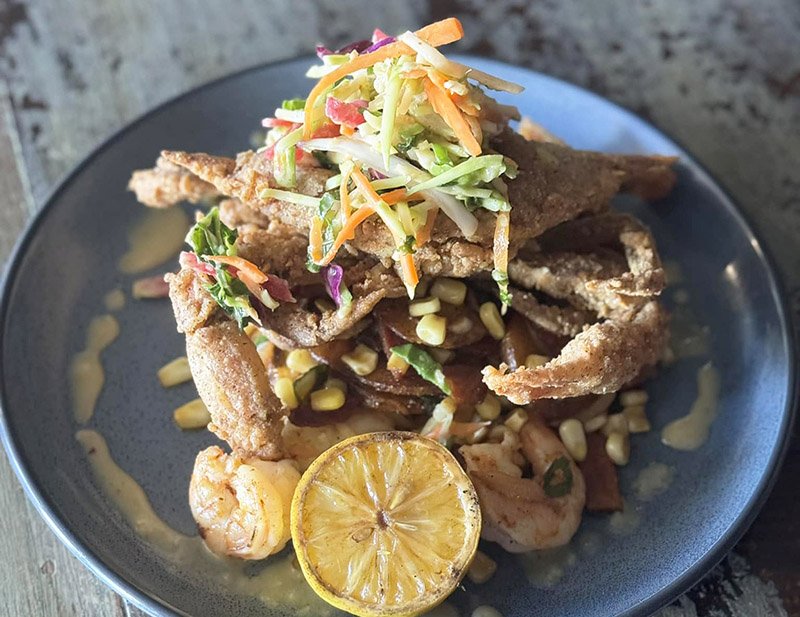
If crabs are left in the water, the new crab shell will harden quickly. But pulled out just after the original shell is shed, that’s when they are considered soft-shell crabs. The closer the crabs are found to this period, the better. In season through the end of September, soft-shell crabs are most often served lightly battered and deep fried, but they can also be prepared by grilling and sauteing. Here’s what’s great about soft-shell crab: You can eat the whole thing (minus the gills and face) and there’s no peeling the skin or picking the meat required. Now, if you’ve ever picked the meat from hard-shell blue crabs, you know it’s a lot of work for little reward. Only about 25 percent of hard shell crabs are edible. That’s just one reason eating a soft-shell crab is such a pleasure.
And here’s a fun fact: The blue crab’s scientific name is Callinectes sapidus. In Latin, the translation means “beautiful savory swimmer.” I remember fishing for blue crabs once on the pier at St. Simons Island and when we slowly pulled up our crab net, they were the most beautiful creatures I had ever seen with the brightest blue claws and olive green shells. I’d say “beautiful savory swimmer” is a name never more fitting.
If you see soft-shell crab on the menu next time you’re in a restaurant, order it. You will thank me later.
Rebekah Faulk Lingenfelser is a private chef and the author of the best-selling memoir “Some Kinda Good.” Featured in Forbes, on Food Network and ABC, she writes about Southern, coastal cuisine, locally sourced and in season. Connect with her on social media by liking Some Kinda Good on Facebook, or follow @SKGFoodBlog on Instagram and Twitter.