Editor:
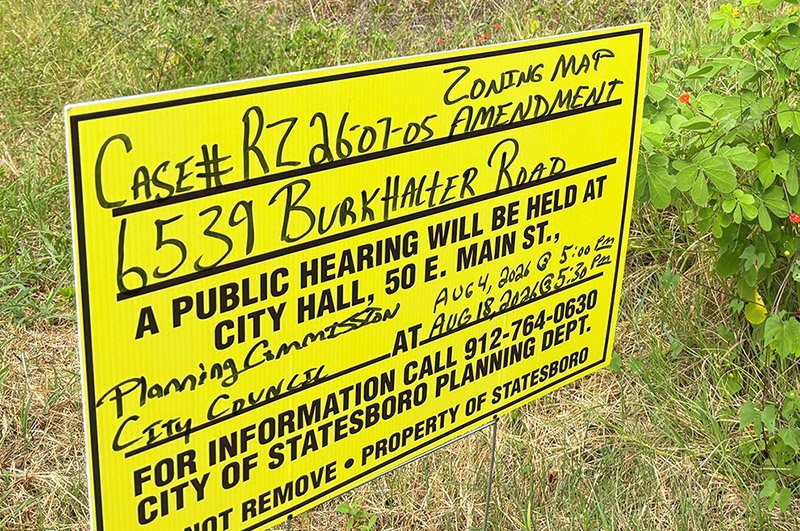
In reference to the data center planning to be built here in Statesboro, some questions and thoughts prior to the city’s zoning hearing for the data center at 5:30 p.m. Tuesday in City Hall:
OBSERVATION 1: Statesboro has actually adopted a fairly restrictive data-center ordinance. The city has prohibited the enormous “hyperscale” facilities within the city limits and capped permitted “edge” data centers at 50 acres. It also requires closed-loop cooling, connection to municipal water/sewer, water-management planning, noise limits, environmental protections, an economic-impact report, and a decommissioning plan.
QUESTION 1: Is the City holding firm to all of these requirements?
OBSERVATION 2: Groundwater contamination is possible, if the coolant actually contains chemicals capable of contaminating groundwater, and only possible if the cooling loop system develop minor leaks that went unnoticed.
QUESTION 2: Will the cooling system use such chemicals?
OBSERVATION 3: Closed loop water cooling systems are designed to minimize water use from a community’s water supply. I read an estimate that the data center will draw about 1,000 gallons of water a day - about the consumption of 6-7 average homes in Statesboro.
QUESTION 3: Is this estimate accurate? If so, than additional loss of water from our aquifer is insignificant.
OBSERVATION 4: The proposed Burkhalter facility is in roughly the 50–100+ MW range. A 100-MW data center operating continuously consumes about 2.4 million kWh every day, or 876 million kWh/year. For perspective, Caltech’s recent discussion of data-center loads estimates that a 100-MW facility is roughly equivalent to the electricity consumption of about 90,000 average U.S. homes. That means our data center will continually draw, on average, the equivalent amount of electricity used by 45,000 to 90,000 homes in our community.
QUESTION 4: What is being contracted for, eg. guaranteed, to boost our community’s continuous electrical generation and the capacity of our electrical grid to readily handle the additional load?
QUESTIONS 5 & 6: Who pays for those electrical-system upgrades—the data-center developer or existing Georgia ratepayers? How will it affect Statesboro residents?
OBSERVATION 5: Potential possible benefits include:
a) A larger property-tax base. A data center can contain hundreds of millions of dollars in buildings, electrical equipment, servers and related infrastructure. Depending on Georgia tax treatment and whatever incentives are negotiated, that can generate substantial local tax revenue.
b) Construction employment. Building the facility, electrical infrastructure, cooling system, fiber connections and roads can employ hundreds of people temporarily and generate business for local contractors.
Some permanent high-skilled jobs. IT technicians, electricians, security, facilities engineers and maintenance personnel are needed—but typically far fewer permanent employees than a conventional factory representing the same capital investment.
c) Utility revenue. An enormous industrial electrical customer can produce considerable revenue for the supplying utility, assuming rates are structured so residential customers aren’t subsidizing it.
d) Infrastructure improvements. New substations, transmission capacity, fiber-optic infrastructure and sometimes road improvements can leave the community with infrastructure it would not otherwise have received.
e) Technology-development possibilities. Given Georgia Southern’s engineering/IT programs, a serious partnership could create internships, technical training, research collaborations and a pipeline into relatively well-paying technical jobs (needs to be contracted for).
f) Economic diversification. Statesboro/Bulloch County is growing rapidly, and adding technology infrastructure alongside manufacturing, education, agriculture and logistics could broaden the economic base.
QUESTION 7: How far along is the city council’s planning toward estimating the likelihood and degree of these possible benefits and when will they have projected numbers?
OBSERVATION 6: Burkhalter Road is already under development pressure. City planning estimates about 1,342 housing units in the Burkhalter/Cawana/Herman Rushing area over five years, and traffic studies already project some intersections deteriorating to Level of Service F without improvements. The city and county are consequently planning widening, turn lanes and roundabouts.
QUESTION 8: Is the City biting off more than it can chew? We’re expanding like crazy? Are we going to be able to properly and safely service all of this expansion? Personal question. I understand we are planning extending sewer services to Brooklet and surrounding areas while within our city limits, subdivisions like Merrywood continue to rely on septic tanks and drain fields. If we are unable to completely serve all of our city residents, what are we thinking?
Kenneth Johnson, MS, LPC Ret., VA Claims Agent, Ret.
Statesboro